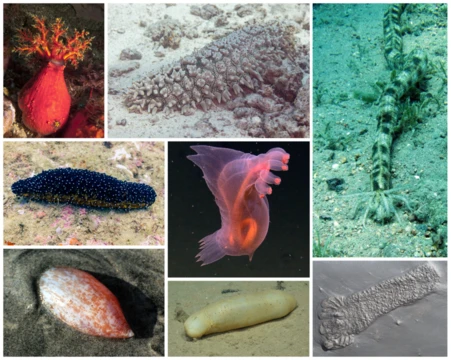
Synaptula recta
A nocturnal sea cucumber with anchor-like spicules for traction.

The gut-like sea cucumber, *Synaptula recta*, is a member of the Synaptidae family within the phylum Echinodermata. It lives in shallow waters across the tropical Indo-Pacific. This species has an elongated body that can reach up to 40 cm (16 in) in length. Its color varies widely, often appearing in deep shades such as dark reddish-purple, bright red, olive, or with longitudinal lilac stripes on a pale background. Thirteen feeding tentacles surround the mouth at the front end. The cuticle contains calcareous spicules shaped like anchors with knobbed ends and curved bodies; the spicule tips project through the skin to provide traction as the animal moves by peristalsis, since synaptids lack tube feet.
The species is found from the Red Sea, the Maldives, and Sri Lanka, through northern Australia, Indonesia, and the Philippines, to several Pacific island groups. It inhabits coastal waters, reefs, sand flats, and seagrass meadows, at depths down to about 20 m (66 ft). Nocturnal by nature, it feeds on detritus and planktonic particles, sweeping them into its mouth with its tentacles, and is often seen moving over and feeding on debris on sponge surfaces. The sexes are separate, with external fertilization. The planktonic larvae first develop into auricularia, then into barrel-shaped doliolaria, which eventually settle on the seabed and metamorphose into juveniles.
Quick Facts
- Taxon
- Synaptula recta
Facts from the source article.
Lore & Background
Synaptula recta is an elongated sea cucumber growing to a maximum length of about 40 cm (16 in). The mouth is at the anterior end and is surrounded by thirteen feeding tentacles. The colour is variable but it is often a deep colour, ranging from dark reddish-purple to a fairly bright red, olive or a pattern of longitudinal lilac stripes on a pale background. The calcareous spicules in the cuticle consist of anchors with knobbed ends and curved bodies. The tips of these spicules project through the cuticle and help give traction during locomotion which is performed by peristalsis, synaptids having no tube feet.
Synaptula recta is native to the tropical western Indo-Pacific region. Its range extends from the Red Sea, the Maldives and Sri Lanka to northern Australia, Indonesia, the Philippines and several Pacific island groups. It inhabits coastal waters and reefs, sand flats and seagrass meadows and occurs at depths down to about 20 m (66 ft).
Synaptula recta is nocturnal and feeds on detritus and planktonic particles which it sweeps into its mouth with its feeding tentacles. It is often found moving over and feeding on debris on the surfaces of sponges. The sexes are separate and fertilisation is external. The larvae are planktonic, the first-stage auricularia larvae developing into barrel-shaped, doliolaria larvae which when sufficiently developed settle on the seabed and undergo metamorphosis into juvenile sea cucumbers.
Reader's Guide
Synaptula recta is a species of sea cucumber in the family Synaptidae, notable for its lack of tube feet and reliance on peristalsis for movement, aided by anchor-like spicules that project through the cuticle. Its variable coloration—from deep reds and purples to olive or striped patterns—makes it visually distinctive. The species is nocturnal and feeds on detritus and plankton, often on sponge surfaces. Its range spans the tropical western Indo-Pacific, from the Red Sea to northern Australia and Pacific islands, in shallow waters down to 20 m. Reproduction involves external fertilisation and planktonic larvae that undergo metamorphosis. The species is sometimes called the gut-like sea cucumber, reflecting its elongated form. Its ecological role includes recycling detritus in reef and seagrass habitats.
Did You Know?
- Synaptula recta has thirteen feeding tentacles surrounding its mouth.
- It uses peristalsis for locomotion because synaptids have no tube feet.
- The larvae develop from auricularia to doliolaria stages before settling on the seabed.
More in Sea Cucumbers and Brittle Stars, Part 2 1-24
Spotted an error? Know more?
Reader corrections go straight into our review queue. Suggest an edit · How this site is sourced