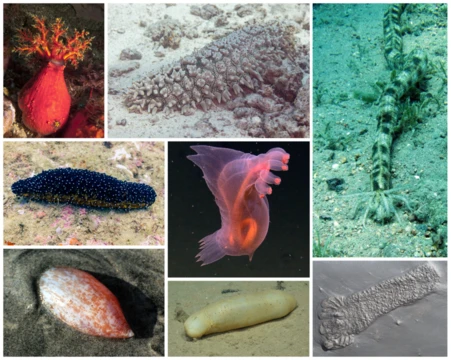
Synaptula lamperti
A sea cucumber that moves with hooks and feeds on a specific sponge.

Synaptula lamperti is a sea cucumber from the family Synaptidae, part of the phylum Echinodermata, which also includes starfish and sea urchins. Like other echinoderms, it is radially symmetrical and uses a water vascular system powered by hydrostatic pressure to move, typically via tube feet. Sea cucumbers are generally leathery and cucumber-shaped, with a cluster of short tentacles at one end, and live on the seafloor.
S. lamperti has an elongated, opaque body marked by several dark longitudinal stripes. It lacks tube feet on its body, but a few have been modified into a tuft of constantly moving, feathery feeding tentacles. Its skeleton consists of small calcareous plates embedded in the cuticle; these ossicles form tiny hooks that protrude through the skin, giving the animal a sticky texture. It moves quickly and efficiently by using the hooks at one end for adhesion while muscular contractions and shifts in hydrostatic pressure reposition the other end.
The genus Synaptula includes about thirty very similar species, and amateur observers often misidentify any of them as S. lamperti. Color patterns once used to distinguish these species—notably by Heding in 1928—are no longer considered reliable. The many synonymies of visually distinct species, especially with S. lamperti, mean that identification requires caution and verification by examining the dermal spicules.
S. lamperti occurs in the western Pacific, along the coasts of Indonesia, Papua New Guinea, Micronesia, and the Philippines. It is very common on coral reefs, both on exposed and inner slopes. It is a detritivore that feeds specifically on or around the sponge *Ianthella basta*. It often remains firmly attached to the sponge’s surface for extended periods rather than moving across the substrate, indicating a sessile feeding strategy. It appears to need nutrients from this particular sponge, ingesting microscopic organic particles like diatoms as well as substances exuded from the sponge’s surface. It feeds only at night, and food passes through its digestive tract in under an hour.
Most individuals are either male or female, but hermaphrodites occur occasionally, and self-fertilization is possible. In the closely related *Synaptula hydriformis*, fertilized eggs are retained in the coelom, where juveniles develop in a protected environment. If S.
Quick Facts
- Taxon
- Synaptula lamperti
Facts from the source article.
Lore & Background
Synaptula lamperti has an elongated, opaque body with several dark-coloured, longitudinal stripes. It lacks tube feet on the body, but a few have been modified into a tuft of pinnate feeding tentacles that are constantly in motion. Its skeletal system consists of small calcareous plates embedded in the cuticle, with ossicles forming little hooks that protrude through the skin, making the animal seem sticky. It moves rapidly and efficiently using these hooks at one end for adhesion while muscular contractions and hydrostatic pressure changes alter the position of the other end.
The genus Synaptula comprises some thirty very similar species, and identification as Synaptula lamperti is often wrongly attributed to all species observed by amateurs. Coloration patterns formerly used to distinguish these species are no longer considered reliable, and the number of synonymies of visually distinct species, notably with Synaptula lamperti, calls for the greatest caution apart from verification by dermal spicules.
S. lamperti is very common on coral reefs, both on exposed and inner slopes. It is a detrivore that specifically feeds on or around living sponges of the Ianthella basta species. It often remains firmly attached to the surface of its sponge host for extended periods, indicating a sessile-oriented feeding strategy. It appears to require nutrients provided by this particular sponge, ingesting microscopic organic particles such as diatoms and substances exuded from the sponge surface. It feeds only at night, and food is processed rapidly, with a passage time through the digestive tract of under an hour.
Reader's Guide
Synaptula lamperti is significant as a sea cucumber that demonstrates an unusual mode of locomotion using dermal hooks instead of tube feet, and a specialized feeding relationship with a single sponge species, Ianthella basta. Its reliance on this sponge for nutrients highlights a narrow ecological niche within coral reef ecosystems. The species also illustrates taxonomic challenges within the genus Synaptula, as coloration patterns once used for identification are now considered unreliable, and many visually distinct species have been synonymized with S. lamperti. This underscores the need for verification by dermal spicules. Its ability to regenerate both anterior and posterior portions into new individuals, and the occasional occurrence of hermaphrodites capable of self-fertilisation, add to its biological interest. The species is common on coral reefs in the Western Pacific, including Indonesia, Papua New Guinea, Micronesia, and the Philippines. Its legacy lies in serving as a cautionary example for amateur identification and as a model for studying host-specific feeding and rapid digestion in echinoderms.
Did You Know?
- Synaptula lamperti moves using small hooks that protrude through its skin, not tube feet.
- It feeds only at night and digests food in under an hour.
- Most individuals are male or female, but hermaphrodites occasionally occur and may self-fertilise.
- If damaged, both the anterior and posterior portions can regenerate into new individuals.
Frequently Asked Questions
What is Synaptula lamperti?
Synaptula lamperti is a sea cucumber in the family Synaptidae, belonging to the phylum Echinodermata alongside starfish and sea urchins. It has an elongated, opaque body marked by several dark longitudinal stripes and lives on the seafloor.
Where can I find Synaptula lamperti in the wild?
This species occurs on coral reef slopes—both exposed and inner—throughout the Western Pacific, with records from Indonesia, Papua New Guinea, Micronesia, and the Philippines.
What does Synaptula lamperti eat?
It is a detritivore that feeds on or around living sponges of the species Ianthella basta, giving it a notably specialized dietary niche among sea cucumbers.
How does Synaptula lamperti reproduce?
Most individuals are gonochoric, meaning they have separate sexes, but occasional hermaphrodites do occur. Self-fertilisation is also possible in this species.
What makes Synaptula lamperti unusual compared to other sea cucumbers?
Rather than relying on widespread tube feet for locomotion, it lacks them along its body and instead moves using hooks, with only a small tuft of modified structures present. Its tight association with a single sponge species also sets it apart from many free-ranging relatives.
More in Sea Cucumbers and Brittle Stars, Part 2 1-24
Spotted an error? Know more?
Reader corrections go straight into our review queue. Suggest an edit · How this site is sourced