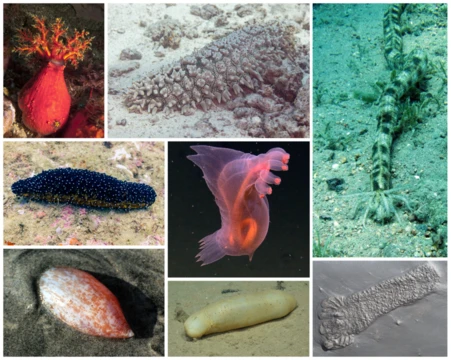
Synapta maculata
One of the longest sea cucumbers, found in tropical Indo-Pacific waters.

Synapta maculata, also called the snake sea cucumber, belongs to the family Synaptidae. This species lives in shallow tropical waters across the Indo-Pacific region. Reaching up to 3 meters (10 feet) in length, it ranks among the longest sea cucumbers known.
The body is long and slender, with fifteen tentacles, and typically grows to about 2 meters (7 feet). While not the heaviest or bulkiest, it is likely the longest, with exceptional individuals exceeding 3 meters (10 feet). Its coloration varies, ranging from yellowish-brown with wide, dark longitudinal stripes and patches. The ossicles—microscopic, calcareous, spike-like structures supporting the body wall—are large and anchor-shaped, used for locomotion, and can reach 2 millimeters in length. These ossicles are adhesive, making the sea cucumber very hard to pull off a wetsuit.
This species is native to the tropical western Indo-Pacific. It inhabits depths down to about 20 meters (66 feet) on reefs and soft seabed sediments among seagrasses and seaweeds, and can also bury itself under rubble.
The tentacles surround the mouth and are used for surface feeding. When extended, they are about 2.5 centimeters (1 inch) long, with a short stem and a feather-like blade bearing thirty to forty pairs of pinnules. The outer tentacle surfaces have numerous bulges and are adhesive; the inner surfaces are smooth, with clusters of cilia near the base. The tentacles move continuously, flattening against the substrate or seagrass leaves to collect food particles by adhesion. They then bend inward until the tips reach the mouth, where the buccal sphincter muscle scrapes off the food. The entire process takes only seconds, and several tentacles can deliver food simultaneously. If disturbed, the tentacles retract into the pharynx but soon emerge again to gather more particles.
The outer tentacle surfaces contain many vesicular cells, and a few scattered vesicles also appear on the body surface. Their function is unclear, but they may contain a noxious substance for defense. Since tentacles are vulnerable to fish predation, a bad taste would allow the sea cucumber to spend more time feeding instead of constantly retracting its tentacles when fish approach.
Quick Facts
- Taxon
- Synapta maculata
Facts from the source article.
Lore & Background
Synapta maculata is a long, slender sea cucumber with fifteen tentacles, growing to a length of about 2 m (7 ft). Although not the heaviest or bulkiest sea cucumber in the world, it is probably the longest, with individuals exceptionally reaching to over 3 m (10 ft). Its colouring is variable, being some shade of yellowish-brown with wide longitudinal stripes and patches of darker colour. The ossicles (microscopic calcareous spike-like structures that support the body wall) are large and shaped like anchors and are used in locomotion; they can be as long as 2 mm. The ossicles are adhesive, and the sea cucumber is very difficult to detach from a wetsuit.
The species is native to the tropical western Indo-Pacific region. It occurs at depths down to about 20 m (66 ft) on reefs and on soft sediments on the seabed among seagrasses and seaweeds. It can also bury itself under rubble.
The tentacles of Synapta maculata surround the mouth and are used in surface feeding. They are about 2.5 cm (1 in) long when extended and have a short stem and a feather-like blade with thirty to forty pairs of pinnules. The outer surfaces of the tentacles have numerous bulges and are adhesive while the inner surfaces are smooth, with clusters of cilia on the proximal parts. The tentacles are in continuous motion; they flatten themselves against the substrate or seagrass leaf blades and collect food particles by adhesion, then bend inwards until the tips are in the mouth, where the food is scraped off by the buccal sphincter muscle. The whole process takes only a few seconds, and several tentacles can deliver their loads at the same time. If the animal is disturbed, the tentacles can contract back into the pharynx, but before long they are out again, collecting more particles.
The outer surface of the tentacles bears numerous vesicular cells, and there are a few scattered vesicles on the body surface also. The function of these cells is unclear, but it is suggested that they may contain a noxious substance and serve a defensive function. The tentacles are particularly vulnerable to predation by fish, but if they taste nasty, that enables the sea cucumber to spend a greater proportion of its time feeding, rather than having to keep retracting its tentacles whenever a fish approaches. There are also some cup-shaped structures on the inside of the tentacles near the stem. It is hypothesized that these are rudimentary sensory organs, able to taste the edibility of the food material that the animal is transporting to its mouth.
A defensive response made by many sea cucumbers is evisceration, but in the case of S. maculata, autotomy is preferred, with large individuals dispensing with sections near the rear end while smaller individuals break into many pieces. Two previously unknown triterpene holostane glycosides have been isolated from S. maculata; one has moderate activity against HeLa tumour cells while the other is inactive.
Reader's Guide
Synapta maculata is notable as one of the longest sea cucumbers, with exceptional individuals reaching over 3 m (10 ft). Its ossicles, shaped like anchors and up to 2 mm long, are adhesive and used in locomotion, making the animal difficult to detach from surfaces such as a wetsuit. The species exhibits a unique feeding behavior: its fifteen tentacles, each with thirty to forty pairs of pinnules, continuously collect food particles by adhesion and deliver them to the mouth in seconds. The tentacles' outer surfaces bear vesicular cells that may contain a noxious substance, hypothesized to deter fish predation and allow more feeding time. Cup-shaped structures on the inside of the tentacles are thought to be rudimentary sensory organs for tasting food. In defense, S. maculata prefers autotomy over evisceration, with large individuals shedding rear sections and smaller ones breaking into many pieces. Two previously unknown triterpene holostane glycosides have been isolated from this species, one showing moderate activity against HeLa tumour cells. The species was observed by naturalist Gerald Durrell in 1977 while snorkeling in shallow water in Mauritius, who described it as a strange, elongated tube that sucks in water and microscopic organisms at one end and expels water at the other.
Did You Know?
- Synapta maculata can grow to over 3 m (10 ft), making it one of the longest sea cucumbers.
- Its ossicles are shaped like anchors, up to 2 mm long, and are adhesive, making the animal hard to detach from a wetsuit.
- The tentacles have thirty to forty pairs of pinnules and can deliver food to the mouth in a few seconds.
Frequently Asked Questions
Who is Synapta maculata?
Synapta maculata, commonly known as the snake sea cucumber, is a long-bodied echinoderm in the family Synaptidae. It inhabits shallow tropical waters throughout the Indo-Pacific and is recognized as one of the longest sea cucumber species on record.
What are Synapta maculata's powers/role?
This species stands out for its extraordinary length, typically reaching around 2 meters (7 feet) and occasionally exceeding 3 meters (10 feet) in exceptional individuals. Its body is notably slender and elongated, equipped with fifteen short tentacles that extend to roughly 2.5 cm (1 inch) when fully opened.
Why is Synapta maculata important?
It holds a place of distinction among sea cucumbers for being likely the longest species known, with its record-breaking length setting it apart from bulkier relatives. Its elongated form and distinctive yellowish-brown coloration with broad dark longitudinal stripes also make it a striking example of morphological diversity within the class Holothuroidea.
Where does Synapta maculata live?
This species is native to tropical Indo-Pacific waters, favoring shallow reef-adjacent habitats where it can anchor its long, snake-like body to the substrate. It typically occupies depths down to roughly 20 meters (66 feet), staying well within the sunlit zone.
More in Sea Cucumbers and Brittle Stars, Part 2 1-24
Spotted an error? Know more?
Reader corrections go straight into our review queue. Suggest an edit · How this site is sourced