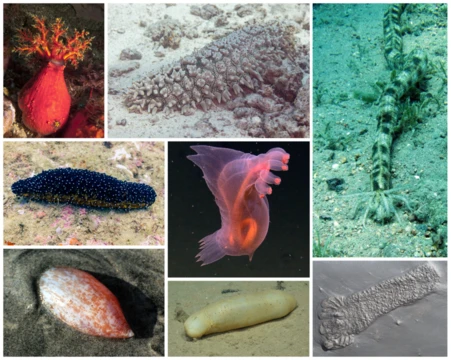
Scotoplanes globosa
A deep-sea sea cucumber that walks on tube feet.

Scotoplanes globosa, commonly known as the sea pig, is a species of deep-sea sea cucumber first described by Swedish scientist Hjalmar Théel. It was discovered during the HMS Challenger expedition between 1873–1876 and officially described in 1882. This species is notable for its translucent white body, unique walking locomotion, and its close relation to the genus Peniagone.
Quick Facts
- Taxon
- Scotoplanes globosa
Facts from the source article.
Lore & Background
Scotoplanes globosa was first collected during the HMS Challenger expedition (1873–1876) and formally described by Swedish scientist Hjalmar Théel in 1882. It is most closely related to the genus Peniagone. The species is found on abyssal plains worldwide, including off the coast of San Diego and in the Arctic, Atlantic, Pacific, and Indian Oceans, at depths exceeding 1,000 m. It has been recorded in the Kermadec Trench at 6,659 m and in the Philippine Trench at 9,997 m by the Galathea expedition in the 1950s.
Scotoplanes globosa is a deposit feeder that consumes detritus, strongly preferring fresh sediments that have fallen within the last 100 days. It captures food using mucus-covered tentacles around its mouth and is known to congregate around whale carcasses, which it locates by smell. The species is bilaterally symmetrical, translucent white, and typically 2 to 15 cm in length. It has tube-like feet on its upper surface (not antennae) and five to seven pairs of long tube feet used for walking via muscle constrictions—a locomotion method unique among holothurians. Both males and females possess only one gonad.
Congregations of smaller individuals often number 10 to 30, but groups as large as 600 have been observed. These groups, called 'trawls,' typically face into the current, a behavior thought to help detect rich feeding sites. Scotoplanes globosa hosts parasites including the gastropods Stilapex and Crinolamia and various parasitic crustaceans, which bore holes into its body wall. It is also frequently accompanied by the symbiotic lithodid crab Neolithodes diomedeae; about 22% of individuals have at least one crab. The relationship may be mutualistic or commensal, with the crab possibly gaining nutrients and transport while the sea cucumber receives protection from parasites.
Reader's Guide
Scotoplanes globosa holds significance as a well-documented deep-sea holothurian discovered during the historic HMS Challenger expedition and described by Hjalmar Théel in 1882. Its unique walking locomotion—using muscle constrictions to move fluid in and out of tube feet—is not observed in any other holothurian genus. The species' ecology reveals complex interactions: it forms large congregations called 'trawls' that face into currents to locate fresh detritus, and it serves as host to multiple parasites and a symbiotic crab, Neolithodes diomedeae. The uncertain nature of this crab association (mutualistic or commensal) highlights ongoing questions in deep-sea symbiosis. Its preference for recently fallen sediments and ability to detect whale carcasses by smell underscore its role in nutrient cycling on the abyssal plain. The species' broad distribution across all major oceans and extreme depths (up to nearly 10,000 m) makes it a key subject for studying deep-sea biodiversity and adaptation.
Did You Know?
- A group of Scotoplanes globosa is called a 'trawl' and can include up to 600 individuals.
- Approximately 22% of Scotoplanes globosa are attended by at least one symbiotic lithodid crab, Neolithodes diomedeae.
- Scotoplanes globosa has been found at depths of 9,997 m in the Philippine Trench.
More in Sea Cucumbers and Brittle Stars, Part 2 1-24
Spotted an error? Know more?
Reader corrections go straight into our review queue. Suggest an edit · How this site is sourced