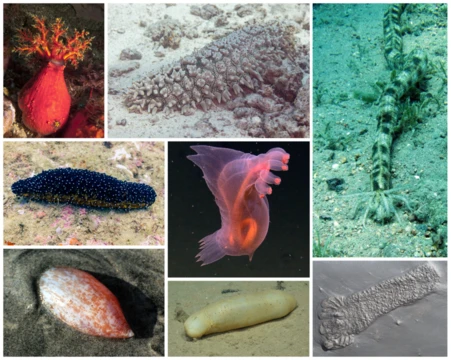
Psychropotidae
Deep-sea swimming sea cucumbers with variable ranges and a dorsal sail.

Psychropotidae are a family of deep-sea sea cucumbers that can swim. Some species in this family have very wide distributions across the abyssal seafloor, while others are confined to smaller areas.
Their bodies are elongated, with the front part of the upper surface flattened. Many have a large appendage at the rear. They typically have 10 to 20 tentacles and a single row of many small tube feet along each side of the underside. Like all sea cucumbers, they have calcareous deposits—remnants of a typical echinoderm skeleton—but in psychropotids these are very poorly calcified and made mostly of connective tissue. The calcareous ring and spicules vary greatly among species and are thought to have evolved independently as different species adapted to different environments. In this family, the spicules usually have four arms that curve inward and a single large central projection pointing outward. The calcareous ring is incomplete, made of five separate pieces. The tiny sclerites in the papillae are oriented sideways relative to the papilla’s length. Some concave sclerites in this family may be related to similar ones in Laetmogonidae and Elpidiidae. In certain specimens of the species *Benthodytes typica* and *Benthodytes sanguinolenta*, sclerites may be absent. In the order Elasipodida, the three membranes that hold the intestine are attached to the body wall on the upper side in the front and middle of the body; only in the rear does the membrane holding the second descending part of the intestine attach to the right lower side, near the central muscle band.
All psychropotids can swim for short distances. Some, like *Psychropotes longicauda*, spend much of their juvenile stage floating in the open water. One early researcher suggested that the long tail of that species is a swimming organ, which appears true for juveniles but not for adults. Several authors have noted that some *Psychropotes* species use a large, unpaired dorsal appendage as a sail, catching currents and steering by twisting the body. The wide variation in this appendage across the family suggests it is an important adaptation for finding food in the sparse deep-sea environment. Another researcher observed that most psychropotids, and some related species, are darker on the underside than on the top, possibly to hide from predators looking up or down.
Quick Facts
- Taxon
- Psychropotidae
Facts from the source article.
Lore & Background
Psychropotidae are elongate in shape, with the anterior part of the dorsal surface depressed. Many have a large posterior appendage. They usually have 10-20 tentacles and ventrolateral radii, each with a single row of many small tube feet. Their calcareous deposits are similar to other Holothuroidea but differ in a very low degree of calcification, consisting mainly of connective tissue. The calcareous ring is incomplete and has 5 independent parts. Spicules are usually four-armed with arms projecting inward and a single large central process projecting outward. Sclerites can be absent in some specimens of Benthodytes typica and Benthodytes sanguinolenta. In Elasipodida, all three mesenteries suspending the intestine attach dorsally in the anterior and middle body, while in the posterior part the mesentery holding the second descending intestine enters the right ventral interradius.
All psychropotidae can swim short distances. Psychropotes longicauda spends much of its juvenile phase in the pelagic zone. Mortensen (1927) speculated that the long tail is a swimming apparatus, which appears true for juveniles but not adults. Several authors describe the ability of Psychropotes species to use a large, unpaired dorsal appendage as a 'sail' to move with prevailing currents, contorting the body to steer. The great variation of this appendage suggests it is significant for accessing food in food-scarce environments. Ostergren (1938) noted that most psychropotids are darker ventrally than dorsally, which may conceal swimming animals from predators above and below.
Using traditional taxonomy, Psychropotidae were placed with Deimatidae, but recent molecular data suggests the taxon is polyphyletic, with Deimatidae separated from all other Elasipoda families. In psychropotids, the ovary is a large thick-walled nodular structure containing oocytes with an interspecific maximum size of 1.2 mm to 3 mm. The testes are well-developed and packed with spermatozoa except in specimens infested with protozoan parasites. Hansen (1975) noted a maximum egg size of 4.4 mm for Psychropotes longicauda, the largest egg known in holothurians.
Reader's Guide
Psychropotidae are significant as deep-sea swimming sea cucumbers that exhibit remarkable adaptations to abyssal environments. Their ability to swim short distances and use a dorsal appendage as a sail to move with currents highlights a unique strategy for foraging in food-scarce habitats. The family's extensive geographic range in some species contrasts with restricted ranges in others, indicating varied ecological niches. The large egg size of Psychropotes longicauda, the largest known among holothurians, suggests a reproductive strategy adapted to deep-sea conditions. The variation in spicules and calcareous structures, along with the incomplete calcareous ring, provides phylogenetic information, though molecular data has challenged traditional taxonomy by suggesting polyphyly with Deimatidae. The ventral-dorsal color difference noted by Ostergren (1938) may serve as camouflage from predators. The presence of protozoan parasites affecting testes development adds a biological dimension to their life history. Overall, psychropotids illustrate how deep-sea organisms evolve specialized morphological and behavioral traits to thrive in extreme environments.
Did You Know?
- Psychropotes longicauda has the largest egg known in holothurians, at 4.4 mm.
- Some psychropotids use a large dorsal appendage as a 'sail' to move with ocean currents.
- Sclerites can be absent in specimens of Benthodytes typica and Benthodytes sanguinolenta.
- The calcareous ring in psychropotids is incomplete and has 5 independent parts.
More in Sea Cucumbers and Brittle Stars, Part 2 1-24
Spotted an error? Know more?
Reader corrections go straight into our review queue. Suggest an edit · How this site is sourced