Psychropotes longicauda
A deep-sea sea cucumber with a sail-like larval appendage.

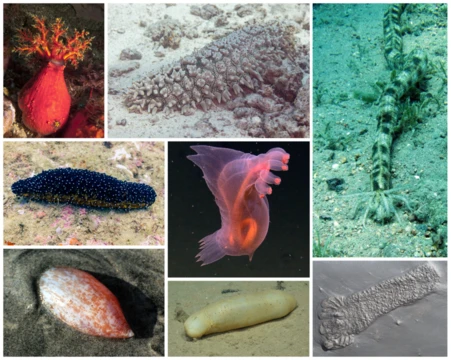
The gummy squirrel, or *Psychropotes longicauda*, is a deep-sea cucumber from the Psychropotidae family. Adults live on the ocean floor, while the larvae drift in open water, sporting a sail-like appendage on their backs that may help them swim. Adults have eighteen short feeding tentacles, each tipped with a leathery disc edged with tiny, retractable projections. Their bodies are highly flexible, reaching 14 to 32 centimeters long, roughly cylindrical but wider and flatter near the front. At the rear, a tail-like dorsal appendage up to 12 centimeters long may be pointed or split into two uneven tips. A double row of small tube feet runs along the underside, with a single row of larger tube feet on each side. The skin is soft and pliable; preserved specimens turn violet. Larvae have ten tentacles, are transparent with a reddish front end, and bear a single gelatinous dorsal appendage. They can grow to at least 23 millimeters, not counting the appendage, which may be nearly as long as the body. This species is cosmopolitan in the abyssal zone, found on soft seabeds worldwide, where adults sift through sediment with their tentacles. Its eggs are the largest of any echinoderm, measuring 4.4 millimeters across. Because the larvae do not feed, the yolk sustains them for a long time, allowing wide dispersal.
Quick Facts
- Taxon
- Psychropotes longicauda
Facts from the source article.
Lore & Background
As an adult, Psychropotes longicauda has eighteen short feeding tentacles, each with a leathery terminal disc with retractile processes projecting around the margin. Its body is very flexible and can grow to a length of between 14 and 32 cm. It is approximately cylindrical but broadest and somewhat flattened near the anterior end. At the posterior end there is a dorsal, tail-like appendage up to 12 cm long, either pointed or with a pair of unequal-length tips. There is a double row of small tube feet along the ventral surface and a single row of larger tube feet on each side of the body. The skin is soft and pliable and the colour is violet in preserved specimens. The larva has ten tentacles and is transparent with a reddish hue at the anterior end. It has an unpaired gelatinous dorsal appendage. Larvae can grow to at least 23 mm in length excluding the appendage which may be nearly as long as the body. Psychropotes longicauda is a cosmopolitan abyssal species of sea cucumber and is found on the seabed throughout the world's deep oceans. Its larva is pelagic and is often found more than 500 m above the ocean floor but still in the abyssal zone. Adult Psychropotes longicauda are found on soft sediments through which they sift with the aid of their feeding tentacles. The eggs, with a diameter of 4.4 mm, are the largest of any echinoderm. The size of the eggs, and the fact that the larvae do not appear to feed, makes it so that the yolk nourishes them for an extended time and that they can therefore disperse widely.
Reader's Guide
Psychropotes longicauda is notable for its distinctive larval form, which bears a sail-like dorsal appendage that may aid in movement through the water. The species is also remarkable for having the largest eggs of any echinoderm, measuring 4.4 mm in diameter. Because the larvae do not appear to feed, the yolk provides nourishment for an extended period, allowing wide dispersal across the deep ocean. The adult's posterior tail-like appendage, which can reach up to 12 cm, and its common name 'gummy squirrel' reflect its unusual appearance. The species is cosmopolitan in the abyssal zone, with pelagic larvae found more than 500 m above the seabed. Its feeding tentacles, each with a leathery terminal disc and retractile processes, allow it to sift through soft sediments. The violet coloration of preserved specimens and the flexible, cylindrical body further characterize this deep-sea inhabitant.
Did You Know?
- The larva has an unpaired gelatinous dorsal appendage shaped like a sail that may enable it to move through the water.
- The eggs of Psychropotes longicauda, at 4.4 mm in diameter, are the largest of any echinoderm.
- The adult has a posterior tail-like appendage up to 12 cm long, either pointed or with two unequal tips.
- The species is sometimes called the 'gummy squirrel' because it looks like a squirrel-shaped gummy bear.
More in Sea Cucumbers and Brittle Stars, Part 2 1-24
Spotted an error? Know more?
Reader corrections go straight into our review queue. Suggest an edit · How this site is sourced