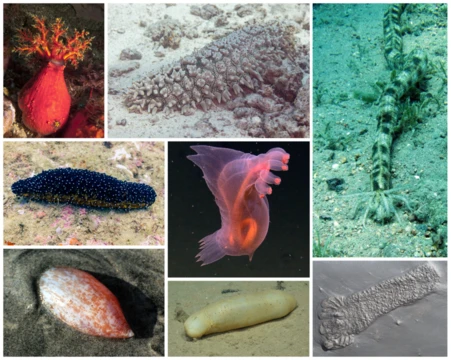
Psolus chitonoides
A toxic, scaly sea cucumber found on North America's western coast.

Psolus chitonoides, called the slipper sea cucumber, armoured sea cucumber, creeping armoured sea cucumber, or creeping pedal sea cucumber, belongs to the family Psolidae. Its scientific name means "resembling a chiton." This species lives in shallow waters along North America's western coast.
The body is oval, about 7 cm long and 5.8 cm wide, with a domed upper surface and a flat underside covered in tube feet. A staggered row of large tube feet runs down the center of the sole, with one or two rows of stout tube feet near each edge, plus a single row of smaller feet set in pits along the margins. At one end is the mouth, surrounded by a ring of eight to ten repeatedly branched tentacles—either all the same size or with two smaller than the rest. The anus sits on the dorsal surface at the opposite end. The skin is leathery and somewhat spiny, protected by rows of stiff, overlapping scales that range from yellow to bright orange. The tentacles are red with white tips.
This sea cucumber was first discovered in 1886 in Puget Sound by Columbia University teams. Its range stretches from the Aleutian Islands to Baja California, inhabiting both exposed coasts and quiet inlets in the sublittoral zone down to about 247 m deep. Its soft, pliable sole allows it to stick to rocks, and it is commonly found clinging firmly to vertical rock faces.
It feeds by suspension, intercepting floating particles that get trapped by sticky papillae on its tentacles. High concentrations of saponins in its tissues make it toxic, and most predatory fish, gastropod molluscs, and crabs avoid it; its flesh is unpalatable to the tidepool sculpin. Its main predators are starfish, especially the leather star. Juveniles are photo negative, and the eggs are bright red.
Quick Facts
- Taxon
- Psolus chitonoides
Facts from the source article.
Lore & Background
Psolus chitonoides was discovered in 1886 in Puget Sound by Columbia University teams. Its scientific name 'chitonoides' means resembling a chiton, referencing its protective scales. The species has an oval body about 7 cm long and 5.8 cm wide, with a domed upper surface and a flat sole equipped with tube feet arranged in staggered rows. The mouth is surrounded by eight to ten repeatedly branched tentacles, either all the same size or with two smaller than the rest; the anus is on the dorsal surface opposite the mouth. The skin is leathery, somewhat spiny, and protected by rows of stiff, overlapping scales that are yellow to bright orange, while the tentacles are red with white tips.
The slipper sea cucumber is found from the Aleutian Islands to Baja California, in the sublittoral zone down to about 247 m, on both exposed coasts and quiet inlets. Its soft, pliable sole allows it to cling firmly to vertical rock faces. It is a suspension feeder, intercepting particles with sticky papillae on its feeding tentacles. The species has a high concentration of saponins in its tissues, making it toxic and unpalatable to most predatory fish, gastropod molluscs, and crabs; its flesh has been shown to be unpalatable to the tidepool sculpin. Its main predators are starfish, especially the leather star. Juveniles are photo negative, and the eggs are bright red.
Reader's Guide
The significance of Psolus chitonoides lies in its unique defensive chemistry and physical adaptations. The article highlights that its high concentration of saponins makes it toxic and avoided by most predatory fish, gastropod molluscs, and crabs, with experimental evidence showing its flesh is unpalatable to the tidepool sculpin. This chemical defense is a key survival trait in its shallow-water habitat. Its main predators are starfish, particularly the leather star, indicating a specialized predator-prey relationship. The species' leathery, scaly skin and ability to cling to vertical rock faces via its pliable sole further illustrate its adaptation to exposed coastal environments. Discovered in 1886 by Columbia University teams in Puget Sound, it represents an early example of systematic marine biological exploration in the Pacific Northwest. Its bright orange scales and red-and-white tentacles make it visually distinctive among sea cucumbers. The species' range from the Aleutian Islands to Baja California underscores its broad ecological tolerance. The fact that juveniles are photo negative suggests a behavioral adaptation to avoid light, possibly to reduce predation risk. Overall, Psolus chitonoides is notable as a chemically defended, armored suspension feeder that occupies a specific niche in rocky sublittoral habitats.
Did You Know?
- Its eggs are bright red in color.
- Juveniles of the species are photo negative.
- Its main predator is the leather star (Dermasterias imbricata).
More in Sea Cucumbers and Brittle Stars, Part 2 1-24
Spotted an error? Know more?
Reader corrections go straight into our review queue. Suggest an edit · How this site is sourced