Pelagothuria
The only true pelagic sea cucumber, resembling a jellyfish.

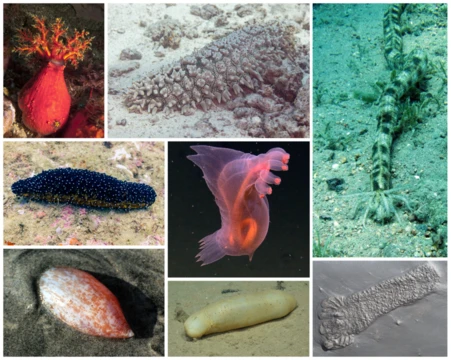
Pelagothuria is a genus of sea cucumber in the family Pelagothuriidae, represented by the single species Pelagothuria natatrix. It is notable for being the only true pelagic holothurian (and even echinoderm) known to date, with a jellyfish-like appearance and a swimming position that places the mouth on top.
Quick Facts
- Taxon
- Pelagothuria natatrix
Facts from the source article.
Lore & Background
Pelagothuria is somewhat unusual in appearance compared to other sea cucumbers, as it looks more like a jellyfish with a large umbrella-like swimming structure supported by a ring of around 12 highly modified oral tentacles. Its body is translucent with pale purple pigmentation, and the mouth is surrounded by around 15 short feeding tentacles. The veil can be contracted like jellyfishes do, and is interrupted at the central ventral radius. The animal reaches around 16 cm in total diameter. Its swimming seems mostly passive, more like slightly controlled drifting.
Pelagothuria was described by Hubert Jacob Ludwig in 1893 based on trawled specimens collected in 1891 by the USS Albatross between the Gulf of Panama and the Galápagos Islands at depths of 605–3,350 m. It was not until 1989 that the first in situ footage was obtained via a scientific expedition in the Galapagos at 542 m deep off San Cristóbal Island, followed by a scientific review by John Miller and David Pawson in 1990. In 2011, the NOAAS Okeanos Explorer photographed what scientists first believed to be an unknown jellyfish, but the picture was formally identified in 2014 by Christopher Mah and David Pawson as Pelagothuria natatrix. A second observation was made in March 2017 by the same mission off the Samoa Islands at 443 m deep near Howland Island, identified by Steve Auscavitch, including high-resolution video of the animal swimming in the water column.
Reader's Guide
Pelagothuria holds a unique place in echinoderm biology as the only true pelagic holothurian known to date. Its jellyfish-like appearance and swimming behavior set it apart from all other sea cucumbers, which are typically benthic. The species is extremely rare, yet its geographic range is very wide, having been collected in the Atlantic, Pacific, and Indian Oceans between 200 and 4,433 m depth. Its discovery history spans over a century, from the initial trawled specimens in 1891 to the first in situ footage in 1989 and subsequent high-resolution video in 2017. The 2011 misidentification as an unknown jellyfish highlights how little was known about this species until recent deep-sea expeditions. Since 2017, more attention has been brought to Pelagothuria, and it has been observed more than 100 times by NOAA. Its passive, drifting swimming style and translucent, pale purple body with a contractile veil make it a remarkable example of convergent evolution with medusae, though it remains a true echinoderm.
Did You Know?
- It was first described by Hubert Jacob Ludwig in 1893 from specimens collected by the USS Albatross.
- The species was misidentified as an unknown jellyfish in a 2011 photograph before being formally identified in 2014.
More in Sea Cucumbers and Brittle Stars, Part 2 1-24
Spotted an error? Know more?
Reader corrections go straight into our review queue. Suggest an edit · How this site is sourced