Holothuriidae
Family of sea cucumbers with sticky defensive threads.

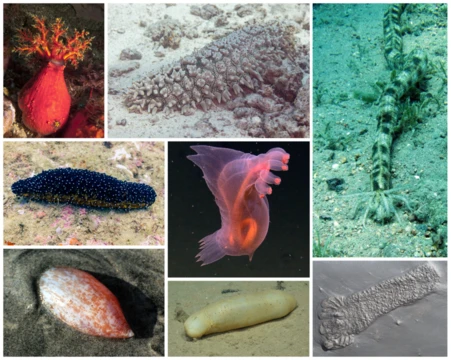
Holothuriidae is a family of sea cucumbers, which are echinoderms. These animals have thick, fleshy bodies and multiple rows of tube feet they use for movement and gripping surfaces. Their bodies are often covered with blunt projections called papillae. Many species can defend themselves by shooting out a mass of fine, sticky threads known as cuvierian tubules, or by turning their internal organs inside out. For taxonomic identification, the genera *Actinopyga* and *Bohadschia* have spicules shaped only like sticks, while *Holothuria* and *Labidodemas* never have table-shaped spicules. *Actinopyga* also has anal teeth (modified podia) and, like *Pearsonothuria*, never ejects cuvierian tubules. Members of this family are found worldwide in low to middle latitudes, typically living in coral reefs and nearby sandy areas, with a few species inhabiting deeper waters. In the Indo-Pacific, they are often dominant in coral reef habitats. Most species are detritivores. With over 200 recognized species, this is the second largest family of sea cucumbers. The accepted genera are *Actinopyga* (18 species), *Bohadschia* (12 species), *Holothuria* (163 species), *Labidodemas* (8 species), and *Pearsonothuria* (1 species).
Quick Facts
- Taxon
- Holothuriidae
Facts from the source article.
Lore & Background
Members of the family Holothuriidae have thick fleshy bodies and several rows of tube feet used for moving and adhering to surfaces. The body is often covered with blunt projections known as papillae. Many members can eject a mass of fine sticky threads called cuvierian tubules to distract predators, or even turn their viscera inside out. For taxonomic determination, the genera Actinopyga and Bohadschia have spicules exclusively shaped like sticks, while Holothuria and Labidodemas never have theirs shaped like tables. Actinopyga is also equipped with anal teeth (modified podia) and never throws out cuvierian tubules, just like Pearsonothuria. Most species are detritivores.
Reader's Guide
Holothuriidae is notable as the second largest family of sea cucumbers, encompassing over 200 species across five accepted genera. Its members are widely distributed in low to middle latitude oceans, often dominating coral reef habitats in the Indo-Pacific. The family is distinguished by several key traits: thick fleshy bodies, rows of tube feet, and papillae-covered surfaces. A remarkable defensive adaptation is the ejection of cuvierian tubules—sticky threads that entangle predators—or the eversion of internal viscera. Taxonomic identification relies on spicule shapes: Actinopyga and Bohadschia have stick-shaped spicules, while Holothuria and Labidodemas lack table-shaped spicules. Actinopyga uniquely possesses anal teeth and, along with Pearsonothuria, never deploys cuvierian tubules. Most species are detritivores, playing a role in nutrient recycling on coral reefs and sandy habitats. The family's diversity and ecological dominance in tropical reefs underscore its significance in marine benthic communities.
Did You Know?
- Members of Holothuriidae can eject sticky cuvierian tubules to distract predators.
- Actinopyga and Pearsonothuria never throw out cuvierian tubules.
- Actinopyga is equipped with anal teeth, which are modified podia.
More in Sea Cucumbers and Brittle Stars, Part 2 1-24
Spotted an error? Know more?
Reader corrections go straight into our review queue. Suggest an edit · How this site is sourced