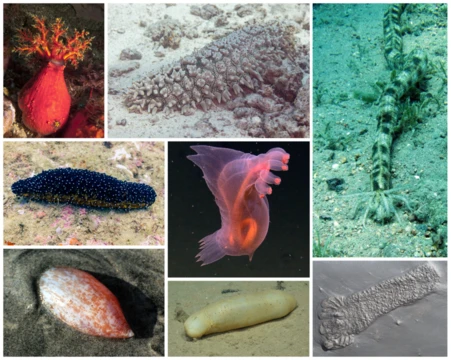
Holothuria leucospilota
A medium-sized sea cucumber found in shallow Indo-Pacific waters.

Holothuria leucospilota, known as the black sea cucumber or black tarzan, belongs to the family Holothuriidae. Its full scientific name is *Holothuria (Mertensiothuria) leucospilota*, and it serves as the type species for the subgenus Mertensiothuria. This marine invertebrate lives on the shallow seabed across the Indo-Pacific.
When relaxed, this medium-sized sea cucumber reaches up to 40 centimeters in length, but it can stretch to about a meter when extended. Its body is roughly cylindrical and tapers toward the rear. At the front, twenty branched oral tentacles surround the mouth, which sits on the underside. The animal is soft and pliable, covered in fleshy papillae. Its usual color is charcoal gray or reddish-black, with pale gray tube feet underneath; off the African coast, however, it appears bright or dark brown with white patches that grow larger toward the rear.
The species inhabits shallow waters along East Africa and much of the Indo-Pacific. It is common on Australia’s northeast coast, where it lives on reefs and rocky shores, often partly hidden under boulders. A study near Singapore found it more abundant near boulders, corals, and seaweed clumps than on open seabed. This sea cucumber tolerates changes in salinity and temperature relatively well, thriving in the lab when these conditions shifted. In contrast, the Japanese sea cucumber (*Apostichopus japonicus*) shrank, eviscerated, and died within three days under the same conditions. In Singapore, *A. japonicus* is eaten and has become increasingly rare due to overexploitation.
*Holothuria leucospilota* is a scavenger. While feeding, it usually anchors its rear end under a rock or in a crevice so it can contract back out of sight if disturbed. It uses its tentacles to shovel organic debris—along with a significant amount of sand—into its mouth; the sand passes through its gut. When threatened, it can expel a mass of fine, sticky Cuvierian tubules from its anus to entangle predators, allowing escape. These tubules regenerate in fifteen to eighteen days. The worm pearlfish (*Encheliophis vermicularis*) parasitizes this species; each infected *H. leucospilota* hosts a male-female pair of the fish living inside its body.
Quick Facts
- Taxon
- Holothuria leucospilota
Facts from the source article.
Lore & Background
Holothuria leucospilota is a medium-sized sea cucumber reaching a length of up to 40 centimetres when relaxed but can stretch to about a metre when extended. It is roughly cylindrical, tapering towards the posterior end, with twenty oral tentacles with branched tips surrounding the mouth on the underside. The animal is soft and pliable, covered with fleshy papillae, and its usual colour is charcoal grey or reddish-black with pale grey tube feet on the underside; off the African coast it is described as bright or dark brown with white patches that are larger towards the posterior end.
It is found in shallow water along the east coast of Africa and in much of the Indo-Pacific region, and is common on the north east coast of Australia on reefs and rocky coasts, often partly concealed under a boulder. A study near Singapore found it more common near boulders, corals and seaweed clumps than on the open seabed, and that it is relatively tolerant of changes in salinity and temperature, continuing to thrive in the laboratory when these parameters were changed. Under the same conditions, the Japanese sea cucumber (Apostichopus japonicus) shrank, eviscerated, and died within three days.
As a scavenger, it feeds by using its tentacles to shovel organic debris from the seabed into its mouth, swallowing significant quantities of sand that pass through the gut. When threatened, it can emit a mass of fine sticky Cuvierian tubules from its anus to ensnare predators, regenerating these tubules in fifteen to eighteen days. The worm pearlfish (Encheliophis vermicularis) is a parasite of this species, with each parasitised H. leucospilota hosting a male and female pair of the fish inside its body.
Reader's Guide
Holothuria leucospilota is notable as the type species of the subgenus Mertensiothuria within the family Holothuriidae. Its distribution spans the east coast of Africa and much of the Indo-Pacific, including common occurrence on the north east coast of Australia. The species demonstrates a preference for structured habitats such as boulders, corals, and seaweed clumps over open seabed, as observed in a study near Singapore. Its tolerance to changes in salinity and temperature distinguishes it from the Japanese sea cucumber (Apostichopus japonicus), which perished under similar laboratory conditions. This resilience may contribute to its relative abundance in its range. The species also plays a role in the life cycle of the worm pearlfish (Encheliophis vermicularis), which lives as a parasite inside its body. Its defensive use of Cuvierian tubules and ability to regenerate them within fifteen to eighteen days is a characteristic biological feature. The species is not noted as being consumed or overexploited in the source article, unlike Apostichopus japonicus in Singapore.
Did You Know?
- Holothuria leucospilota can stretch from 40 cm when relaxed to about one metre when extended.
- It has twenty oral tentacles with branched tips surrounding its mouth.
- When threatened, it emits sticky Cuvierian tubules from its anus and can regenerate them in 15 to 18 days.
- The worm pearlfish (Encheliophis vermicularis) lives as a parasite inside this sea cucumber, with a male and female pair per host.
More in Sea Cucumbers and Brittle Stars, Part 2 1-24
Spotted an error? Know more?
Reader corrections go straight into our review queue. Suggest an edit · How this site is sourced