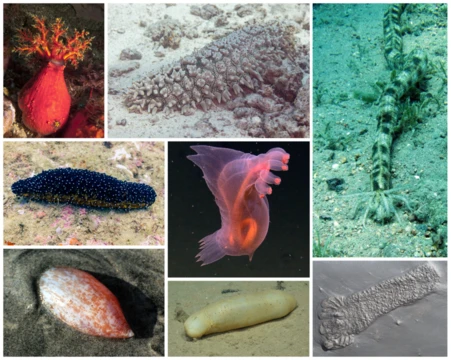
Holothuria hilla
A detritivorous sea cucumber found in Indo-Pacific and Red Sea.

Holothuria hilla belongs to the subgenus *Mertensiothuria* within the genus *Holothuria*. It goes by several common names: contractile sea cucumber, sand sifting sea cucumber, tigertail sea cucumber, and, in Hawaii, light spotted sea cucumber. Its range covers the Indo-Pacific region and the Red Sea.
This sea cucumber has a cylindrical body that tapers slightly at the rear, reaching about 40 cm in length and 5 cm in diameter. Its skin is thin, soft, and wrinkled. On the dorsal side, rows of tube feet are modified into thornlike, conical papillae with broad bases, sometimes paired. These papillae are creamy-white, standing out against a pinkish, golden, or brown background. The ventral side is similarly colored, but its papillae are longer, yellowish, and arranged in four or five rows. The mouth, located on the underside, is ringed by twenty yellowish, peltate tentacles. Although it possesses Cuvierian tubules, it does not expel them defensively like some other species.
The species lives in the Red Sea, Persian Gulf, and across the tropical west and central Indo-Pacific, reaching as far east as Hawaii and even Panama. It is most common at depths less than 30 m, though it can occur down to 200 m. Its habitats include sandy, rocky, and coral substrates, as well as lagoons, seagrass meadows, and flat areas.
As a detritivore, *H. hilla* scoops sand into its mouth with its oral tentacles, digests bacteria and organic particles, and expels the cleaned sand through its anus, thereby churning large areas of the seabed. Reproduction can be sexual, with males and females releasing gametes into the water, or asexual, through fission. Sexual reproduction tends to occur during hotter periods, while fission is more common in cooler weather. In Réunion, where the species is rare, only fission has been observed. During fission, the animal stops feeding and hides; the missing parts regenerate, often appearing paler than the original sections.
Quick Facts
- Genus
- Holothuria
- Species
- hilla
- Parent
- Holothuria (Mertensiothuria)
Facts from the source article.
Lore & Background
Holothuria hilla is a cylindrical sea cucumber, tapering slightly at the posterior end, growing to about 40 cm in length and 5 cm in diameter. Its integument is thin, soft, and wrinkled. The dorsal surface bears longitudinal rows of tube feet modified into thornlike conical papillae with broad bases, sometimes joined in pairs; these papillae are creamy-white against a pinkish, golden, or brown background. The ventral surface is similar in color but has four or five rows of longer, yellowish papillae. The mouth, on the underside, is surrounded by a ring of twenty yellowish peltate tentacles. This species possesses Cuvierian tubules but does not expel them defensively as some other species do.
It inhabits the Red Sea, Persian Gulf, tropical west and central Indo-Pacific oceans, as far east as Hawaii, and even Panama. It is mainly found at depths less than 30 m, but occasionally as deep as 200 m, on sandy, rocky, and coral substrates, in lagoons, seagrass meadows, and flat areas.
As a detritivore, it rakes sand into its mouth with its oral tentacles, extracting and digesting bacteria, animal and vegetal particles, and voiding the sand through its anus, thereby churning up significant areas of the seabed. Reproduction is either sexual, with gametes liberated into the water column, or asexual, by fission. Sexual reproduction mostly occurs at hotter times of year, asexual when cooler. In Réunion, where the species is rare, only fission has been observed. The animal stops feeding and conceals itself while splitting; missing parts regenerate and are often paler in color.
Reader's Guide
Holothuria hilla is significant as a detritivore that actively churns up the seabed by ingesting sand and digesting organic particles, thereby playing a role in nutrient cycling and sediment turnover in its habitats. Its ability to reproduce both sexually and asexually, with sexual reproduction mostly in hotter periods and asexual fission in cooler periods, demonstrates adaptive reproductive strategies. Notably, in Réunion, where the species is rare, only fission has been observed, indicating possible environmental or population constraints on sexual reproduction. The species does not expel its Cuvierian tubules defensively, a trait that distinguishes it from some other sea cucumbers. Its wide distribution across the Indo-Pacific, Red Sea, and even Panama highlights its ecological adaptability to various substrates and depths, from shallow lagoons to depths of 200 m. The presence of twenty yellowish peltate tentacles and the distinctive coloration of its papillae aid in identification. Its legacy lies in its contribution to benthic ecosystem processes and its varied reproductive biology, which may inform studies of population dynamics and resilience in marine environments.
Did You Know?
- It has twenty yellowish peltate tentacles surrounding its mouth.
- This species does not expel its Cuvierian tubules defensively, unlike some other sea cucumbers.
- In Réunion, where the species is rare, only asexual reproduction by fission has been observed.
More in Sea Cucumbers and Brittle Stars, Part 2 1-24
Spotted an error? Know more?
Reader corrections go straight into our review queue. Suggest an edit · How this site is sourced