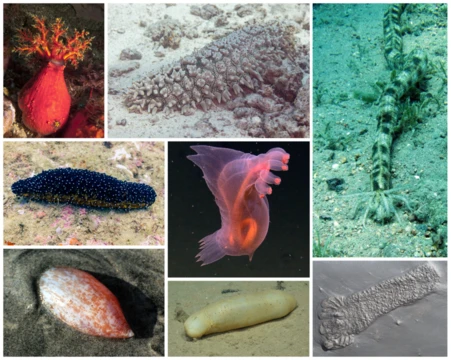
Holothuria fuscopunctata
A large, slow-maturing sea cucumber of the tropical Indo-Pacific.

Holothuria fuscopunctata, called the elephant trunkfish, is a sea cucumber from the family Holothuriidae. It lives in the shallow waters of the tropical Indo-Pacific and belongs to the subgenus Microthele, so its full scientific name is Holothuria (Microthele) fuscopunctata.
This is a big sea cucumber. It can grow up to 70 cm long, though it is more often around half that size, and can weigh as much as 4.5 kg. Its body wall is thick and golden-brown, covered with darker spots and dark brown wrinkles. The underside is whitish. Around its mouth are twenty thick brown tentacles, and its anus has a black band around it. The cloaca is large and black, but the animal lacks Cuvierian tubules.
The species has a wide range across the tropical Indo-Pacific, from Madagascar and East Africa to Japan, China, Australia, the Mariana Islands, Palau, and New Caledonia. It lives down to depths of 30 m. It is common in some areas but rare in the Philippines, the Federated States of Micronesia, and the Marshall Islands. Off the African coast, it is mostly found on sandy seabeds and in seagrass meadows. In the Central Pacific, it mainly lives on reef slopes and coral rubble, though it also occurs in seagrass beds.
It feeds by grazing on organic material from the seabed. The species matures slowly and has low fecundity. Males and females are separate, and breeding happens during the warm season, from December to January.
Sea cucumbers are eaten in the Central Pacific. *H. fuscopunctata* is not highly valued, but people eat it as a poverty food during hard times, such as after cyclones. It is mostly collected by skin-diving, and it may face more pressure as other, more popular species become rarer. Fisheries exist in Malaysia, the Philippines, Vietnam, Indonesia, Madagascar, the Western Pacific (including the Torres Strait), and Tuvalu. The International Union for Conservation of Nature currently lists it as "least concern," but its low fertility makes it vulnerable to over-exploitation.
Quick Facts
- Taxon
- Holothuria fuscopunctata
Facts from the source article.
Lore & Background
Holothuria fuscopunctata has a wide distribution in the tropical Indo-Pacific, ranging from Madagascar and the eastern coast of Africa to Japan, China, Australia, the Mariana Islands, Palau, and New Caledonia. Its depth range extends down to a maximum of 30 m. On the African coast it mostly occurs on sandy seabeds and seagrass meadows, but in the Central Pacific it mostly occurs on reef slopes and on coral rubble, although it also lives in seagrass beds. The species is common in some parts of its range, but scarce in the Philippines, Federated States of Micronesia, and Marshall Islands.
Reader's Guide
Holothuria fuscopunctata is a large sea cucumber with a thick, golden-brown body wall marked by darker spots and dark brown wrinkles. Its underside is whitish, and its mouth is surrounded by twenty thick brown tentacles, while the anus is surrounded by a black band. The cloaca is large and black, but it lacks Cuvierian tubules. This species feeds on organic material that it grazes on the seabed. It is slow to mature and has low fecundity; the sexes are separate, and breeding takes place in the warm season between December and January. Sea cucumbers are eaten in the Central Pacific, and H. fuscopunctata is not particularly esteemed but is eaten as a poverty food in times of hardship, such as after cyclones. It is mostly harvested by skin-diving and is likely to face greater exploitation as other more favoured species become scarcer. Fisheries exist in Malaysia, the Philippines, Vietnam, Indonesia, Madagascar, the Western Pacific including the Torres Strait, and Tuvalu. The International Union for Conservation of Nature has assessed its conservation status as being of 'least concern', but it is vulnerable to over-exploitation because of its low fertility rate.
Did You Know?
- Holothuria fuscopunctata can reach a maximum length of 70 cm and weigh up to 4.5 kg.
- Its cloaca is large and black, but it has no Cuvierian tubules.
- Breeding takes place between December and January.
- It is eaten as a poverty food in the Central Pacific, especially after cyclones.
More in Sea Cucumbers and Brittle Stars, Part 2 1-24
Spotted an error? Know more?
Reader corrections go straight into our review queue. Suggest an edit · How this site is sourced