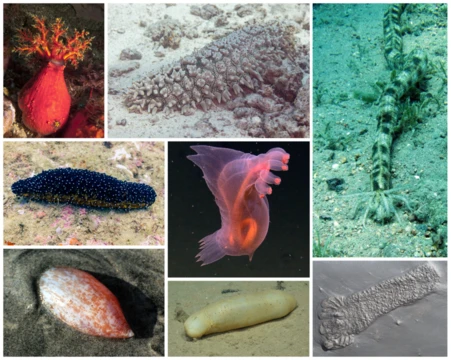
Holothuria floridana
A sea cucumber found in warm Caribbean and Gulf waters.

The Florida sea cucumber (*Holothuria floridana*) is a marine invertebrate belonging to the family Holothuriidae. It lives on the seabed just below the low tide mark, inhabiting sandy areas and seagrass beds in Florida, the Gulf of Mexico, the Bahamas, and the Caribbean.
This species reaches a maximum length of about 8 inches (20 cm). Its body is elongated and cylindrical, covered in tough, leathery skin dotted with blunt, conical bumps. The underside features several rows of short tube feet, while one end holds a mouth ringed with feeding tentacles. Its coloration is a mottled mix of brown, fawn, and white.
Found at depths up to 5 metres (16 ft), it moves across the sandy bottom, sifting through sand with its tentacles to feed on detritus and other organic particles. Reproduction occurs through gametogenesis, a process that produces gametes, and takes place during spring and summer. Temperature directly controls this cycle: research shows that gonad maturity and maximum reproductive output happen when water reaches 28 degrees Celsius.
Quick Facts
- Genus
- Holothuria
- Species
- floridana
Facts from the source article.
Lore & Background
Holothuria floridana can grow to a length of up to 8 inches (20 cm). It has an elongated cylindrical shape with a tough, leathery skin bearing blunt conical protuberances. On its underside are several rows of short tube feet, and one end features a mouth surrounded by a ring of feeding tentacles. The body colour is mottled brown, fawn and white.
It is found at depths of up to 5 metres (16 ft) on sand and on seagrass beds in the Caribbean Sea, Gulf of Mexico and the coasts of Florida. It moves across the sandy seabed sifting through the sand with its tentacles and feeding on detritus and other organic particles.
Holothuria floridana undergoes gametogenesis, a biological process to produce gametes for reproduction, during the spring and summer seasons. Reproduction is driven by temperature levels. Scientists discovered that its gonads maturity is dependent on temperature, with optimal maturity and maximum reproduction output at 28 degrees Celsius water (Ramos-Miranda et al., 2017).
Reader's Guide
Holothuria floridana is significant as a species whose reproductive cycle is closely tied to temperature, with optimal reproduction occurring at 28 degrees Celsius. This temperature dependence, documented by Ramos-Miranda et al. (2017), highlights the species' sensitivity to environmental conditions. Its role in the ecosystem involves sifting through sand and feeding on detritus and organic particles, contributing to nutrient cycling on sandy seabeds and seagrass beds. The species is found in the Caribbean Sea, Gulf of Mexico, and Florida coasts, at depths up to 5 metres. Its physical characteristics—elongated cylindrical shape, leathery skin with conical protuberances, and mottled brown, fawn, and white coloration—distinguish it within the family Holothuriidae. The species' reliance on temperature for gametogenesis and gonadal maturity underscores its potential vulnerability to climate-related changes in water temperature, though the article does not discuss conservation status. Its legacy lies in its role as a model for understanding temperature-driven reproduction in marine invertebrates.
Did You Know?
- Holothuria floridana can grow up to 8 inches (20 cm) in length.
- It feeds by sifting through sand with its tentacles, consuming detritus and organic particles.
- Its gonads reach optimal maturity at a water temperature of 28 degrees Celsius.
- Reproduction occurs during spring and summer, driven by temperature levels.
More in Sea Cucumbers and Brittle Stars, Part 2 1-24
Spotted an error? Know more?
Reader corrections go straight into our review queue. Suggest an edit · How this site is sourced