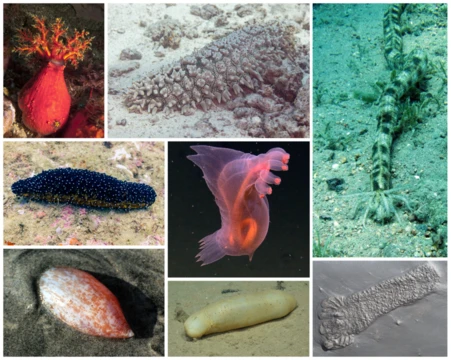
Holothuria edulis
A pink-and-black sea cucumber valued as food and in aquariums.

Holothuria edulis, also called the edible sea cucumber or the pink and black sea cucumber, is an echinoderm belonging to the family Holothuriidae. In 1914, Pearson assigned it to the subgenus Halodeima, giving it the full scientific name Holothuria (Halodeima) edulis. This species lives in shallow waters throughout the tropical Indo-Pacific Ocean.
This sea cucumber is medium-sized, growing to about 30 centimeters long. Its body is roughly cylindrical with rounded ends, but it can change shape by retracting or expanding. Normally soft and pliable with smooth skin, it can become firm and rigid due to the special properties of its connective tissue. Small tube feet line the body in longitudinal rows and can be withdrawn into the body wall, leaving tiny hollows. Around the mouth, about twenty tube feet are modified into feeding tentacles. The upper side is usually dark reddish-black, while the underside is pinkish-mauve, though it can also appear grey or dark brown.
Holothuria edulis is common and widespread across the Indo-Pacific. It lives on the seabed at depths up to 20 meters. Its range stretches from the Red Sea and East African coast to Sri Lanka, Japan, China, Indonesia, the Philippines, northern Australia, and various Pacific islands. It inhabits sandy or muddy substrates, coral rubble, and seagrass meadows, and can be found on inner and outer reef flats, back reef slopes, and in lagoons.
Primarily nocturnal, it hides under rocks or coral pieces during the day. As a detritivore, it feeds by using its feeding tentacles to pick up sand and debris from the seabed. Sand is pushed into the mouth, and organic matter—including biofilm on the grains—is digested as the sand passes through the gut. Indigestible material is expelled from the anus, leaving a sand ridge as the animal moves. This feeding activity churns the top few centimeters of seabed and aerates the sediment.
Locomotion is very slow. It moves mainly through peristaltic action of its body wall, with limited help from its tube feet. It can also anchor its feeding tentacles into the sand and pull itself along. If overturned, it uses its feeding tentacles to right itself. Holothuria edulis has separate sexes and spawns year-round, releasing gametes into the water column. The larvae are planktonic. It can also reproduce asexually by splitting into two parts, each regrowing missing organs.
Quick Facts
- Genus
- Holothuria
- Parent
- Holothuria (Halodeima)
- Species
- edulis
Facts from the source article.
Lore & Background
Holothuria edulis is a medium-sized sea cucumber reaching a length of about 30 centimetres. It has a roughly cylindrical shape with rounded ends but can retract and expand its body and adopt different shapes. It is usually soft and pliable with a smooth skin but, due to the special characteristics of its connective tissue, it can become firm and rigid. The body is lined with longitudinal rows of small tube feet which can be withdrawn into the body wall, leaving small hollows. About twenty tube feet in a ring round the mouth are modified into feeding tentacles. This sea cucumber is usually a dark reddish-black colour on its upper side and a pinkish-mauve colour below, but can be grey or dark brown.
It is mainly nocturnal and tends to hide during the day under rocks or pieces of coral. It is a detritivore and feeds by ingesting sand and debris which has accumulated on the seabed which it picks up using its feeding tentacles. Sand is pushed into the mouth and any organic matter present, including the biofilm round the grains, is digested as the sand passes through the gut. The indigestible matter is expelled from the anus leaving a sand ridge as the animal moves around. During its feeding activities, the sea cucumber churns up the top few centimetres of seabed and aerates the sediment. Locomotion is very slow, mainly by peristaltic action of its body wall, assisted to a limited extent by its tube feet. It can also anchor its feeding tentacles into the sand and haul itself along. If it gets overturned, it can use its feeding tentacles to help right itself.
Holothuria edulis has separate sexes and spawns at any time of year with gametes being liberated into the water column. The larvae are planktonic. This sea cucumber can also reproduce asexually by breaking into two parts, each of which then regrows the missing organs.
Reader's Guide
Holothuria edulis is a common and widespread species in the Indo-Pacific Ocean, living on the seabed at depths down to 20 metres. Its range extends from the Red Sea and East African coast to Sri Lanka, Japan, China, Indonesia, the Philippines, northern Australia and various Pacific islands. It is found in a number of different habitats including on sandy or muddy substrates, on coral rubble and in seagrass meadows, as well as on inner and outer reef flats, on back reef slopes and in lagoons.
As its name implies, Holothuria edulis is edible. It is dried and sold as 'bêche-de-mer' or 'trepang' in China and Indonesia. Additionally, it is common in the aquarium trade for its colors and its ability to eat detritus. It needs a tank size of 50 US gallons (190 litres) or more. It is easy to care for but may release a toxin when stressed, although this only happens very rarely. The species was placed in the subgenus Halodeima by Pearson in 1914, giving it the full scientific name Holothuria (Halodeima) edulis.
Did You Know?
- Holothuria edulis can reproduce asexually by breaking into two parts, each regrowing the missing organs.
- It is usually dark reddish-black on its upper side and pinkish-mauve below, but can also be grey or dark brown.
- It can become firm and rigid due to special characteristics of its connective tissue.
- It may release a toxin when stressed, though this happens very rarely.
More in Sea Cucumbers and Brittle Stars, Part 2 1-24
Spotted an error? Know more?
Reader corrections go straight into our review queue. Suggest an edit · How this site is sourced