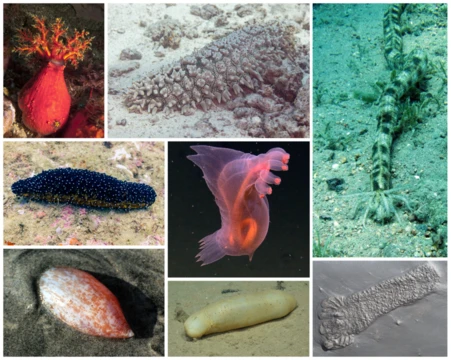
Holothuria difficilis
A sea cucumber with noxious defenses and dual reproductive modes.

Holothuria (Platyperona) difficilis is a sea cucumber belonging to the family Holothuriidae. The genus name *Holothuria* is derived from Latin, originally from Greek, and its meaning is uncertain—it refers to a plantlike animal, though German zoologist Hubert Ludwig suggested it might translate to “sea penis,” as the root *thoúrios* carries a connotation of sexual arousal. Like all echinoderms, this species has a body plan featuring pentamerous radial symmetry, an endoskeleton, a distinct oral and aboral side, a water vascular system, and tube feet used for movement. The mouth sits on the oral side for feeding, while the anus on the aboral side handles waste and respiration. For defense, *H. difficilis* has a noxious dermis and can eject very thin Cuvierian tubules—adaptations thought to have evolved against predators. It has a single gonad and can reproduce sexually.
This sea cucumber is found in many seas and oceans worldwide, including the Red Sea and near Central America, but its general range is the Indian and Pacific Oceans. It is benthic and lives inshore; for instance, on La Réunion Island’s fringing reefs, it occupies outer reef flats and spaces under large boulders. In terms of feeding, *H. difficilis* is a deposit feeder—observed in Western Australia grazing on rocks and ingesting sediment. The exact feeding mechanism is unknown, though other deposit-feeding holothurians use differently shaped tentacles to capture food.
The life cycle of *H. difficilis* is not fully known, but sea cucumbers generally begin as fertilized eggs that develop either inside an adult or freely in the water. During spawning, holothurians often wave the front of their body, likely to prevent gametes from settling in sediment. As an adult, this species mainly reproduces asexually through body fission (fragmentation), though it can also reproduce sexually. Depending on where fission occurs, internal organs may be affected, but the animal can regenerate and rebuild its body. In the southern hemisphere, *H. difficilis* and other *Holothuria* species follow specific reproductive schedules: asexual reproduction peaks in winter (linked to cooler water), while sexual reproduction peaks in late spring to summer (linked to warmer water).
The main predator of *H. difficilis* is sea stars, which can ingest the entire sea cucumber.
Quick Facts
- Genus
- Holothuria
- Species
- difficilis
Facts from the source article.
Lore & Background
Holothuria difficilis is a member of the phylum Echinodermata, sharing pentamerous radial symmetry, an endoskeleton, an oral side opposite an aboral side, a water vascular system, and tube feet. The oral side contains the mouth for feeding, and the aboral side contains an anus used for waste removal and respiration. Tube feet are used for locomotion. Structurally, its dermis is noxious, and it also contains very thin Cuvierian tubules that can be ejected. It has been hypothesized that these defense mechanisms are due to evolution against predation. This species contains one gonad and can perform sexual reproduction.
The species has been found in many seas and oceans across the globe such as the Red Sea and near Central America, but its general distribution is in the Indian and Pacific Oceans. Typically, it is benthic and lives inshore. When observed in La Reunion Island fringing reefs, the species resided in outer reef flats and under large boulders. In Western Australia, it was found that H. difficilis were deposit feeders, grazing on rocks and eating sediment. The mechanism by which it feeds is unknown, but other Holothurian deposit feeders have different shaped tentacles that catch food.
Although the life cycle of H. difficilis is not specifically known, sea cucumbers can start off as fertilized eggs that either develop inside an adult or float freely through the water. During spawning, Holothurians tend to wave the front of their body, hypothesized to ensure gametes do not get stuck in sediment. As an adult, this species mainly reproduces asexually via fragmentation but can also reproduce sexually. Depending on the fission site, internal organs may be affected, but the species can regenerate and rebuild its body. H. difficilis, along with other Holothuria species in the southern hemisphere, have specific reproductive schedules: asexual reproduction was highest in winter (correlated with lower water temperatures), while sexual reproduction was highest in late spring to summer (correlated with warmer water temperatures).
Reader's Guide
Holothuria difficilis is significant as a deposit-feeding sea cucumber that illustrates key echinoderm traits and adaptive defenses. Its noxious dermis and ejectable Cuvierian tubules represent evolutionary responses to predation, primarily from sea stars and fish. Sea stars can wholly ingest sea cucumbers, while fish are limited by dermal toxicity. The species' dual reproductive strategy—asexual fragmentation in winter and sexual reproduction in warmer months—highlights its flexibility in varying environmental conditions. The uncertainty surrounding the etymology of Holothuria, with Hubert Ludwig's proposed 'sea penis' meaning, adds a layer of historical curiosity. Its observed habitat under boulders in La Reunion Island and its deposit-feeding behavior in Western Australia provide concrete ecological data. The species' ability to regenerate after fragmentation underscores the resilience common among echinoderms. Overall, H. difficilis serves as a representative example of how sea cucumbers balance defense, reproduction, and feeding in benthic marine environments.
Did You Know?
- The German zoologist Hubert Ludwig proposed that the genus name Holothuria may mean 'sea penis,' from the Greek root θούριος (thoúrios) meaning 'sexually arousing.'
- H. difficilis can eject very thin Cuvierian tubules as a defense mechanism.
- Asexual reproduction in this species is highest in winter, correlating with lower water temperatures.
- Its main predators are sea stars, which can wholly ingest sea cucumbers.
More in Sea Cucumbers and Brittle Stars, Part 2 1-24
Spotted an error? Know more?
Reader corrections go straight into our review queue. Suggest an edit · How this site is sourced