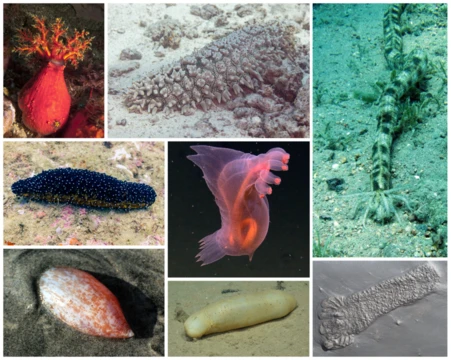
Holothuria cubana
A sea cucumber found in shallow Atlantic and Caribbean waters.

Holothuria cubana is a species of sea cucumber in the family Holothuriidae, first described by Ludwig in 1875. It is notable for its presence in the western central Atlantic Ocean, Gulf of Mexico, and Caribbean Sea, and for its role in nutrient cycling in reef ecosystems.
Quick Facts
- Taxon
- Holothuria cubana
Facts from the source article.
Lore & Background
Holothuria cubana was first described by Ludwig in 1875. Individuals have a cylindrical body with a mouth and anus on opposite ends. Young individuals are soft and light-colored, with papillae appearing on the dorsal surface as they grow. They have suckered pedicels that increase in number with age. Adults develop a rougher texture and have dark gray bodies with brown spots and a white underside.
The calcareous ossicles in this species can serve as indicators for growth. Small individuals have thin, curved rods supporting their tentacles; in juveniles these rods have distinctive perforated ends. In large specimens, these perforated rods shorten and become less frequent, replaced by knob-like buttons. Each individual has one gonad and engages in external fertilization through broadcast spawning. They sift through sediment to eat coral rubble, algae, microorganisms, and detritus, and can filter water for food.
Specimens have been found throughout the western central Atlantic Ocean, the Gulf of Mexico, and the Caribbean Sea. They position themselves under objects or sand, making them difficult to spot. Commercial harvesting has led to declines and extinctions of sea cucumber species in the Indo-Pacific, and harvesting efforts have increased in the Americas, including Mexico, Nicaragua, and Panama. Recovery can be slow for exploited populations, and individuals can experience shrinkage after nutritional stress or environmental conditions.
Reader's Guide
Holothuria cubana contributes to nutrient cycling in reef ecosystems by consuming bacteria, diatoms, and detritus. Its calcareous ossicles provide a means to track growth, with distinct forms in juveniles (perforated rods) and adults (knob-like buttons). The species is found at shallow depths of 0–7 meters across the western central Atlantic, Gulf of Mexico, and Caribbean Sea, often hiding under objects or sand. Commercial harvesting has caused declines in sea cucumber populations in the Indo-Pacific, and similar pressures are rising in the Americas, including Mexico, Nicaragua, and Panama. Exploited populations may recover slowly, and individuals can shrink under nutritional or environmental stress. These factors highlight the species' vulnerability and ecological importance within its range.
Did You Know?
- Juveniles have thin, curved rods with perforated ends supporting their tentacles.
- Individuals have one gonad and engage in external fertilization through broadcast spawning.
More in Sea Cucumbers and Brittle Stars, Part 2 1-24
Spotted an error? Know more?
Reader corrections go straight into our review queue. Suggest an edit · How this site is sourced