Holothuria cinerascens
Ashy sea cucumber: a nutritious, pharmaceutically valuable broadcast spawner.

Holothuria cinerascens, commonly known as the ashy sea cucumber, is a species of sea cucumber in the family Holothuriidae. It is widely distributed in the Pacific and Indian Ocean, found from the Red Sea to Madagascar and from Japan to Australia. First described by Brandt in 1835, this species is notable for its nutritional and pharmaceutical value, as well as its cultural significance in Hawaiʻi, where it is known as 'Loli pua'.
Quick Facts
- Genus
- Holothuria
- Species
- cinerascens
Facts from the source article.
Lore & Background
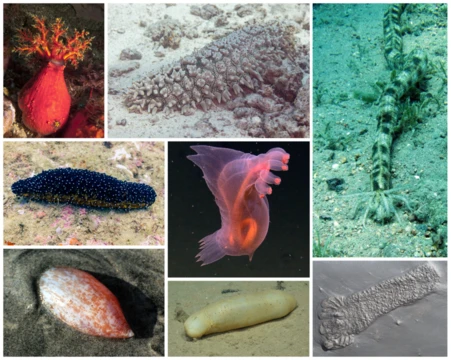
The ashy sea cucumber appears as a black tube with grey or red specs, giving it an overall appearance like ashes. It varies in size from ten to thirty centimeters and lives for about five to fifteen years. It uses its tentacles to catch floating particles from the water column, such as plankton, algae, tiny aquatic organisms, and organic detritus. Holothuria cinerascens is gonochoric and a broadcast spawner.
This species can be found around coral reefs and rocks, in tide pools, deeper waters, lagoons, and bays, often hiding in very tight spaces. Its movement and migration patterns depend on depth, light intensity, temperature conditions, and the amount of predators in the area.
In Hawaiʻi, ashy sea cucumbers are very common on shorelines and are known as 'Loli pua'. During traditional Hawaiian life, they were eaten and used as medicine.
Reader's Guide
Holothuria cinerascens holds significance as a human food source due to its high nutritional content, including minerals, calcium, vitamins, iron, zinc, and magnesium. This gives it high economic food value. Additionally, it has pharmaceutical uses: its protein is rich in glycine as a major component, and it also contains amino acids such as glutamic acid, alanine, and threonine acid. In Hawaiʻi, the species is culturally important, having been eaten and used as medicine in traditional Hawaiian life. Its wide distribution across the Pacific and Indian Ocean, from the Red Sea to Madagascar and from Japan to Australia, underscores its ecological and economic relevance. The species was first described by Brandt in 1835, and its habitat preferences—coral reefs, rocks, tide pools, lagoons, and bays—along with its dependence on environmental factors for movement, contribute to its adaptability. The ashy sea cucumber's role as a broadcast spawner and its use of tentacles to capture floating particles further define its biological niche.
Did You Know?
- It is known as 'Loli pua' in Hawaiian and was traditionally eaten and used as medicine.
- Its protein is rich in glycine and also contains glutamic acid, alanine, and threonine acid.
More in Sea Cucumbers and Brittle Stars, Part 2 1-24
Spotted an error? Know more?
Reader corrections go straight into our review queue. Suggest an edit · How this site is sourced