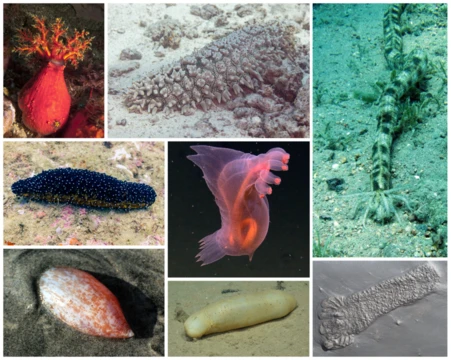
Holothuria atra
A black sea cucumber that emits toxic red fluid when threatened.

Holothuria atra, known as the black sea cucumber or lollyfish, is a marine invertebrate belonging to the family Holothuriidae. In 1914, Pearson assigned it to the subgenus Halodeima, giving it the full scientific name Holothuria (Halodeima) atra, and it serves as the type species for this subgenus.
This sea cucumber can reach up to 60 centimeters in length, though 20 centimeters is more typical. Its skin is smooth, flexible, and entirely black, often coated with sand—especially in smaller specimens. The mouth, located on the underside at one end, is ringed by 20 black, branched tentacles, while the anus sits at the opposite end.
Holothuria atra inhabits the tropical Indo-Pacific, from the Red Sea and East Africa to Australia. It lives on the seabed in shallow waters, including reefs, sand flats, and seagrass meadows, down to depths of 20 meters. Its dark color makes it stand out, but a sand coating often camouflages it and may also shield it from the sun. It prefers reef flats with good water aeration but limited wave exposure, as well as shallows near rock slabs where cool water seeps out at low tide. It is frequently found in sun-warmed pools above the low tide mark and tolerates high temperatures well, remaining healthy and feeding even at 39 °C.
As an omnivore, it sifts through sediment with its tentacles, consuming detritus and organic matter. For defense, it releases a toxic red fluid when its skin is rubbed or damaged. Unlike some sea cucumbers, it does not eject Cuvierian tubules when attacked; instead, it extrudes its internal organs through the anus. Males and females cannot be distinguished externally. Sexual maturity occurs at about 16 centimeters in length, with spawning mainly in summer and autumn, though it may happen year-round in equatorial waters. It takes 18 to 25 days to reach natural competence. Holothuria atra is also fissiparous, reproducing by transverse fission, mostly in smaller individuals. A constriction forms and deepens until the skin separates, creating two relatively wide, short individuals; no sand sticks to the new surfaces because they lack tube feet.
Like many echinoderms, this species contributes to sediment bioturbation, which supports coral reef health. It is often associated with the black polychaete worm Gastrolepidia clavigera, which crawls over its skin, and appears to have few natural predators.
Quick Facts
- Genus
- Holothuria
- Species
- atra
Facts from the source article.
Lore & Background
Holothuria atra has a smooth, pliable, entirely black skin that often has sand adhering to it, especially in smaller individuals. Its mouth is on the underside at one end, surrounded by a fringe of 20 black, branched tentacles, and the anus is at the other end. It is found in the tropical Indo-Pacific region, from the Red Sea and East Africa to Australia, on the seabed in shallow waters on reefs, sand flats, and seagrass meadows at depths up to 20 metres. Its colouring makes it conspicuous, but it is often camouflaged by a coating of sand, which may also keep it cool by protecting it from the sun's rays. It favours reef flats where water is well aerated, and shallows beside rock slabs where cool water wells out at low tide. It tolerates high temperatures well, with individuals appearing healthy and feeding at water temperatures up to 39 °C.
Reader's Guide
Holothuria atra is notable for its role in sediment bioturbation, a process important to coral reef health. As an omnivore, it sifts through sediment with its tentacles, feeding on detritus and organic matter. For defence, it emits a toxic red fluid when its skin is rubbed or damaged, and when attacked it extrudes its internal organs through its anus rather than ejecting Cuvierian tubules. It is fissiparous, reproducing by transverse fission, mostly in smaller individuals. It is often found associated with the polychaete worm Gastrolepidia clavigera and the commensal crab Lissocarcinus orbicularis. In the Pacific Islands, it is collected for human consumption, though its commercial value is low. On Guam, its toxic red fluid is used to drive octopuses out of hiding holes. Compounds of potential biomedical importance present in this species include lectin, steroidal sapogenins, and triterpene glycoside.
Did You Know?
- Holothuria atra can grow to 60 cm but is more commonly 20 cm long.
- It reproduces by transverse fission, with a constriction deepening until the integument separates.
More in Sea Cucumbers and Brittle Stars, Part 2 1-24
Spotted an error? Know more?
Reader corrections go straight into our review queue. Suggest an edit · How this site is sourced