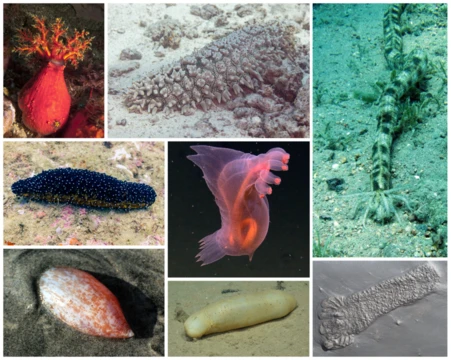
Elpidia minutissima
Deep-sea swimming sea cucumber with variable podia and population swings.

Elpidia minutissima is a deep-sea swimming sea cucumber belonging to the family Elpidiidae. It feeds on detritus and lives in the northern Pacific Ocean.
The species shows physical variation between populations. Specimens from the Aleutian Trench averaged 13 mm in length and had three pairs of dorsal podia. In contrast, specimens from Station M in the northeastern Pacific, at a depth of about 4,000 meters, had four pairs of podia: two on the dorsal surface and two on the ventral surface, with the rearmost ventral pair being shorter than the others. When population density was low at Station M, the average length matched that of the Aleutian Trench specimens, but during periods of high abundance, average length increased to 25 mm. It is possible these two groups are not the same species.
Ecologically, *E. minutissima* consumes detritus from the seabed, which originates as "marine snow"—a mix of mucus, feces, and organic debris sinking from surface waters. It plays a key role in processing, using, and redistributing organic particles that reach the seafloor. This species is one of several echinoderms that experience dramatic swings in population density. Over a sixteen-year study, both *E. minutissima* and another deep-sea holothurian, *Peniagone vitrea*, declined in density by one to two orders of magnitude. Researchers suggest that broadcast spawning and planktotrophic larvae increase the likelihood of such large fluctuations. These traits create a positive feedback loop: once populations drop, recovery is very slow because individuals are farther apart, making fertilization less likely and reducing the number of available larvae for recruitment.
Quick Facts
- Taxon
- Elpidia minutissima
Facts from the source article.
Lore & Background
Specimens collected from the Aleutian Trench averaged 13 mm in length and had three pairs of dorsal podia. In contrast, specimens from Station M in the northeastern Pacific Ocean at a depth of about 4,000 metres had four pairs of podia: two pairs on the dorsal surface and two pairs on the ventral surface, with the hindermost ventral podia being shorter than the others. At times of low abundance at Station M, the average length was similar to the Aleutian Trench specimens, but at times of high abundance it increased to 25 mm. It is possible that these two populations are not in fact the same species.
Elpidia minutissima feeds on detritus on the seabed, the result of 'marine snow' consisting of mucus, faeces and organic debris that sink from surface waters. It plays an important part in the processing, utilization and redistribution of particles of organic material that have fallen to the sea bed. This species is one of a number of echinoderm species that show great variations in population density.
Reader's Guide
Elpidia minutissima is significant as a deep-sea detritivore that helps process and redistribute organic material on the seabed, playing a key role in the benthic ecosystem. Its notable population swings—observed over a sixteen-year period alongside Peniagone vitrea, with declines of one to two orders of magnitude—highlight the vulnerability of deep-sea species with certain reproductive strategies. Researchers have hypothesized that broadcast spawning and planktotrophic larvae create a positive feedback loop: when populations decline, individuals are farther apart, reducing fertilization success and slowing recovery. This makes E. minutissima an important species for understanding population dynamics in the deep sea. The morphological differences between the Aleutian Trench and Station M populations, including variations in podia number and body size, also raise questions about whether they represent the same species, underscoring the need for further taxonomic study.
Did You Know?
- Specimens from the Aleutian Trench had three pairs of dorsal podia, while those from Station M had four pairs of podia.
- At Station M, the average length increased from about 13 mm to 25 mm during times of high abundance.
- It is possible that the Aleutian Trench and Station M populations are not the same species.
- Over a sixteen-year period, E. minutissima and Peniagone vitrea underwent a decline in density of one to two magnitudes.
More in Sea Cucumbers and Brittle Stars, Part 2 1-24
Spotted an error? Know more?
Reader corrections go straight into our review queue. Suggest an edit · How this site is sourced