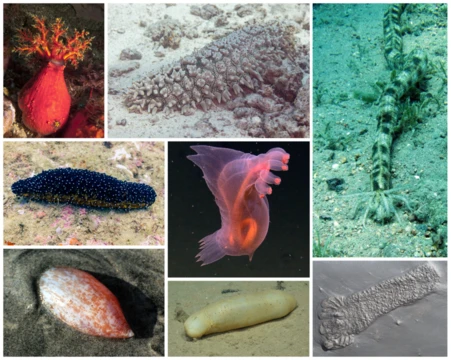
Elpidia glacialis
Abyssal sea cucumber found across Arctic and North Atlantic basins.

Elpidia glacialis is a sea cucumber belonging to the family Elpidiidae. It lives on the deep seabed of the Arctic Ocean, the Barents Sea, the Kara Sea, and the North Atlantic Ocean. Swedish zoologist Johan Hjalmar Théel first described the species in 1876, after collecting specimens during an expedition with explorer Adolf Erik Nordenskiöld that aimed to find the Northeast Passage.
In the Greenland Sea, this sea cucumber has been found on the lower continental slope at around 2,700 meters deep, sharing its habitat with the sea lily *Bathycrinus* sp., the sea spider *Ascorhynchus abyssi*, the brachiopod *Waldheimia cranium*, and the zoanthid *Epizoanthus* sp. The sea lily and the sea cucumber were the most common animals there, possibly because echinoderms can adjust their feeding methods based on available food. In the central Arctic Ocean, most large bottom-dwelling animals stayed within specific depth ranges, but *E. glacialis* and the predatory swimming snail *Limacina helicina* were exceptions. In the Canada Basin, the seabed depth was about 3,800 meters. In a canyon in the western Greenland Sea at roughly 3,200 meters deep, *E. glacialis* sometimes reached densities of up to sixty individuals per square meter. It feeds on organic matter in the sediment, and its abundance likely reflects differences in how much food is available there.
Quick Facts
- Taxon
- Elpidia glacialis
Facts from the source article.
Lore & Background
Elpidia glacialis was first described in 1876 by the Swedish zoologist Johan Hjalmar Théel after he had collected specimens while accompanying the explorer Adolf Erik Nordenskiöld on an expedition attempting to find the Northeast Passage. In a study in the Greenland Sea, it occurred on the lower slopes of the continental shelf at depths of about 2,700 metres, alongside the sea lily Bathycrinus sp., the sea spider Ascorhynchus abyssi, the brachiopod Waldheimia cranium and the zoanthid Epizoanthus sp. The sea lily and the sea cucumber were the dominant species present, perhaps because echinoderms can adopt various foraging strategies to suit the availability of food supplies.
In another study, in the central Arctic Ocean, most of the megafauna was only found within a certain range of depths, the only exceptions being E. glacialis and the predatory swimming snail Limacina helicina. The depth of the seabed in the study area of the Canada Basin was about 3,800 metres. A further study in a canyon in the western part of the Greenland Sea at a depth of about 3,200 metres found E. glacialis sometimes present with an abundance of up to sixty individuals per 1 square metre. It is a deposit feeder and its abundance may reflect differences in the availability of food in the sediment.
Reader's Guide
Elpidia glacialis holds significance as a dominant megafaunal species in abyssal Arctic and North Atlantic habitats, particularly on the lower continental slope of the Greenland Sea at about 2,700 metres depth, where it co-occurs with other echinoderms, brachiopods, and zoanthids. Its dominance alongside the sea lily Bathycrinus sp. suggests that echinoderms may have flexible foraging strategies that allow them to thrive in food-limited deep-sea environments. In the central Arctic Ocean, E. glacialis is one of only two megafaunal species found across a wide depth range, the other being the predatory swimming snail Limacina helicina, indicating a broad ecological tolerance. Its abundance can reach up to sixty individuals per square metre in certain canyons of the Greenland Sea at about 3,200 metres depth, a density that may reflect local variations in sediment food availability. As a deposit feeder, its distribution and abundance are tied to the organic content of the seabed. The species was first collected during an expedition to find the Northeast Passage, linking its discovery to a historic Arctic exploration effort.
Did You Know?
- Elpidia glacialis was first described in 1876 by Swedish zoologist Johan Hjalmar Théel.
- It is one of only two megafaunal species found across a wide depth range in the central Arctic Ocean, the other being the snail Limacina helicina.
- In a canyon in the western Greenland Sea, its abundance reached up to sixty individuals per square metre.
More in Sea Cucumbers and Brittle Stars, Part 2 1-24
Spotted an error? Know more?
Reader corrections go straight into our review queue. Suggest an edit · How this site is sourced