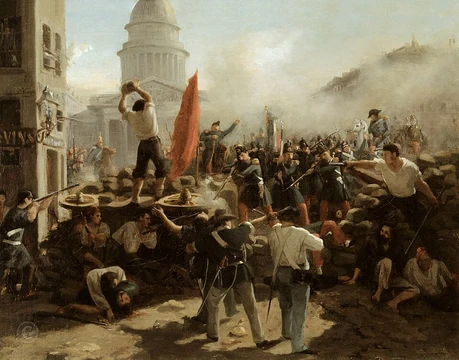
Russian Revolution
The Russian Revolution: a period of political and social change that abolished the monarchy and established the first lasting socialist state.
Last updated

via Wikipedia: Russian Revolution of 1905 · see source
The upheaval known as the Russian Revolution began in 1917 and transformed the country’s political and social landscape. Over the course of two revolutions and a civil war, Russia ended its monarchy and established a socialist system. This event set the stage for later uprisings after World War I, like the one in Germany from 1918 to 1919, and is considered a major turning point of the 20th century. The revolution started with the February Revolution in 1917, during World War I. Russia’s army was suffering defeats by Germany, and shortages of bread and grain—made worse by logistical failures—were draining morale.
Mutinies were becoming likely. Officials believed that if Tsar Nicholas II stepped down, the unrest might calm. He abdicated, and a provisional government, formed by the Duma (the parliament), took over. At the same time, local councils called Soviets emerged in Petrograd (now Saint Petersburg).
Initially, these Soviets did not challenge the new government, but they insisted on having a say in governance and control over local militias. By March, Russia had two competing authorities: the Provisional Government handled military and foreign affairs, while the network of Soviets managed domestic matters. Crucially, the Soviets had the loyalty of workers and the urban middle class. Strikes, protests, and mutinies were widespread.
Dual power: Dvoyevlastiye
Various leftist groups—including Mensheviks, Socialist Revolutionaries, Anarchists, and the Bolsheviks, a far-left party led by Vladimir Lenin—vied for influence within both the government and the Soviets. The Bolsheviks gained popularity by promising peace, land, and bread: ending the war, giving land to peasants, and stopping famine. The Provisional Government, however, kept fighting the war despite public opposition. The Bolsheviks and other factions used this to build support.
When the government cracked down on protesters in Petrograd during the July Days, the Bolsheviks merged loyal workers’ militias into the Red Guards. Tensions peaked with the October Revolution, an armed Bolshevik uprising in Petrograd that toppled the Provisional Government. The Bolsheviks then formed their own government and declared the Russian Soviet Federative Socialist Republic (RSFSR). German military pressure forced them to move the capital to Moscow.
The RSFSR began turning the old empire into the world’s first socialist state, aiming to practice soviet democracy nationally and internationally. They kept their promise to exit World War I by signing the Treaty of Brest-Litovsk with Germany in March 1918. To suppress opposition, the Bolsheviks created the Cheka, a secret police that carried out the Red Terror—targeting and eliminating those deemed “enemies of the people.” Though the Bolsheviks had strong urban support, they faced enemies at home and abroad who rejected their rule.
Russian Civil War
A bloody civil war broke out between the Reds (Bolsheviks) and various opponents: nationalist movements, anti-Bolshevik socialists, anarchists, monarchists, and liberals. The latter two groups largely backed the White movement, led by right-leaning officers who wanted to restore the imperial order. Bolshevik commissar Leon Trotsky organized loyal workers’ militias into the Red Army. Fighting raged not only in Moscow and Petrograd but in every city, including provinces of national minorities, while peasants in rural areas seized and redistributed land.
Historiography
As the civil war progressed, the RSFSR extended Soviet power into Armenia, Azerbaijan, Byelorussia, Georgia, and Ukraine. Wartime unity and foreign intervention pushed these nations to unify under one flag, forming the Soviet Union. Historians mark the revolution’s end in 1922, when the civil war concluded with the defeat of the White Army and separatist groups, prompting mass emigration. The victorious Bolshevik Party renamed itself the All-Union Communist Party (Bolsheviks) and held power for six decades.
The 1905 Russian Revolution helped set the stage for 1917. Bloody Sunday sparked nationwide protests and soldier mutinies, leading to the creation of the St. Petersburg Soviet, a workers’ council. Though the 1905 uprising was crushed and its leaders arrested, it laid the groundwork for the later Petrograd Soviet and other revolutionary movements. It also forced the creation of a Duma, which later formed the Provisional Government after February 1917.
Background
Russia’s poor performance in 1914–1915 fueled growing complaints against Tsar Nicholas II and his family. A brief wave of patriotic nationalism faded as defeats and harsh conditions on the Eastern Front mounted. The Tsar worsened matters by taking personal command of the army in 1915—a role beyond his abilities—making him personally blamed for losses. Meanwhile, Tsarina Alexandra, who ruled while he was at the front, was German-born, stirring suspicions of collusion, further inflamed by rumors about her.
Lore & Background
The Russian Revolution was inaugurated with the February Revolution in 1917, in the midst of World War I. With the German Empire inflicting defeats on the front, and increasing logistical problems causing shortages of bread and grain, the Russian Army was losing morale, with large scale mutiny looming. Officials were convinced that if Tsar Nicholas II abdicated, the unrest would subside. Nicholas stepped down, ushering in a provisional government led by the Duma. During the unrest, Soviet councils were formed by locals in Petrograd that initially did not oppose the new government; however, the Soviets insisted on their influence in the government and control over militias.
By March, Russia had two rival governments. The Provisional Government held state power in military and international affairs, whereas the network of Soviets held domestic power. Critically, the Soviets held the allegiance of the working class, and urban middle class. There were mutinies, protests and strikes.
Socialist and other leftist political organizations competed for influence within the Provisional Government and Soviets. Factions included the Mensheviks, Socialist Revolutionaries, Anarchists, and the Bolsheviks, a far-left party led by Vladimir Lenin. The Bolsheviks won popularity with their program promising peace, land, and bread: an end to the war, land for the peasantry, and ending famine.
After assuming power, the Provisional Government continued fighting the war in spite of public opposition. Taking advantage, the Bolsheviks and other factions gained popular support to advance the revolution. Responding to discontent in Petrograd, the Provisional Government repressed protestors leading to the July Days. The Bolsheviks merged workers' militias loyal to them into the Red Guards.
The volatile situation reached its climax with the October Revolution, a Bolshevik armed insurrection in Petrograd that overthrew the Provisional Government. The Bolsheviks established their own government and proclaimed the establishment of the Russian Soviet Federative Socialist Republic (RSFSR). Under pressure from German military offensives, the Bolsheviks relocated the capital to Moscow. The RSFSR began reorganizing the empire into the world's first socialist state, to practice soviet democracy on a national and international scale.
Reader's Guide
The Russian Revolution of 1905 was a major factor contributing to the cause of the Revolutions of 1917. The events of Bloody Sunday triggered nationwide protests and soldier mutinies. A council of workers called the St. Petersburg Soviet was created in this chaos. While the 1905 Revolution was ultimately crushed, and the leaders of the St. Petersburg Soviet were arrested, this laid the groundwork for the later Petrograd Soviet and other revolutionary movements during the leadup to 1917.
The 1905 Revolution also led to the creation of a Duma that would later form the Provisional Government following February 1917. Russia's poor performance in 1914–1915 prompted growing complaints directed at Tsar Nicholas II and the Romanov family. A short wave of patriotic nationalism ended in the face of defeats and poor conditions on the Eastern Front of World War I. The Tsar made the situation worse by taking personal control of the Imperial Russian Army in 1915, a challenge far beyond his skills. He was now held personally responsible for Russia's continuing defeats and losses.
In addition, Tsarina Alexandra, left to rule while the Tsar commanded at the front, was German born, leading to suspicion of collusion, only to be exacerbated by rumors relating to her relationship with the controversial mystic Grigori Rasputin. Rasputin's influence led to disastrous ministerial appointments and corruption, resulting in a worsening of conditions within Russia. After the entry of the Ottoman Empire on the side of the Central Powers in October 1914, Russia was deprived of a major trade route to the Mediterranean Sea, which worsened the economic crisis and the munitions shortages.
Meanwhile, Germany was able to produce great amounts of munitions whilst constantly fighting on two major battlefronts. The conditions during the war resulted in a devastating loss of morale within the Russian army and the general population of Russia itself. This was particularly apparent in the cities, owing to a lack of food in response to the disruption of agriculture. Food scarcity had become a considerable problem in Russia, but the cause of this did not lie in any failure of the harvests, which had not been significantly altered during wartime.
Frequently Asked Questions
What is the Russian Revolution of 1905?
It was a wave of mass unrest in the Russian Empire that kicked off in January 1905, driven by worker strikes, peasant uprisings, and military mutinies against Tsar Nicholas II's autocratic rule. The movement ultimately compelled the tsar to accept a constitutional monarchy and Russia's first formal constitution in 1906.
What were the main outcomes of the 1905 Russian Revolution?
The revolution forced the creation of the State Duma, a legislative body, and the adoption of the Russian Constitution of 1906, which established a constitutional monarchy. However, many of these gains were gradually eroded by the tsarist government in the years that followed.
Also in the Codexery
More in Revolutions & Uprisings
Sources
Compiled from Wikipedia and the sources listed below. Text from Wikipedia is available under CC BY-SA 4.0; this entry is adapted from it.
- Wikipedia: Russian Revolution (CC BY-SA 4.0).
- Word definitions: the Codexery glossary, each quoted from its Wikipedia article.
Spotted an error? Know more?
Reader corrections go straight into our review queue. Suggest an edit · How this site is sourced