
French Wars of Religion

Edward Baines · Public domain
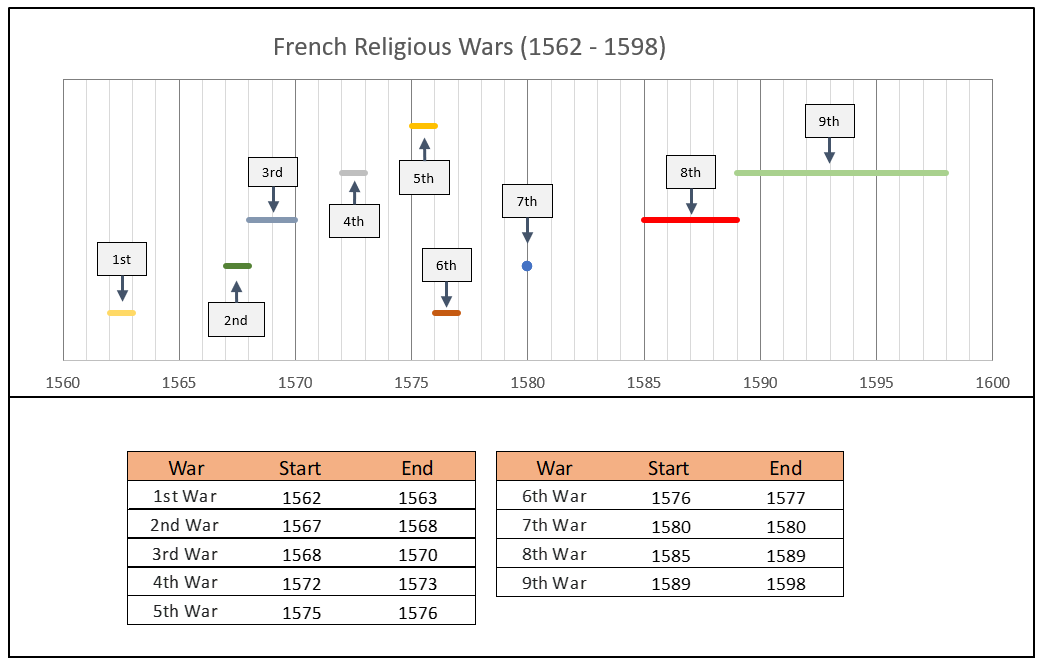
The French Wars of Religion were a series of civil wars fought between French Catholics and Protestant Huguenots from 1562 to 1598. The conflict caused between two and four million deaths from violence, famine, and disease, and severely weakened the French monarchy. The wars ended with a compromise in 1598 when Henry of Navarre, who had converted to Catholicism in 1593, became King Henry IV and issued the Edict of Nantes, granting substantial rights to Huguenots. However, Catholic disapproval of both Protestants and Henry persisted, and his assassination in 1610 sparked further Huguenot rebellions in the 1620s. Religious tensions had been building since the 1530s, deepening existing regional divisions and noble power struggles. The accidental death of Henry II in July 1559 triggered a prolonged power struggle between his widow Catherine de’ Medici and powerful nobles, including a fervently Catholic faction led by the Guise and Montmorency families, and Protestants led by the House of Condé and Queen Jeanne d’Albret of Navarre. Both sides received foreign support: Spain and Savoy backed the Catholics, while England and the Dutch Republic aided the Protestants. Moderates, or Politiques, sought order through centralization and concessions to Huguenots, a stance initially supported by Catherine de’ Medici. Her Edict of Saint-Germain in January 1562 was strongly opposed by the Guise faction, leading to widespread fighting in March. She later hardened her position and supported the 1572 St. Bartholomew’s Day massacre in Paris, where Catholic mobs killed between 5,000 and 30,000 Protestants across France. The wars threatened the authority of the last Valois kings—Francis II, Charles IX, and Henry III—and their Bourbon successor Henry IV responded by creating a strong central state and extending toleration to Huguenots, a policy that lasted until Louis XIV revoked the Edict of Nantes in 1685.
- field
- Civil wars
- nationality
- French
- known_for
- Series of civil wars between Catholics and Huguenots, ending with the Edict of Nantes
Lore & Background
The French Wars of Religion were a series of civil wars fought between French Catholics and Protestant Huguenots, lasting from 1562 to 1598. The conflict resulted in an estimated two to four million deaths from violence, famine, and disease, and severely weakened the French monarchy. The wars ended with a compromise in 1598 when Henry of Navarre, who had converted to Catholicism in 1593, became King Henry IV and issued the Edict of Nantes, granting substantial rights to Huguenots. However, Catholic disapproval persisted, and Henry’s 1610 assassination sparked further Huguenot rebellions in the 1620s. Religious tensions had been escalating since the 1530s, deepening existing regional divisions and noble power struggles. The accidental death of Henry II in 1559 triggered a power struggle between his widow Catherine de’ Medici and powerful nobles, including the Catholic Guise and Montmorency families and the Protestant House of Condé and Queen Jeanne d’Albret of Navarre. External powers intervened: Spain and Savoy aided Catholics, while England and the Dutch Republic backed Protestants. Moderates, or Politiques, sought order through centralization and Huguenot concessions, initially supported by Catherine. Her 1562 Edict of Saint-Germain provoked the Guise faction, leading to widespread fighting in March. Catherine later hardened her stance, backing the 1572 St. Bartholomew’s Day massacre, in which Catholic mobs killed between 5,000 and 30,000 Protestants across France. The wars threatened the last Valois kings—Francis II, Charles IX, and Henry III—and their Bourbon successor Henry IV responded by strengthening the central state and extending toleration, a policy lasting until 1685 when his grandson Louis XIV revoked the Edict of Nantes.
Reader's Guide
The wars severely weakened the French monarchy, as the last Valois kings—Francis II, Charles IX, and Henry III—struggled to maintain control amid factional violence. The conflict arose from long-building religious tensions since the 1530s, which worsened existing regional divisions and noble power struggles. After Henry II’s accidental death in 1559, a power struggle erupted between his widow Catherine de’ Medici and rival noble factions: the Catholic Guise and Montmorency families, and the Protestant House of Condé and Queen Jeanne d’Albret of Navarre. Both sides received foreign support, with Spain and Savoy aiding Catholics, while England and the Dutch Republic backed Huguenots. Moderates called Politiques sought central authority and concessions to Huguenots, a stance Catherine initially supported with the Edict of Saint-Germain in 1562, but opposition from the Guise faction sparked widespread fighting. Catherine later hardened her position, backing the 1572 St. Bartholomew’s Day massacre, in which Catholic mobs killed thousands of Protestants in Paris and elsewhere. The wars ended with a compromise in 1598, when Henry of Navarre, who converted to Catholicism in 1593, became Henry IV and issued the Edict of Nantes, granting substantial rights to Huguenots. However, Catholic disapproval persisted, and Henry’s 1610 assassination triggered further Huguenot rebellions in the 1620s. The monarchy’s authority was ultimately restored by Henry IV’s creation of a strong central state, and toleration for Huguenots lasted until Louis XIV revoked the Edict of Nantes in 1685.
Did You Know?
- Between two and four million people died from violence, famine or disease directly caused by the conflict.
- The wars are also known as the 'Eight Wars of Religion' or simply the 'Wars of Religion' within France.
Gallery

Frequently Asked Questions
What are the French Wars of Religion?
A series of civil wars fought in France between Catholic and Protestant Huguenot factions, spanning roughly 1562 to 1598. The conflicts were driven by deep religious division intertwined with noble power struggles over the French crown.
How many people died in the French Wars of Religion?
Between two and four million people lost their lives to violence, famine, and disease directly tied to the conflict. That death toll makes it one of the deadliest internal upheavals in early modern Europe.
How did the French Wars of Religion end?
Henry IV issued the Edict of Nantes in 1598, granting Huguenots limited religious and civil rights and effectively halting the cycle of sectarian warfare. The settlement also left the French monarchy significantly stronger and more centralized.
Who were the main factions in the French Wars of Religion?
Catholic forces, frequently backed by the powerful Guise family, clashed with Protestant Huguenots led by Bourbon princes such as Condé and later Henry of Navarre. Both sides also pulled in foreign allies, with Spain and England each intervening at various points.
Why are the French Wars of Religion historically important?
The wars ended with the monarchy greatly consolidated under Henry IV, curbing the political power of rival noble houses. They also set an early European precedent for state-managed religious coexistence through the Edict of Nantes.
More in Revolutions And Conflicts 1-20
Spotted an error? Know more?
This is a living reference — every entry is fact-audited, and reader corrections feed straight into our audit queue. Suggest an edit · See this site's audit record