Devils Tower
First U.S. national monument, sacred to several Native American tribes.
Last updated
Where it is
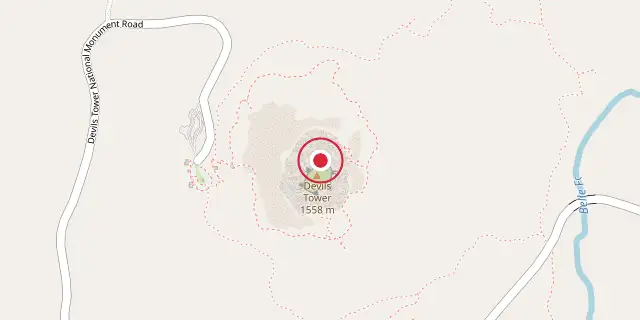
Coordinates: 44°35′28″N 104°42′54″W (44.5910, -104.7150) · Open in OpenStreetMap
Coordinates and connected clubs: the infobox of Wikipedia: Devils Tower (CC BY-SA 4.0). Map: drawn by Codexery from OpenStreetMap tiles.
Devils Tower, also known as Matȟó Thípila or Bear Lodge, is a laccolithic butte of igneous rock in the Bear Lodge Ranger District of the Black Hills, northeastern Wyoming. It rises 1,267 feet above the Belle Fourche River and stands 867 feet from summit to base, with its summit at 5,112 feet above sea level.
Name
Indigenous names for the monolith include Bear's House, Bear's Lodge, Bear's Tipi, Home of the Bear, Bear's Lair; in Cheyenne, Matȟó Thípila and Daxpitcheeaasáao (Home of Bears); Aloft on a Rock (Kiowa); Tree Rock; Great Gray Horn; and Brown Buffalo Horn (Ptehé Ǧí). The name "Devil's Tower" originated in 1875 during an expedition led by Colonel Richard Irving Dodge, when his interpreter reportedly misinterpreted a native name to mean "Bad God's Tower".
All information signs in that area use the name "Devils Tower", following a geographic naming standard that omits the apostrophe. In 2005, a proposal to recognize several indigenous ties through the additional designation of Bear Lodge National Historic Landmark was opposed by Representative Barbara Cubin, who argued that a name change would harm tourist trade. In November 2014, Arvol Looking Horse proposed renaming the feature "Bear Lodge" and submitted the request to the United States Board on Geographic Names.
A second proposal requested that the U.S. acknowledge the "offensive" mistake in keeping the current name and rename the monument and sacred site into Bear Lodge National Historic Landmark. The formal public comment period ended in fall 2015. Local state senator Ogden Driskill opposed the change. The name was not changed.
Geology
The area around Devils Tower is mostly made of sedimentary rock. The oldest rocks visible in the monument were deposited in a shallow sea during the Triassic period. These are dark red sandstone and maroon siltstone mixed with shale, known as the Spearfish Formation, and their red color comes from oxidized iron. You can see them along the Belle Fourche River.
Above that lies a thin white gypsum layer called the Gypsum Springs Formation, from the Jurassic period, which is topped by the Sundance Formation. Around 56 to 66 million years ago, during the Paleocene, the Rocky Mountains and Black Hills were pushed up, and magma forced its way into the existing sedimentary rock layers. In the late 1800s, geologists Carpenter and Russell studied the tower and decided it was an igneous intrusion. In 1907, Nelson Horatio Darton and C.C. O'Harra suggested it was the eroded remains of a laccolith.
The tower itself is made of phonolite porphyry, a light to dark gray or greenish-gray rock with noticeable white feldspar crystals, which intruded about 40.5 million years ago. As the magma cooled, it formed mostly hexagonal columns, though some have four, five, or seven sides, reaching up to 20 feet wide and 600 feet tall. Rain and snow keep wearing away the sedimentary rocks around the base, exposing more of the tower, while the tower itself also erodes.
Water and ice work on cracks in the columns, causing pieces or whole columns to break off and fall. Piles of broken columns, boulders, and stones, called scree, sit at the base, showing the tower was once wider. The Missouri Buttes, which are geologically related, lie 3.5 miles northwest.
Native American cultural beliefs
Devils Tower is the setting for several traditional Native American stories that explain its unusual shape and markings. In one story told by the Kiowa and Lakota, a group of girls were playing when giant bears began chasing them. The girls climbed onto a rock and prayed to the Great Spirit for help. In response, the Great Spirit caused the rock to rise high into the sky, lifting the girls out of reach.
The bears tried to climb the now-steep sides, leaving deep scratch marks that can still be seen on the tower today. The girls themselves were transformed into the stars of the Pleiades. A different version from the Sioux tells of two boys who wandered far from their village. A massive bear named Mato, with claws as long as tipi poles, spotted them and wanted to eat them.
As the bear closed in, the boys prayed to Wakan Tanka, the Creator, who lifted them up on a huge rock. Mato tried to climb from every side, leaving enormous scratch marks, but eventually gave up and wandered away, discouraged. He came to rest east of the Black Hills at a place now called Bear Butte. An eagle named Wanblee then helped the boys down and returned them to their village.
A painting of this legend by Herbert A. Collins hangs in the visitor center at Devils Tower. In a Cheyenne version, a giant bear chased and killed most of a group of girls. Two sisters escaped home, but the bear followed them. They told two boys that the only way to kill the bear was with an arrow shot through the bottom of its foot.
The boys had the sisters lead the bear to Devils Tower and trick it into thinking the sisters had climbed the rock. As the bear repeatedly tried to climb and slid back down, leaving more claw marks, the boys shot arrows at its foot. The bear finally fled when an arrow came very close to its left foot. That last arrow kept going upward and never came back down.
Climbing
By the mid-1990s, climbing at Devils Tower was on the rise. Of the roughly 400,000 people who visited the monument each year, about 1.3% took to the rock, most using traditional methods. The very first climb happened on July 4, 1893, when two local ranchers, William Rogers and Willard Ripley, hammered wooden pegs into cracks to build a ladder. Some of those pegs still remain and can be spotted from the 1.3-mile Tower Trail.
For the next three decades, climbers used that ladder until it fell apart. The first modern-style ascent came in 1937, led by Fritz Wiessner with William P. House and Lawrence Coveney. Wiessner climbed almost entirely free, placing just one piton—a piece of gear he later thought was unnecessary. In 1941, George Hopkins parachuted onto the tower without permission as part of a bet and a publicity stunt.
He planned to descend using a 1,000-foot rope dropped to him, but the package with the rope, sledgehammer, and car axle slid off the edge. A second drop failed when the rope got tangled and frozen in rain and wind. Hopkins spent six days stranded, enduring cold, rain, and 50 mph winds, until a rescue team led by Jack Durrance—who had climbed the tower in 1938—brought him down. The media covered the whole ordeal heavily.
Today, hundreds of climbers tackle the tower each summer. The most popular path is the Durrance Route, established in 1938. Routes now cover every side, following vertical cracks and columns, with difficulty ranging from easy to world-class. Climbers must check in with a ranger before and after their climb, and no one is allowed to camp overnight on the summit.
Did You Know?
- The 1977 movie Close Encounters of the Third Kind used the formation as a plot element and location, leading to a large increase in visitors and climbers.
- Fur trappers may have visited Devils Tower but left no written evidence of having done so.
- The first documented nonindigenous visitors were members of Captain William F. Raynolds's 1859 expedition to Yellowstone.
More in Religious Places of the Indigenous Peoples of North America
Sources
Compiled from Wikipedia and the sources listed below. Text from Wikipedia is available under CC BY-SA 4.0; this entry is adapted from it.
- Wikipedia: Devils Tower (CC BY-SA 4.0).
Spotted an error? Know more?
Reader corrections go straight into our review queue. Suggest an edit · How this site is sourced