Bear Butte
Sacred laccolith and pilgrimage site for Plains tribes.
Last updated
Where it is
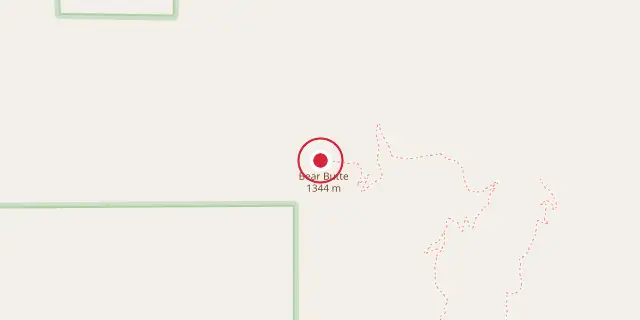
Coordinates: 44°28′34″N 103°25′37″W (44.4760, -103.4270) · Open in OpenStreetMap
Coordinates and connected clubs: the infobox of Wikipedia: Bear Butte (CC BY-SA 4.0). Map: drawn by Codexery from OpenStreetMap tiles.
Bear Butte is a laccolith near Sturgis, South Dakota, that became a State Park in 1961. It is a sacred site for Plains Indians tribes, known as Matȟó Pahá to the Lakota and Noahȧ-vose or Náhkȯhe-vose to the Cheyenne. The Cheyenne believe Ma'heo'o imparted their religious, political, social, and economic customs to the prophet Sweet Medicine at this location.
Geological history
Bear Butte is a laccolith, not a true butte, formed by magma intruding into crustal rock during the Eocene Epoch in the Black Hills area. The overlying sedimentary layers have largely eroded away, and it is possible magma breached the surface, creating a volcano that has since eroded. The peak rises 1253.5 ft above the plain and reaches 4426 ft above sea level.
Modern history
Human artifacts near Bear Butte date back 10,000 years. The Cheyenne and Lakota have maintained spiritual interest from their earliest recorded history. Notable pilgrims included Red Cloud, Crazy Horse, and Sitting Bull. In 1857, a council of many Indian nations gathered there to discuss white settlement in the Black Hills.
George Armstrong Custer camped near Bear Butte during his 1874 expedition, which violated an 1868 treaty and confirmed gold in the Black Hills, triggering a rush of prospectors. The government later reneged on treaty obligations and confined Plains tribes to reservations. Ezra Bovee homesteaded the southern slopes; by spring 1945, the Northern Cheyenne received permission from Bovee to hold a ceremony praying for the end of World War II. The Bovee family encouraged native ceremonies.
Lakota ceremonial chief Frank Fools Crow made pilgrimages there throughout his life, taught racial harmony, and believed the Lakota should never sell the Black Hills. A bust and plaque at the education center honor his efforts.
More in Religious Places of the Indigenous Peoples of North America
Sources
Compiled from Wikipedia and the sources listed below. Text from Wikipedia is available under CC BY-SA 4.0; this entry is adapted from it.
- Wikipedia: Bear Butte (CC BY-SA 4.0).
Spotted an error? Know more?
Reader corrections go straight into our review queue. Suggest an edit · How this site is sourced