Mount Diablo
Sacred creation site of California Native American peoples.
Last updated
Where it is
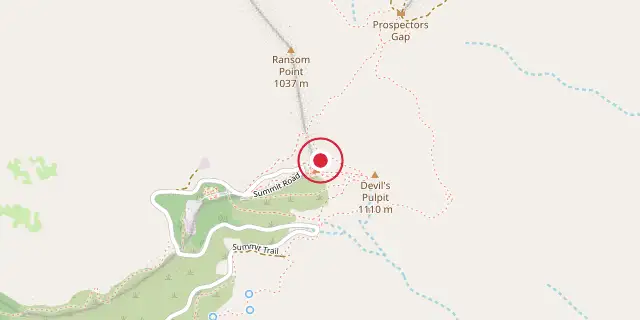
Coordinates: 37°52′55″N 121°54′50″W (37.8820, -121.9140) · Open in OpenStreetMap
Coordinates and connected clubs: the infobox of Wikipedia: Mount Diablo (CC BY-SA 4.0). Map: drawn by Codexery from OpenStreetMap tiles.
It is visible from most of the San Francisco Bay Area and lies within Mount Diablo State Park. The mountain is sacred to many California Native American peoples, who regard it as a point of creation.
Cultural history
Mount Diablo holds deep spiritual significance for several California Native American groups. In Miwok and Ohlone mythology, it was the point of creation. One surviving narrative describes Mount Diablo and Reed's Peak (Mount Tamalpais) as islands surrounded by water; from these the creator Coyote and his assistant Eagle-man made Native American people and the world. Another account tells of Molok the Condor bringing forth his grandson Wek-Wek the Falcon Hero from within the mountain.
The name Kawukum or Kahwookum has been suggested as an early Native American name, but historian Bev Ortiz and Save Mount Diablo state that this name was invented in 1866 with no real Native American connection, later used as a real estate gimmick in 1916. The peak lay within the homeland of the Volvon (also spelled Wolwon, Bolbon or Bolgon), a Bay Miwok–speaking tribe. Spanish colonists called it Cerro Alto de los Bolbones or Sierra de los Bolgones as early as 1811.
The conventional view holds that the mountain's current name derives from a 1805 nighttime escape of Chupcan Native Americans aided by mysterious lights, with an 1850 report by General Mariano G. Vallejo interpreting the native word puy as meaning 'devil.' By 1824 the region north of the mountain was called Monte del Diablo, meaning 'devil's thicket,' and later U.S. settlers applied the name to the mountain itself, with 'Mount Diablo' becoming official in 1850.
Natural history
The mountain's geology includes the Mount Diablo Ophiolite, ancient oceanic crust from the Coast Range Ophiolite formed near the end of the Jurassic. This ophiolite underlies the area north of a line from Long Ridge through Murchio Gap and contains basalt, diabase, and serpentinite. The Franciscan Complex underlies the summit and North Peak; it is an accretionary complex formed in an east-dipping subduction zone, composed of pillow basalt, chert, graywacke, shale, and other materials scraped off during subduction.
These rocks were mixed, partially subducted, and later uplifted. The contact between the Franciscan Complex and the Coast Range Ophiolite is a fault plane known as the Coast Range Fault. The Great Valley Group consists of sedimentary rocks deposited underwater between the Upper Jurassic and Cretaceous. The Mount Diablo area was intermittently submerged into the Pliocene and was uplifted during the Tertiary Period.
Art and literature
Mount Diablo has inspired numerous artists and writers. Early works centered on exploration and surveying, linked to the rise of tourism in the Pacific west. Themes were shaped by early tourism promoters, preservation efforts, and the environmental movement. Artists associated with the University of California, Berkeley, the California College of Arts, and organizations such as Save Mount Diablo and the Mount Diablo Interpretive Association have contributed.
Modern representation is strong in plein aire painting, especially the group Artists for Action, and photography. Writers include William Brewer, Richard Henry Dana Jr., Alexandre Dumas père, Bret Harte, Thomas Starr King, and Mark Allen Cunningham. Poets include Philip Lamantia, Andrew Schelling, and Helen Pinkerton. Early painters include Thomas Almond Ayres, William Keith, and Henry Miller, among many others.
Photographers include Ansel Adams, Cleet Carlton, and Alfred A. Hart. Musical works range from the Kronos Quartet to commissioned pieces by the California Symphony, and the pop-punk band The Story So Far has a song titled 'Mt. Diablo.' The mountain's name is the source for the 'Devils' part of the Blue Devils Drum and Bugle Corps, founded in Concord, California in 1957.
Events
Each fall, male tarantulas emerge from their burrows on Mount Diablo to seek mates, a phenomenon called the March of the Tarantulas, which can begin as early as August and last through October; the Mount Diablo Interpretive Association offers guided hikes. Since 1964, Pearl Harbor survivors and their families have memorialized Pearl Harbor Day by relighting the historic Beacon atop the summit, with a ceremony at the Cal State East Bay Concord Campus.
Under cloudless conditions, the mountain's shadow can be seen progressing across the California Central Valley to the distant Sierra Nevada. In April 1946, an Army C-45 transport plane crashed on the north side, killing both pilots. Save Mount Diablo sponsors spring and fall event schedules, including Spring on Diablo, Autumn on Diablo, Moonlight on the Mountain, Four Days Diablo, the Mount Diablo Challenge (an annual hill climb with over 1,100 cyclists each October), and the Mount Diablo Trail Adventure.
The park is popular in winter when snow falls, as occurred in February 2001 and February and March 2006; in March 2006 the summit received about six inches of snow.
Did You Know?
- On a clear day, eight bridges are visible from the summit: San Mateo, Bay, Golden Gate, San Rafael, Carquinez, Benicia, Antioch, and Rio Vista.
- The mountain has 520 miles of hiking and equestrian trails, some available for mountain biking.
- The Mary Bowerman Trail is a level wheelchair-accessible path with interpretive stations.
More in Religious Places of the Indigenous Peoples of North America
Sources
Compiled from Wikipedia and the sources listed below. Text from Wikipedia is available under CC BY-SA 4.0; this entry is adapted from it.
- Wikipedia: Mount Diablo (CC BY-SA 4.0).
Spotted an error? Know more?
Reader corrections go straight into our review queue. Suggest an edit · How this site is sourced