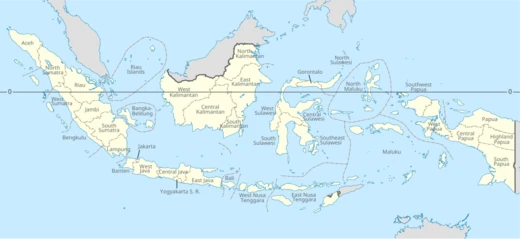
North Sumatra
Province of Sumatra, site of ancient supervolcano and diverse cultures.

via Wikipedia: North Sumatra · see source
North Sumatra is an Indonesian province occupying the northern portion of Sumatra island. Its administrative seat and biggest city is Medan, situated on the island’s eastern coastline. By 2020, the province counted roughly 14.8 million residents; a mid-2025 estimate places that figure at about 15.8 million, with an annual increase of around 200,000 people. This makes North Sumatra the fourth most populous province in Indonesia and the most populous one outside Java. Covering 72,437.755 square kilometers, it is the third-largest province on Sumatra. Its borders include Aceh to the northwest, Riau to the southeast, West Sumatra to the south, the Indian Ocean to the west, and the Strait of Malacca to the east, where it shares a maritime boundary with Malaysia. The province is ethnically diverse: the Malay are native to the east coast; various Batak groups inhabit the west coast and central highlands; the Nias people live on Nias Island and its surrounding islets; and Chinese, Javanese, and Indian communities arrived during Dutch colonial rule. The province contains the Toba supervolcano, which sits beneath what is now Lake Toba. That volcano erupted between 74,000 and 75,000 years ago—a VEI-8 event—and the eruption nearly wiped out the entire human population at the time, also forming Lake Toba in the process. Historically, under Dutch administration, the entire island of Sumatra was governed from Medan as the Gouvernement van Sumatra. After Indonesia’s independence, the province of Sumatra was divided into three sub-provinces in 1948, each with self-governing authority. April 15 is commemorated as the founding anniversary of North Sumatra province. Prehistoric evidence suggests the earliest inhabitants were Austronesian or Melanesian peoples who arrived during the Mesolithic era, leaving shell deposits along rivers and coasts. Later, Deutero Malays settled on the coast, living by fishing and agriculture. The Batak likely descended from Austronesian speakers who reached Sumatra about 2,500 years ago, while the Nias people’s ancestors arrived from Taiwan via the Philippines 4,000 to 5,000 years ago. The eastern coast hosted early kingdoms like the Aru Kingdom, a maritime power from the 13th to 16th centuries, and the Panai Kingdom, while the western port of Barus attracted traders for its camphor.
- capital
- Medan
- population_2020
- ~14.8 million
- population_2025_estimate
- ~15.8 million
- area
- 72,437.755 km²
- major_ethnic_groups
- Malay, Batak, Nias, Chinese, Javanese, Indian
- notable_feature
- Toba supervolcano and Lake Toba
Verified Timeline
Lore & Background
Archaeological understanding of early North Sumatran peoples is limited compared to that of other nearby regions. Prehistoric relics show that the oldest population may have been Austronesian or Melanesian, with evidence of their dispersal taking place in the Mesolithic era. Early peoples consumed mostly snails and clams, leaving large shell deposits sometimes referred to as kjokkenmoddinger, some of which are still found as hills in Saentis, Hinai, Tanjung Beringin, along the Deli-Langkat shore, and on riverbanks. In the second wave of migration from mainland Southeast Asia c. 1000 BC, the Young Malays or Deutero Malays settled on the coast, living mainly by fishing and cultivating marshy land. Linguistic and archaeological evidence indicates that Austronesian speakers reached Sumatra from Taiwan and the Philippines through Borneo or Java about 2,500 years ago, and the Batak probably descended from these settlers. New genetic research has found that the Nias people also came from the Austronesian peoples, though their initial ancestors may have arrived earlier: ancestors of the Nias people are thought to have come from Taiwan through the Philippines 4,000 to 5,000 years ago. The eastern coast of North Sumatra, bordering the Strait of Malacca, has been widely visited by Hindus and by Chinese traders for centuries since the founding of early Situs Kota Cina or Chinatown sites in Hamparan Perak c. 11th–14th centuries AD. The earliest kingdom on the eastern coast was the Aru Kingdom, which existed from the 13th to the 16th century AD. In its height, the kingdom was a maritime power and controlled the northern part of the Malacca strait. The kingdom was initially established as a Karo polity. An area near Lake Toba called Batakland housed kingdoms of Batak people, first mentioned in Zhao Rugua's 13th-century Description of the Barbarous Peoples. The Toba people divided the Batak Lands into several independent kingdoms, with Bakkara and their king or Sisingamangaraja holding the most leverage due to customs and traditions which consider Bakkara the place of origin of the Batak people. During Dutch rule, North Sumatra was administered under the Gouvernement van Sumatra, which governed the entire island of Sumatra out of Medan. In 1948, after Indonesian independence was proclaimed, Sumatra Province was divided into three sub-provinces, each of which had the right to regulate and manage its own affairs. The 15th of April was later designated as the anniversary of the founding of the province of North Sumatra.
Reader's Guide
North Sumatra holds significance as a province that bridges ancient human migration, volcanic catastrophe, and colonial trade dynamics. The Toba supereruption, rated VEI-8, is one of the largest known volcanic events, drastically affecting human population history. The province's ethnic diversity—including Malay, Batak, Nias, Chinese, Javanese, and Indian groups—reflects millennia of migration and trade along the Strait of Malacca. Its early kingdoms, such as Aru and the Batak kingdoms, illustrate the region's political complexity before and during European colonial influence. The Dutch and British competition for pepper and other goods shaped the area's economic integration into global networks. Today, North Sumatra remains Indonesia's most populous province outside Java, with a growing population and a capital, Medan, that was the administrative center for the entire island of Sumatra under Dutch rule. Its archaeological and linguistic records provide key insights into Austronesian dispersal and early Southeast Asian societies.
Did You Know?
- The Toba supervolcano erupted 74,000–75,000 years ago, wiping out nearly all of humanity, and was rated a VEI-8 eruption.
- The Batak probably descended from Austronesian speakers who reached Sumatra from Taiwan and the Philippines through Borneo or Java about 2,500 years ago.
- The Nias people's ancestors are thought to have come from Taiwan through the Philippines 4,000 to 5,000 years ago, based on genetic research involving blood samples of 440 Nias people.
- The earliest kingdom on the eastern coast of North Sumatra was the Aru Kingdom, which existed from the 13th to the 16th century AD and initially was established as a Karo polity.
- During Dutch rule, the Gouvernement van Sumatra governed the entire island of Sumatra out of Medan.
Frequently Asked Questions
Who is North Sumatra?
North Sumatra is a province in the northern part of Sumatra, Indonesia, with Medan on the east coast serving as both its capital and largest city. As of a mid-2025 estimate it is home to roughly 15.8 million people, making it the most populous province on the island outside Java.
What are North Sumatra's powers/role?
The province sits atop the Toba supervolcano, whose VEI-8 blast around 74,000–75,000 years ago carved out Lake Toba and nearly eliminated the human species. Culturally, it functions as a crossroads of Malay, Batak, Nias, Chinese, Javanese, and Indian communities spread across roughly 72,438 square kilometers.
How does North Sumatra's story end?
There is no single 'ending' for a living province, but its most dramatic chapter is the Toba eruption, after which the caldera filled to form one of the world's largest volcanic lakes. Today that same landscape anchors the region's identity, tourism, and ecological significance.
Why is North Sumatra important?
It holds the distinction of being Indonesia's fourth-most-populous province and the largest one outside Java, so it carries outsized demographic and economic weight. Pair that with hosting a supervolcano whose last eruption reshaped the planet, and North Sumatra becomes a key node in both national and global narratives.
Where exactly is North Sumatra on the map?
It occupies the northernmost stretch of the island of Sumatra, bordering the Strait of Malacca to the west and the Karimata Strait to the east. The capital, Medan, sits on the east coast and anchors the province's urban and port infrastructure.
More in Provinces Of Indonesia 1-24
Related in Provinces Of Indonesia
Links follow this subject's own source article.
Spotted an error? Know more?
This is a living reference — every entry is fact-audited, and reader corrections feed straight into our audit queue. Suggest an edit · See this site's audit record