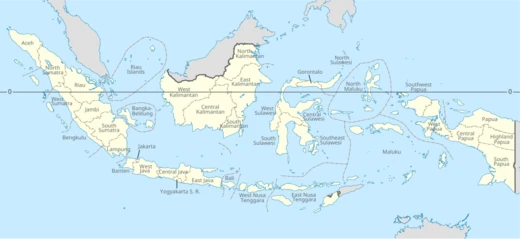
North Kalimantan
Province formed in 2012 from East Kalimantan.

via Wikipedia: North Kalimantan · see source
North Kalimantan is a province of Indonesia, occupying the northernmost section of Kalimantan, the Indonesian part of Borneo. It shares borders with the Malaysian states of Sabah to the north and Sarawak to the west, and with the Indonesian province of East Kalimantan to the south. The capital is the town of Tanjung Selor, while Tarakan serves as the province’s only city, its largest urban center, and its financial hub. The province was created on 25 October 2012, when it was split from East Kalimantan with the goals of narrowing development gaps and countering Malaysian influence in the area. Covering 69,901 square kilometres, North Kalimantan comprises four regencies and one city. Its population stood at 524,656 in the 2010 Census and rose to 701,784 by the 2020 Census, making it Indonesia’s least populous province at that time—a status it held until the 2022 creation of South Papua, West Papua, and Southwest Papua. The mid-2025 official estimate placed the population at 749,370, with 393,130 males and 356,240 females. Much of the province remains sparsely inhabited.
Historically, the region was the domain of the Sultanate of Bulungan, founded by a group of coastal Kayan. Around the 16th century, a Kayan princess named Asung Luwan married a visiting Brunei nobleman, Datuk Mencang. Their lineage established a princely state centered in Tanjung Selor, ruling over what are now Bulungan, Tana Tidung, Malinau, Nunukan, Tarakan, and parts of Sabah. Bulungan was a vassal of the Berau Sultanate, which in turn answered to the Kingdom of Kutai. After later conflicts, the territory fell under Brunei’s control and, following agreements with the Sultanate of Sulu, officially came under Sulu’s authority. In 1777, the royal family converted to Islam; King Wira Amir changed his name to Aji Muhammad and took the title Sultan Amirul Mukminin. In 1853, the Dutch imposed a Politiek Contract that asserted sovereignty over the Bulungan kingdom—Sulu, then at war with Spain, could not respond. In 1881, the British North Borneo Company was formed, placing North Borneo (modern Sabah) under British rule and claiming the Tawau region. Under Dutch control, the sultan was forced to cede the Bahau River, Pujungan River, and Apo Kayan areas. After lengthy negotiations with the British, the Dutch recognized the British borders in 1915, which became the modern boundary between Sabah and North Kalimantan. During World War II, Japanese occupiers struck an agreement with Bulungan to share natural resources, and in exchange the region largely avoided the Romusha forced-labor system.
During the Indonesia–Malaysia confrontation in 1963, the Sultanate of Bulungan took an ambiguous stance on Malaysia’s formation. In April 1964, a document was reportedly found linking the Bulungan aristocracy to Malaysia, suggesting they would support Malaysia’s formation and potentially join it. On 24 April 1964, Brigadier General Soeharjo, leader of the Mulawarman regional military command, ordered the capture and killing of Bulungan aristocrats. On 2 July 1964, Lt. B. Simatupang and Captain Buntaran were received cordially by the Sultan. The next day, units of Brawijaya 517 invaded the palace, burning and looting it and killing members of the royal family. According to Burhan Djabier’s 1991 book *East Kalimantan: The Decline of a Commercial Aristocracy*, the central TNI leadership did not act against Soeharjo because he was a known leftist with political connections. Most leftists and the PKI were hostile to royals, drawing parallels to the East Sumatra revolution. The sultanate’s position, as stated by Dato’ Seri Pangeran Sanusi Hussin, holds that the PKI was responsible for the palace burning and ethnic cleansing. Surviving royal family members fled and became Malaysian citizens. In 2017, they announced they were in the process of regaining Indonesian citizenship.
Transportation in the province is served by Tarakan Airport, also called Juwata International Airport, on the island of the same name, along with an international ferry port connecting to Tawau in Malaysia. There are no international land crossings; entering the mainland requires a ferry from Tarakan or road access from the south. Large sections of the province’s roads remain unpaved muddy ditches. The airport’s runway and apron are shared with Suharnoko Harbani Air Force Base, a Type A base of the Indonesian Air Force. Named after a former Minister of Industry and Air Force officer, the base was established in 2006 as part of national defense strategy, particularly in response to tensions with Malaysia over Ambalat. Before the base’s formation, an Air Force post existed under the Balikpapan Air Force Base. Because the airport serves both military and civilian aviation, the apron is shared. In July 2014, airport authorities began building a 183-meter taxiway to the military apron, designed to accommodate four Sukhoi and two Hercules aircraft simultaneously; the project was expected to finish in December 2014. The Trans-Kalimantan Highway was completed in early 2019 under President Joko Widodo’s administration.
- Capital
- Tanjung Selor
- Largest urban area
- Tarakan
- Formed
- 25 October 2012
- Area
- 69,901 square kilometres
- Population (2020 Census)
- 701,784
- Population (mid 2025 estimate)
- 749,370
- Number of regencies and city
- 4 regencies and 1 city
Verified Timeline
Lore & Background
North Kalimantan is the territory of the Sultanate of Bulungan, which was founded by a group of coastal Kayan. Around the 16th century, a Kayan princess called Asung Luwan married a visiting nobleman from Brunei, called Datuk Mencang. From this line a princely state was established, centered in Tanjung Selor, which ruled territory now comprising Bulungan, Tana Tidung, Malinau, Nunukan, Tarakan, and some part of Sabah. Bulungan was a vassal of the Berau Sultanate, which in turn was a vassal of the Kingdom of Kutai. During subsequent wars, the territory fell into the hands of Brunei and after agreements with the Sultanate of Sulu, the territory officially came under Sulu control. In 1777, the royal family converted to Islam, with the king Wira Amir changing his name to Aji Muhammad, and title to Sultan Amirul Mukminin. In 1853, the Dutch signed a Politiek Contract to impose their sovereignty over the Bulungan kingdom. In 1881, the British North Borneo Company was formed, placing North Borneo (present-day Sabah) under British jurisdiction. After long negotiation with the British, the Dutch recognised the British borders in 1915 which became the modern border between Sabah and North Kalimantan. During World War II, the Japanese occupying forces had an agreement with Bulungan under which they shared natural resources and in exchange the region largely escaped the Romusha system.
Reader's Guide
North Kalimantan's significance lies in its recent formation as a province on 25 October 2012, separated from East Kalimantan to reduce development disparity and Malaysia's influence. Its history is deeply tied to the Sultanate of Bulungan, which experienced the Bultiken Tragedy in 1964 during the Indonesia–Malaysia confrontation. On 24 April 1964, Brigadier General Soeharjo ordered the capture and killing of Bulungan aristocracy. On 3 July 1964, the palace was invaded by units of Brawijaya 517, burned and looted, and members of the royal family killed. The surviving royal family fled and became citizens of Malaysia; in 2017 they announced they were in the process of becoming Indonesian citizens. The province relies on Tarakan Airport (Juwata International Airport) and an international ferry port with services to Malaysia from Tawau. There are no international land crossings. The Trans-Kalimantan Highway was finished in early 2019, connecting Pontianak with Tanjung Selor. The province's coat of arms underwent a redesign under Regional Regulation No. 3/2021, restoring omitted elements and increasing the rice to 25 grains and cotton to 12 bolls, tied with ten twists, symbolizing 25 October 2012, the province's founding date. The province forms one of Indonesia's 84 national electoral districts, electing 3 members to the People's Representative Council.
Did You Know?
- North Kalimantan was the least populous province in Indonesia at the 2020 Census, with 701,784 people, until the creation of South Papua, West Papua, and Southwest Papua in 2022.
- The province's coat of arms features 25 rice grains and 12 cotton bolls tied with ten twists, symbolizing its founding date of 25 October 2012.
- During the Bultiken Tragedy on 3 July 1964, the Sultan of Bulungan's palace was invaded by units of Brawijaya 517, burned and looted, and members of the royal family were killed.
- The Trans-Kalimantan Highway, finished in early 2019 under President Joko Widodo, connects Pontianak in West Kalimantan with Tanjung Selor, the capital of North Kalimantan.
- Tarakan Airport shares its runway and apron with Suharnoko Harbani Air Force Base, a Type A airbase of the Indonesian Air Force formed in 2006.
Frequently Asked Questions
Who is North Kalimantan?
The northernmost province on the island of Borneo, anchored by the capital Tanjung Selor and the larger city of Tarakan, with a population of roughly 750,000 spread across nearly 70,000 square kilometres.
What are North Kalimantan's powers/role?
It occupies Indonesia's northern Borneo coastline, sharing a land border with Malaysia and facing the South China Sea, which makes it a key node for cross-border trade and national territorial sovereignty.
How does North Kalimantan's story end?
There is no ending yet; the province is still actively growing, with its population climbing from the 2020 census count of about 702,000 toward an estimated 749,000 by mid-2025.
Why is North Kalimantan important?
It was split off from East Kalimantan in October 2012 with the explicit goals of narrowing the development gap and pulling the region further away from Malaysian economic and cultural influence.
What's North Kalimantan's origin story?
Before colonial times the area was the homeland of the Sultanate of Bulungan, established by coastal Kayan communities, and later passed under Dutch and then British administration before joining the Republic of Indonesia.
More in Provinces Of Indonesia 1-24
Related in Provinces Of Indonesia
Links follow this subject's own source article.
Spotted an error? Know more?
This is a living reference — every entry is fact-audited, and reader corrections feed straight into our audit queue. Suggest an edit · See this site's audit record