Riau
Indonesian province on Sumatra's east coast, rich in resources and history.

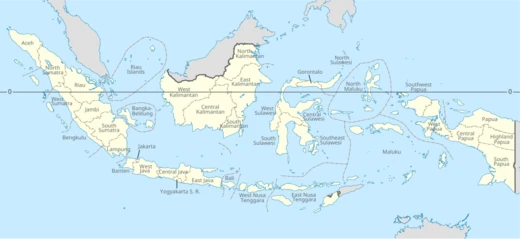
Riau is a province of Indonesia situated on the central eastern coast of Sumatra, stretching from the eastern slopes of the Barisan Mountains to the Malacca Strait and encompassing several large islands within that strait. It shares land borders with North Sumatra to the northwest, West Sumatra to the west, and Jambi to the south, while its maritime borders touch the Riau Islands and Malaysia to the east. As the second-largest province on Sumatra after South Sumatra, it covers a total land area of 69,900.78 square kilometers. Its estimated population in 2025 stands at 6,811,158, with slightly more males than females. The province is divided into ten regencies and two cities, with Pekanbaru serving as both the capital and largest city.
Historically, Riau was part of various monarchies before European colonization. The Buddhist temple complex of Muara Takus, located in Kampar Regency, is believed to be a remnant of the Srivijaya Empire from around the 12th century. After Islam spread in the 14th century, the region fell under the control of the Malay sultanates of Siak Sri Indrapura, Indragiri, and Johor. These sultanates later became Dutch protectorates and puppet states within the Dutch East Indies. Following Indonesia’s independence in 1945, Riau was initially part of the provinces of Sumatra (1945–1948) and Central Sumatra (1948–1957). The province of Riau was officially inaugurated on 10 August 1957 and originally included the Riau Islands until 2004.
Though predominantly considered the land of the Malays, Riau is highly diverse. Malays make up about one-third of the population, with significant communities of Javanese, Minangkabau, Batak, and Chinese peoples. The local Riau dialect of Malay serves as the lingua franca, while standard Indonesian is the official language and a second language for many. Other languages spoken include Minangkabau, Hokkien, and various Batak languages. Riau is one of Indonesia’s wealthiest provinces, rich in natural resources such as petroleum, natural gas, rubber, palm oil, and fibre plantations. However, extensive logging and plantation development have caused a massive decline in forest cover, and associated fires have contributed to regional haze.
- capital
- Pekanbaru
- major_ethnic_groups
- Malay, Javanese, Minangkabau, Batak, Chinese
- official_language
- Indonesian
- natural_resources
- petroleum, natural gas, rubber, palm oil, fibre plantations
Lore & Background
Riau is a province situated on the central eastern coast of Sumatra, stretching from the eastern slopes of the Barisan Mountains to the Malacca Strait and encompassing several large islands within the strait. It is the second-largest province on the island, covering a total land area of 69,900.78 square kilometers. The province shares land borders with North Sumatra to the northwest, West Sumatra to the west, and Jambi to the south, while its maritime border touches the Riau Islands and Malaysia to the east. The capital and largest city is Pekanbaru. Historically, the region was part of the Srivijaya Buddhist empire, evidenced by the Muara Takus temple complex in Kampar Regency, which dates to around the 11th–12th century. Following the spread of Islam in the 14th century, Malay sultanates such as Siak Sri Indrapura, Indragiri, and Johor held sway, later becoming Dutch protectorates. Riau is predominantly Malay but highly diverse, with Javanese, Minangkabau, Batak, and Chinese communities. The local Riau dialect of Malay serves as the lingua franca, while Indonesian is the official language. The province is one of Indonesia’s wealthiest, rich in petroleum, natural gas, rubber, palm oil, and fibre plantations. Extensive logging and plantation development have caused massive forest cover loss and contributed to regional haze.
Reader's Guide
Riau's significance lies in its historical role as a crossroads of Buddhist and Islamic empires, and its modern status as a major economic hub. The province's wealth from petroleum, natural gas, and palm oil has made it one of Indonesia's richest, but extensive logging and plantation development have led to massive forest cover decline and haze. Ethnically diverse, with Malays forming one-third of the population alongside Javanese, Minangkabau, Batak, and Chinese communities, Riau uses the local Malay dialect as a lingua franca while Indonesian serves as the official language. The etymology of 'Riau' is disputed, with possible origins from Portuguese 'rio' (river), Arabic 'riahi' (sea water), or Malay 'riuh' (crowded working people).
Did You Know?
- The Muara Takus temple complex in Kampar Regency is believed to be a remnant of the Buddhist Srivijaya Empire from the 11th-12th century.
Frequently Asked Questions
Who is Riau?
Riau is an Indonesian province sitting on Sumatra's central-eastern coast, stretching from the Barisan Mountains down to the Malacca Strait, with Pekanbaru as its capital. It's home to roughly 6.8 million people drawn from Malay, Javanese, Minangkabau, Batak, and Chinese communities.
What are Riau's powers or role?
Riau's main 'abilities' are its natural resources—petroleum, natural gas, rubber, palm oil, and fibre plantations—which make it one of Indonesia's wealthiest provinces. Its position along the Malacca Strait also gives it a strategic trade-and-shipping role.
How does Riau's story end?
As of the present day, Riau is still very much an active, economically vital province within Indonesia, continuing to extract and export its oil, gas, and agricultural products. Its long arc from the Buddhist Srivijaya Empire through Malay sultanates to modern provincial status is still unfolding rather than wrapped up.
Why is Riau important?
Riau matters because it pairs deep historical roots—Srivijaya, Malay sultanates—with modern economic power from oil and gas, making it a major contributor to Indonesia's national revenue. Its Malacca Strait coastline also ties it directly to global shipping lanes.
More in Provinces Of Indonesia 1-24
Spotted an error? Know more?
This is a living reference — every entry is fact-audited, and reader corrections feed straight into our audit queue. Suggest an edit · See this site's audit record