South Papua
Indonesia's least populous province, formed in 2022 from southern Papua.

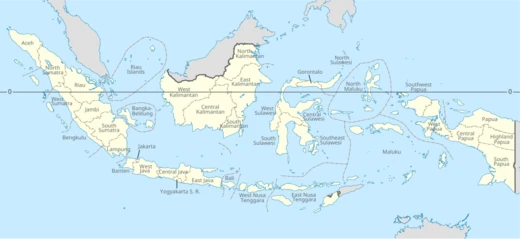
South Papua is an Indonesian province established on 25 July 2022, covering the southern portion of the island of Papua and corresponding to the customary region of Anim Ha. Its land area of roughly 117,849 square kilometers is comparable to the U.S. state of Pennsylvania or Russia’s Kirov Oblast, and about ninety percent the size of England. The province is the least populous in Indonesia, with an estimated mid-2025 population of 549,650. It shares land borders with Papua New Guinea to the east, the Indonesian provinces of Highland Papua and Central Papua to the north and northwest, and faces the Arafura Sea to the west and south, which forms a maritime boundary with Australia. Merauke serves as the economic center, while the administrative seat is the town of Salor, about 60 kilometers northwest of Merauke town.
The landscape is predominantly lowland, featuring extensive swamps and large rivers such as the Digul and Maro. Indigenous groups including the Asmat, Marind, Muyu, and Korowai inhabit the region, relying on sago and fish as staple foods. The Asmat are known for their wood carving and boating culture. Significant numbers of Javanese migrants have arrived through a government transmigration program aimed at converting swamps into rice paddies. Wasur National Park, a vast wetland, hosts rich biodiversity including the agile wallaby, mound-building termites called musamus, and birds of paradise.
Before European contact, indigenous tribes such as the Asmat, Marind, and Wambon lived in the area, maintaining ancestral traditions. The Marind, also called Malind, lived along rivers in the Merauke region, practicing hunting, gathering, and farming, but were notorious for headhunting, traveling by boat to distant settlements to take heads for preservation and celebration. In the 19th century, European powers divided New Guinea, with the west under Dutch control and the east under British control. In 1902, the Dutch established a military base on the Maro River to secure the border and suppress headhunting, naming it Merauke. A Catholic mission was also founded there. During the colonial period, Javanese laborers were brought to cultivate rice, contributing to the town’s growth, which later became the capital of the South New Guinea province.
In the 1920s, the Dutch explored the Digul River and established a remote detention camp called Tanah Merah at Bove
- Capital
- Salor (administrative), Merauke (economic)
Lore & Background
South Papua, officially established on 25 July 2022, is an Indonesian province occupying the southern portion of Papua, corresponding to the customary region of Anim Ha. Its landscape is predominantly lowland, characterized by extensive swamps and massive rivers such as the Digul and Maro. The province covers a land area of 117,849.16 km², comparable in size to Pennsylvania or roughly 90% of England, yet it is the least populous province in Indonesia, with an estimated mid-2025 population of 549,650. It shares land borders with Papua New Guinea to the east, and the Indonesian provinces of Highland Papua and Central Papua to the north and northwest, while facing the Arafura Sea to the west and south, which forms a maritime border with Australia. The economic centre is Merauke, while the administrative centre is the town of Salor, located about 60 km northwest of Merauke. Indigenous ethnic groups include the Asmat, Marind, Muyu, and Korowai, whose staple foods are sago and fish. The Asmat are noted for their wood carving and boating culture. A significant migrant population, particularly Javanese, has arrived through a government transmigration program aimed at converting swamps into rice paddies. The province is home to Wasur National Park, a vast wetland rich in biodiversity, featuring agile wallabies, mound-building termites known as musamus, and birds of paradise.
Reader's Guide
The province is the least populous in Indonesia, with a landscape dominated by lowland swamps and large rivers. Its indigenous cultures, such as the Asmat known for wood carving and boating, and the Marind with their historical headhunting traditions, are central to its identity. The region has been a site of the transmigration program, bringing Javanese migrants to convert swamps into rice paddies. Wasur National Park, a Ramsar wetland, hosts rich biodiversity including agile wallabies, musamus termites, and birds of paradise. The province's name 'South Papua' was chosen over 'Anim Ha' to be inclusive and avoid negative historical connotations.
Did You Know?
- In the 1920s, the Dutch established a concentration camp called Tanah Merah at the headwaters of the Digul River (Boven-Digoel), where Mohammad Hatta and Sutan Sjahrir were detained.
- Wasur National Park, a Ramsar wetland in the province, hosts agile wallabies, musamus termites, and birds of paradise.
Frequently Asked Questions
What is South Papua Province?
South Papua is an Indonesian province occupying the southern portion of the island of Papua, drawn along the boundaries of the Anim Ha customary region. It was formally created on 25 July 2022 as a distinct administrative unit split from the broader Papua province.
What is the capital of South Papua?
The administrative seat sits in the small town of Salor within Kurik District, while the city of Merauke acts as the province's principal economic and commercial hub.
How many people live in South Papua?
With a mid-2025 estimated population of roughly 549,650, South Papua is the least populous province in Indonesia. Its residents are spread across a land area of about 117,849 square kilometres.
Which ethnic groups make up South Papua's population?
The province is home to the Asmat, Marind, Muyu, and Korowai peoples, along with a Javanese community. These groups inhabit a landscape shaped largely by the Digul and Maro river systems.
Why is South Papua significant in Indonesia's provincial map?
As the newest province, established only in 2022, South Papua represents a recent administrative reorganisation of the country's easternmost territory. Its creation gave the Anim Ha customary region a dedicated provincial government for the first time.
More in Provinces Of Indonesia 1-24
Spotted an error? Know more?
This is a living reference — every entry is fact-audited, and reader corrections feed straight into our audit queue. Suggest an edit · See this site's audit record