Yamaguchi Prefecture
Western Honshu prefecture with a key role in Japanese history.

កៀនស្វាយ · via Wikipedia: Yamaguchi Prefecture · Public domain
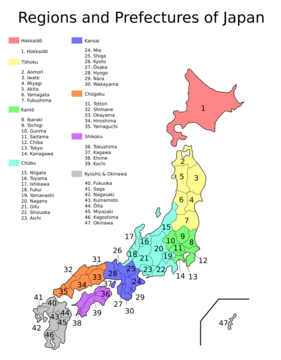
Yamaguchi Prefecture sits at the western tip of Honshu, Japan’s main island, within the Chūgoku region. It shares a border with Shimane Prefecture to the north and Hiroshima Prefecture to the northeast. Its coastline touches both the Sea of Japan and the Seto Inland Sea, and it is separated from the island of Kyushu by the Kanmon Straits. The prefecture covers 6,112 square kilometers and, as of early 2018, had a population of about 1,377,631. The capital is Yamaguchi City, but the largest city is Shimonoseki; other major urban centers include Ube, Shūnan, and Iwakuni.
The prefecture was formed from the old provinces of Suō and Nagato. During the Heian and Kamakura periods, the Ouchi family in Suō and the Koto family in Nagato rose as powerful warrior clans. In the Muromachi period, Ouchi Hiroyo, the 24th Ouchi ruler, conquered both areas. The Ouchi clan modeled their city planning after Kyoto, grew wealthy through trade with Korea and Ming China, and made Yamaguchi known as the “Kyoto of the West.” After Sue Harutaka defeated the 31st Ouchi ruler, the Sue clan was in turn defeated by Mōri Motonari, giving the Mōri family control of the Chūgoku region. During the Sengoku period, Yamaguchi was part of the Mōri domain. Mōri Terumoto lost to Tokugawa Ieyasu at the Battle of Sekigahara in 1600 and was forced to give up all lands except Suō and Nagato, where he built his castle in Hagi. He then launched the “Three Whites” campaign—salt, rice, and paper—to strengthen the local economy.
After Commodore Matthew Perry opened Japan, clans from Nagato (also called Chōshū) were instrumental in toppling the Tokugawa shogunate and establishing the new imperial government. Four years after the Meiji government formed in 1868, the present Yamaguchi Prefecture was created. The Meiji government introduced modern industry, though the prefecture remained largely agricultural. In the Taishō period, shipbuilding, chemical, machinery, and metalworking plants were built in harbors along the Seto Inland Sea. After World War II, petrochemical complexes helped Yamaguchi become one of Japan’s most industrialized prefectures.
As of April 2012, 7 percent of the prefecture’s land was designated as natural parks, including Setonaikai National Park; Akiyoshidai, Kita-Nagato Kaigan, and Nishi-Chūgoku Sanchi Quasi-National Parks; and several prefectural parks.
Quick Facts
- Native Name
- ja · 山口県
- Settlement Type
- Prefecture
- Blank Emblem Type
- Symbol
Facts from the source article.
Lore & Background
During the Heian and Kamakura periods, the Ouchi family of Suō Province and the Koto family of Nagato Province gained influence as powerful warrior clans. In the Muromachi period, Ouchi Hiroyo conquered both areas, imitating the city planning of Kyoto and gaining wealth through trade with Korea and Ming Dynasty China, earning Yamaguchi the name 'Kyoto of the West.' The Ouchi were later defeated by Sue Harutaka, who was then defeated by Mōri Motonari, giving the Mōri family control of the Chūgoku region. After Mōri Terumoto's defeat at the Battle of Sekigahara in 1600, he was forced to give up all land except Suō and Nagato, where he built his castle in Hagi and launched the Three Whites campaign (salt, rice, and paper) to strengthen the economy.
After the Meiji government formed in 1868, Yamaguchi Prefecture was established four years later. During the Taishō period, shipbuilding, chemical, machinery, and metal working plants were built in harbors along the Seto Inland Sea. In the post-World War II Shōwa period, the prefecture became one of the most industrialized in Japan due to petrochemical complexes. Yamaguchi is also home to notable figures such as Aikawa Yoshisuke, founder of the Nissan zaibatsu; Yanai Tadashi, founder of Fast Retailing (Uniqlo); and Viscount Inoue Masaru, a member of the Chōshū Five who studied in England.
Reader's Guide
Yamaguchi Prefecture holds significance as a historical and industrial hub in western Japan. Its role in the fall of the Tokugawa shogunate, led by clans from Nagato (Chōshū), was pivotal in shaping modern Japan. The prefecture's cultural heritage includes the Ouchi clan's imitation of Kyoto and the preservation of traditional sites like Hagi's samurai residences and the Kintai Bridge. Economically, Yamaguchi developed from an agricultural base into one of Japan's most industrialized prefectures, with petrochemical complexes and ports supporting heavy industry. Its location on the Kanmon Straits connects it to Kyushu, and it is considered part of the Northern Kyushu development area. Tourism draws visitors to Shimonoseki's Karato Fish Market and fireworks festival, the Akiyoshidai Quasi-National Park with Japan's longest cave, and the Kintai Bridge, a symbol of Western Honshu. The prefecture's mascot is Choruru, and its symbols include the red pine tree, bitter summer mandarin blossom, hooded crane, tetraodontidae fish, and sika deer.
Did You Know?
- Yamaguchi Prefecture is known as the 'Kyoto of the West' due to the Ouchi clan's imitation of Kyoto's city planning.
- The Kintai Bridge in Iwakuni is a five-arched wooden structure considered a symbol of Western Honshu.
- Hagi City has green or brown post boxes instead of the usual red ones found elsewhere in Japan.
- Kawara soba, a dish of green tea noodles fried on a hot tile, originated during the Seinan Rebellion.
More in Prefectures Of Japan 1-24
Spotted an error? Know more?
Reader corrections go straight into our review queue. Suggest an edit · How this site is sourced