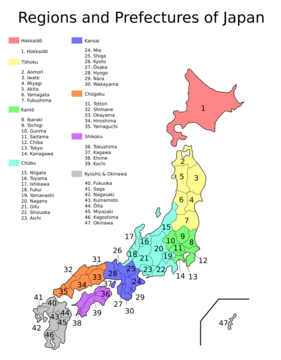
Wakayama Prefecture
A Japanese prefecture on the Kii Peninsula.
Wakayama Prefecture occupies the southwestern portion of the Kii Peninsula in the Kansai region of Honshu, its coastline fronting the Kii Channel, which links the Pacific Ocean with the Seto Inland Sea. Across this channel lies Tokushima Prefecture on the island of Shikoku. The prefecture’s land area is largely mountainous, and as of early 2020, thirteen percent of that territory was designated as protected natural parks, including portions of the Setonaikai and Yoshino-Kumano National Parks, as well as the Kongō-Ikoma-Kisen and Kōya-Ryūjin Quasi-National Parks, alongside numerous prefectural natural parks. Historically, the area corresponds mostly to the western part of the ancient province of Kii. A devastating flood disaster struck on July 17–18, 1953, when torrential rain caused levee collapses, river flooding, and landslides across a wide area, destroying many bridges and houses; official reports recorded 1,015 deaths, 5,709 injuries, and 7,115 houses lost. The prefecture is home to the headquarters of the Shingon sect of Buddhism, located in Ito District, where one of Japan’s earliest Japanese-style Buddhist temples stands amid ancient cedar forests. This site, along with the broader Sacred Sites and Pilgrimage Routes in the Kii Mountain Range—which extend for miles across the prefecture—has been recognized as a UNESCO World Heritage Site. The Kumano Shrines lie on the southern tip of the prefecture, and the Tomogashima island cluster is also part of its territory. In agriculture, Wakayama leads Japan in orange production, with the Arida District—where oranges have been cultivated for over four hundred years—yielding about half of the prefecture’s crop; Arida oranges alone account for roughly ten percent of Japan’s domestic orange output. The prefecture also produces Chinese flowering plum (ume). Demographically, since 1996 the population has steadily declined, and since 2010 it has been the only Kansai prefecture with fewer than one million residents. In the 2020 census, nearly thirty-two percent of the population was aged sixty-five or older, the highest proportion in Japan and among the highest for any national subdivision worldwide.
- Population (2025)
- 876,030
- Area
- 4,724 square kilometres (1,824 sq mi)
- Capital
- Wakayama
- Region
- Kansai, Honshu, Japan
Lore & Background
Present-day Wakayama is mostly the western part of the province of Kii. On July 17–18, 1953, a torrential heavy rain occurred, followed by collapse of levees, river flooding and landslides in a wide area. Many bridges and houses were destroyed. According to an officially confirmed report by the Government of Japan, 1,015 people died, with 5,709 injured and 7,115 houses lost. As of 31 March 2020, 13 percent of the total land area of the prefecture was designated as Natural Parks, namely the Setonaikai and Yoshino-Kumano National Parks; Kongō-Ikoma-Kisen and Kōya-Ryūjin Quasi-National Parks; and twelve Prefectural Natural Parks.
Reader's Guide
Mount Kōya in the Ito District is the headquarters of the Shingon sect of Japanese Buddhism. It is home to one of the first Japanese style Buddhist temples in Japan and remains a pilgrimage site and an increasingly popular tourist destination. The Sacred sites and pilgrimage routes in the Kii Mountain Range extend for miles throughout the prefecture and together have been recognized as Japan's 11th UNESCO World Heritage Site. The Kumano Shrines are on the southern tip of the prefecture. Wakayama Prefecture ranks first in the production of oranges in Japan, with its own brand 'Arida-Orange' produced in Arida District, which yields about half of the orange crops in Wakayama. The yield of Arida-Oranges accounts for about 10 percent of Japanese domestic production of oranges. According to the Ministry of Agriculture, Forestry and Fisheries, Wakayama stands first in the production of Chinese flowering plum (ume), making up about 70 percent of Japanese domestic production of ume as of 2016. Since 1996, population has kept declining, and since 2010, it has been the only prefecture in Kansai region with population below 1,000,000. In the 2020 census, close to 32% of the population was over 65 years of age - the highest percentage in Japan. Governor Shūhei Kishimoto was elected on 27 November 2022. Wakayama Prefecture has friendship and sister relationships with six places: Florida (United States), Galicia (Spain), Pyrénées-Orientales (France), Shandong (People's Republic of China), Sichuan (People's Republic of China), and Sinaloa (Mexico).
Did You Know?
- Wakayama Prefecture has a population of 876,030 as of 1 February 2025.
- On July 17–18, 1953, a flood disaster killed 1,015 people and destroyed 7,115 houses.
- As of 31 March 2020, 13 percent of the prefecture's land area was designated as Natural Parks.
- Wakayama ranks first in Japan for orange production and accounts for about 70% of domestic ume production.
- In the 2020 census, close to 32% of the population was over 65 years of age, the highest percentage in Japan.
More in Prefectures Of Japan 1-24
Related in Prefectures Of Japan
Links follow this subject's own source article.
Spotted an error? Know more?
This is a living reference — every entry is fact-audited, and reader corrections feed straight into our audit queue. Suggest an edit · See this site's audit record