Prefectural road
Secondary public roads planned and maintained by Japanese prefectures.

On-chan · via Wikipedia: Prefectural road · CC0
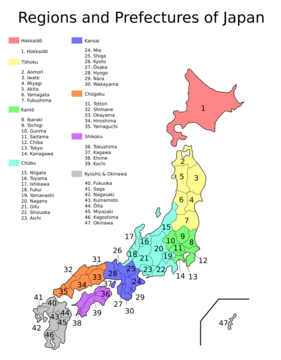
Prefectural roads (都道府県道, todōfukendō) in Japan are roads planned, numbered and maintained by the government of the respective prefecture (-to, -dō, -fu or -ken). They form a secondary tier of public roads below national routes but above municipal roads, and as of 2011 accounted for 10.7% of all public road length in Japan while carrying more than 30% of total traffic volume as of 2007.
- Field
- Transportation infrastructure
- Nationality
- Japan
Lore & Background
Prefectural roads are designated and numbered independently by each prefecture, unlike national roads (kokudō) which include national expressways. Where a national or prefectural road passes through a designated major city, the city government assumes partial responsibility for that road. Some prefectural roads run concurrently with a national route for short distances, though such concurrency is more common between two prefectural roads.
Most prefectural roads terminate at another prefectural road, a national route, or occasionally at or very close to a Japan Railway station. Numbers are used only once within each prefecture, regardless of the road's start or end point. When a prefectural road crosses into another prefecture, its number may or may not be reused; however, many multi-prefectural roads are coordinated to share a number across all prefectures they traverse.
Reader's Guide
Prefectural roads are a critical component of Japan's road network, carrying a disproportionately high share of traffic relative to their length. They fill the gap between national highways and local municipal roads, providing connectivity for intercity and rural travel. Their signage—a blue hexagon with a centered number—is distinct from national route markers. The numbering system is prefecture-specific, but coordination across prefectures for cross-border routes ensures continuity for long-distance travel. The fact that numbers duplicate those of national routes within the same prefecture, yet rarely intersect with them, reflects careful planning to avoid confusion. The involvement of designated major cities in maintaining portions of prefectural roads illustrates the layered governance of Japanese road infrastructure. Overall, prefectural roads are essential for regional mobility and economic activity, handling a traffic volume far exceeding their share of total road length.
Did You Know?
- Prefectural roads carried more than 30% of all traffic volume on public roads in Japan as of 2007.
- Prefectural road numbers are used only once in each prefecture, regardless of where the road begins or ends.
- The Sano-Koga line is designated as Prefectural Road 9 in all four prefectures it runs through: Tochigi, Gunma, Saitama and Ibaraki.
- A national route and a prefectural route bearing the same number rarely if ever meet or cross each other.
More in Prefectures Of Japan 1-24
Spotted an error? Know more?
Reader corrections go straight into our review queue. Suggest an edit · How this site is sourced