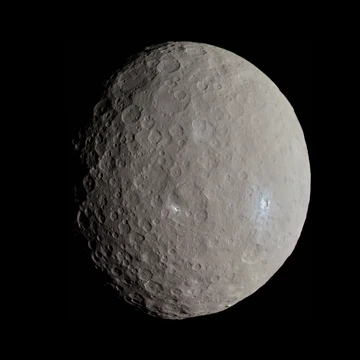
Quaoar
Ringed dwarf planet in the Kuiper belt with an unstable ring system.

Quaoar, designated minor-planet number 50000, is a dwarf planet located in the Kuiper belt, a region of icy bodies beyond Neptune. Its shape is slightly ellipsoidal, with an average diameter of about 1,100 kilometers (680 miles)—roughly half that of Pluto. The object was discovered on 4 June 2002 by American astronomers Chad Trujillo and Michael Brown at Palomar Observatory. Its surface is reddish, composed of crystalline water ice, tholins, and traces of frozen methane.
Quaoar possesses two thin rings that orbit beyond its Roche limit, a location where rings are theoretically expected to be unstable and disperse. Scientists believe the rings are kept stable by Quaoar’s elongated shape, the gravitational influence of its moon Weywot (and a possible second, unconfirmed moon), and its extremely cold temperature. The dwarf planet has one confirmed moon, Weywot, and a potential second moon that has not yet been verified.
**History**
**Discovery**
Quaoar was first spotted on 4 June 2002 by Trujillo and Brown at Palomar Observatory, as part of the Caltech Wide Area Sky Survey. This survey used the 1.22-meter Samuel Oschin telescope to search for the brightest objects in the Kuiper belt. Trujillo identified the object in images on 5 June 2002, noticing a dim, 18.6-magnitude point moving slowly through the constellation Ophiuchus. Its relative brightness for such a distant object suggested it might be comparable in size to Pluto.
To determine its orbit, Brown and Trujillo searched for archival precovery images. They found images from the Near-Earth Asteroid Tracking survey taken in 1996 and 2000–2002, as well as two photographic plates from May 1983 taken by astronomer Charles T. Kowal, who had been searching for the hypothesized Planet X. Using these, they calculated Quaoar’s orbit and distance. The earliest known precovery image was later identified on a plate from 25 May 1954, taken during the Palomar Observatory Sky Survey by Edward Rhoads.
Before announcing the discovery, Brown planned follow-up observations with the Hubble Space Telescope to measure Quaoar’s size. To keep the discovery confidential during this process, he submitted his Hubble proposal directly to an operator, who allocated time without peer review.
Quick Facts
- Minorplanet
- yes
- Symbol
- (mostly astrological)
- Discoverer
- Chadwick A. Trujillo · Michael E. Brown
- Discovery Site
- Palomar Observatory
- Discovered
- 4 June 2002
- Mpc Name
- (50000) Quaoar
- Pronounced
- ˈ · k · w · ɑː · w · ɑːr, ˈ · k · w · ɑː · . · oʊ · . · ɑːr
- Named After
- Qua-o-ar / Kwawar / (deity of the Tongva people)
- Mp Category
- TNOclassical (hot) · distantdwarf planet
- Epoch
- 31 May 2020 (JD 2459000.5)
- Uncertainty
- 3
- Observation Arc
- 65.27 yr (23,839 d)
Facts from the source article.
Lore & Background
Quaoar was discovered on 4 June 2002 by American astronomers Chad Trujillo and Michael Brown at the Palomar Observatory in the Palomar Mountain Range in San Diego County, California. The discovery formed part of the Caltech Wide Area Sky Survey, which was designed to search for the brightest Kuiper belt objects using the Palomar Observatory's 1.22-meter Samuel Oschin telescope. Quaoar was first identified in images by Trujillo on 5 June 2002, when he noticed a dim, 18.6-magnitude object slowly moving among the stars of the constellation Ophiuchus. Quaoar appeared relatively bright for a distant object, suggesting that it could have a size comparable to the diameter of Pluto. To ascertain Quaoar's orbit, Brown and Trujillo initiated a search for archival precovery images, obtaining several from the Near-Earth Asteroid Tracking survey from various observatories in 1996 and 2000–2002, as well as two archival photographic plates taken by astronomer Charles T. Kowal in May 1983. The earliest known precovery image was found by Edward Rhoads on a photographic plate imaged on 25 May 1954 from the Palomar Observatory Sky Survey. The discovery was formally announced by the Minor Planet Center on 7 October 2002, and Quaoar was given the minor planet number 50000 on 20 November 2002, a deliberate choice highlighting its unusual size and the fact that it was discovered during the search for Pluto-sized objects in the Kuiper belt.
Quaoar has a reddish surface made of crystalline water ice, tholins, and traces of frozen methane. It has one moon named Weywot and a potential second moon that has not yet been confirmed. It is believed that Quaoar's elongated shape, gravitational influence of its moon(s), and extremely cold temperature help keep its rings stable. Quaoar orbits the Sun at an average distance of 43.7 AU, taking 288.8 years to complete one full orbit. With an orbital eccentricity of 0.04, Quaoar follows a nearly circular orbit, only slightly varying in distance from 42 AU at perihelion to 45 AU at aphelion. Quaoar has last passed aphelion in late 1932 and is currently approaching the Sun at a rate of 0.035 AU per year; it will reach perihelion around February 2075.
Reader's Guide
Quaoar's discovery has been cited by Brown as having contributed to the reclassification of Pluto as a dwarf planet. Since then, Brown has contributed to the discovery of larger trans-Neptunian objects, including Haumea, Eris, Makemake and Gonggong. The object was given the minor planet number 50000, a deliberate choice highlighting its unusual size and the fact that it was discovered during the search for Pluto-sized objects in the Kuiper belt. Quaoar's two thin rings orbiting outside its Roche limit defy theoretical expectations that rings outside the Roche limit should be unstable. The name Quaoar comes from the creator god of the Tongva people indigenous to the Los Angeles Basin, where Brown's institute, the California Institute of Technology, was located. Brown and Trujillo consulted tribal historian Marc Acuña, who confirmed that the name Kwawar would be appropriate. The Tongva preferred the spelling Qua-o-ar, which Brown and Trujillo adopted, though with the hyphens omitted. Quaoar's name was announced before the official numbering of the object, which Brian Marsden—the head of the Minor Planet Center—remarked in 2004 to be a violation of the protocol, but the name was approved by the Committee on Small Body Nomenclature.
Did You Know?
- Quaoar has two thin rings orbiting outside its Roche limit, which defies theoretical expectations.
- Quaoar's average diameter is 1,100 km (680 mi), about half the size of Pluto.
- The earliest known precovery image of Quaoar was from a photographic plate imaged on 25 May 1954.
More in Planets and Dwarf Planets 1-24
Spotted an error? Know more?
Reader corrections go straight into our review queue. Suggest an edit · How this site is sourced