Mercury (planet)
Smallest planet, closest to the Sun, with extreme temperature swings.

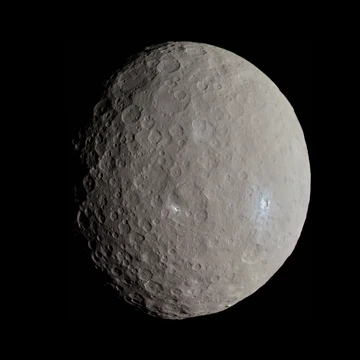
Mercury is the closest planet to the Sun and the smallest in our solar system. This rocky world has only a trace of an atmosphere, and its surface gravity is a bit weaker than Mars’s. Its surface is heavily cratered, much like Earth’s Moon, and features an extensive system of cliffs formed by thrust faults, along with bright ray patterns created by ejected material. The largest crater, Caloris Planitia, spans 1,550 kilometers—roughly one-third of Mercury’s own diameter of 4,880 kilometers. Because it orbits so close to the Sun, Mercury never strays far from it in Earth’s sky, appearing only as a morning or evening star. It also demands the highest change in velocity (delta-v) for any spacecraft traveling from Earth, or to and from other planets.
Mercury’s year lasts 88 Earth days, and its sidereal day is 58.65 Earth days, locked in a 3:2 spin–orbit resonance. As a result, one full solar day—from sunrise to sunrise—takes about 176 Earth days, which is twice its year. This means one side of the planet bakes in sunlight for an entire Mercurian year (88 Earth days), while the opposite side stays dark for the next orbit until the following sunrise. Above the surface lies an extremely thin exosphere and a weak magnetic field, just strong enough to deflect solar wind. Combined with its highly elliptical orbit, sunlight intensity and temperature vary wildly: equatorial regions can plunge to –170 °C at night and soar to 420 °C during the day. Despite being closest to the Sun, Mercury is only the second hottest planet—Venus is hotter—because it lacks a substantial atmosphere to trap heat. Its axial tilt is tiny, so the poles are permanently shadowed, strongly suggesting water ice could exist in craters there.
Like all solar system planets, Mercury formed about 4.5 billion years ago. Several competing ideas explain its origins, including collisions with planetesimals and rock vaporization; as of the early 2020s, many details of its geological history remain unclear or await data from space probes. Its mantle is highly uniform, hinting that Mercury once had a magma ocean, similar to the Moon. Current models suggest a solid silicate crust and mantle over a solid outer core, a deeper liquid core layer, and a solid inner core.
Quick Facts
- Epoch
- J2000
- Aphelion
- 0.466697 AU
- Perihelion
- 0.307499 AU
- Semimajor
- 0.387098 AU
- Eccentricity
- 0.205630
- Synodic Period
- 115.88 d
- Avg Speed
- 47.36 km/s
- Inclination
- 7.005° to ecliptic / 3.38° to Sun's equator / 6.35° to invariable plane
- Asc Node
- 48.331°
- Arg Peri
- 29.124°
- Mean Anomaly
- 174.796°
- Satellites
- None
Facts from the source article.
Lore & Background
Mercury is a classical planet observed throughout history as a wandering star. The ancient Greeks realized the evening and morning 'stars' were the same, naming it Στίλβων (Stilbōn, 'twinkling') and Ἑρμής (Hermēs) for its fleeting motion. The Romans named it after the messenger god Mercury, equated with Hermes, because it moves across the sky faster than any other planet. Its astronomical symbol is a stylized caduceus with a Christian cross added in the 16th century.
Mercury's surface resembles Earth's Moon, being heavily cratered with an expansive rupes system from thrust faults and bright ray systems from ejecta. Its largest crater, Caloris Planitia, has a diameter of 1,550 km, about one-third the planet's diameter. The planet has a 3:2 spin–orbit resonance, so one solar day lasts 176 Earth days—twice its sidereal year. Surface temperatures range from −170 °C at night to 420 °C during sunlight, making it the second hottest planet after Venus due to its lack of a heat-trapping atmosphere. Its poles are permanently shadowed, suggesting water ice may be present in craters.
Mercury formed approximately 4.5 billion years ago. Competing hypotheses about its origins include a giant impact stripping its crust, vaporization of surface rock by the young Sun, or drag from the solar nebula. Its mantle is highly homogeneous, suggesting a magma ocean early in its history. The planet has a solid silicate crust and mantle, a solid outer core, a deeper liquid core layer, and a solid inner core. Mercury is expected to be destroyed when the Sun becomes a red giant in about seven or eight billion years.
Reader's Guide
Mercury holds significance as the smallest planet and the closest to the Sun, with the highest delta-v required for travel from Earth and to other planets. Its first successful flyby was by Mariner 10 in 1974, followed by the MESSENGER and BepiColombo orbiters. The planet's density is the second highest in the Solar System, implying a large, iron-rich core that occupies about 57% of its volume. Research published in 2007 suggests a molten core. The mantle-crust layer is about 420 km thick, with crust thickness estimates ranging from 26 to 35 km. Mercury's surface features numerous narrow ridges thought to form as the core and mantle cooled and contracted after crust solidification. The competing hypotheses about its origin—giant impact, rock vaporization, or nebular drag—each predict different surface compositions. MESSENGER found higher-than-expected potassium and sulfur levels, which disfavors the giant impact and vaporization hypotheses, and BepiColombo, arriving in 2026, will further test these ideas. Mercury's geological history remains under investigation as of the early 2020s.
Did You Know?
- One solar day on Mercury lasts approximately 176 Earth days, twice its sidereal year.
- Mercury is the second hottest planet after Venus, despite being closest to the Sun, because it lacks an atmosphere to trap heat.
- The planet's core occupies about 57% of its volume, compared to 17% for Earth.
A Scarred World of Craters and Faults
Mercury's surface reads like a geological record book written in rock. Like Earth's Moon, the planet is pocked with impact craters, the most spectacular of which is Caloris Planitia, a vast basin stretching 1,550 kilometers across—roughly one-third of the planet's total diameter of 4,880 kilometers. Beyond the craters, Mercury's terrain is carved by an extensive rupes system, long scarps generated by thrust faults as the interior contracted. Bright ray systems, formed by ejecta thrown out during impacts, streak across the surface like frozen lightning. The planet's surface gravity is only slightly lower than Mars's, and above it hangs an extremely tenuous exosphere rather than a true atmosphere. Mercury's poles, thanks to its very small axial tilt, sit in permanent shadow, a condition that strongly suggests water ice may be trapped within those dark craters, a surprising reservoir on a world so close to the Sun.
The Clockwork of a 3:2 Resonance
Mercury's rotation and orbit are locked in a precise 3:2 spin-orbit resonance, meaning it spins exactly three times for every two trips around the Sun. Its sidereal year lasts 88 Earth days while its sidereal day stretches to 58.65 Earth days. The consequence is staggering: a single solar day, measured from one sunrise to the next, spans roughly 176 Earth days—twice the length of a full Mercurian year. For 88 days one hemisphere bakes in unbroken sunlight, then plunges into 88 days of total darkness before the cycle repeats. Combined with Mercury's high orbital eccentricity, this produces extreme temperature swings. Equatorial regions can hit 420 °C under direct sun yet plummet to −170 °C at night. Despite sitting closest to the Sun, Mercury ranks only second in temperature behind Venus, because it lacks a substantial atmosphere to trap heat. A faint magnetic field, just strong enough to deflect solar winds, is the planet's only real shield.
A World Built Around a Giant Iron Heart
Mercury is deceptively dense. At 5.427 grams per cubic centimeter, it ranks second in the Solar System, trailing only Earth. The explanation lies deep inside: Mercury's core occupies roughly 57 percent of the planet's total volume, compared with just 17 percent for Earth. The core radius is estimated at about 2,020 kilometers, and its iron content is the highest of any planet. Current models picture a layered interior—a solid silicate crust and mantle sitting atop a solid metallic outer core, a deeper liquid core layer, and a solid inner core. The mantle-crust shell totals around 420 kilometers in thickness, with the crust itself likely between 26 and 35 kilometers. The planet's overall composition is roughly 70 percent metallic and 30 percent silicate. Its highly homogeneous mantle hints at an early magma ocean, similar to the Moon's. Numerous narrow ridges stretching hundreds of kilometers across the surface are thought to have formed as the cooling core and mantle contracted beneath an already-solidified crust.
From Wandering Star to Probe Target
For millennia, Mercury was simply a bright point of light hugging the Sun, visible only as a morning star or an evening star. Ancient Greeks eventually recognized the two appearances as one object, calling it Stilbōn, meaning twinkling, or Hermēs for its swift motion. The Romans followed suit, naming it after Mercurius, the swift-footed messenger god. Its astronomical symbol, a stylized caduceus with a cross added in the 16th century, still appears in star charts. Because it is the most inferior orbiting planet, it always stays close to the Sun in Earth's sky. That same orbital geometry makes it the hardest planet to reach: Mercury demands the highest delta-v for any trip from Earth, and also for journeys to or from other Solar System bodies. The first spacecraft to succeed was Mariner 10, which flew by in 1974. Since then, MESSENGER and the BepiColombo mission have orbited or targeted the planet, slowly peeling back the mysteries of its geology and interior.
More in Planets and Dwarf Planets 1-24
Spotted an error? Know more?
Reader corrections go straight into our review queue. Suggest an edit · How this site is sourced