Planets of the Solar System
Eight planets orbit the Sun, from rocky worlds to gas giants.

The planets of the Solar System are the eight largest bodies orbiting the Sun that have cleared their neighborhoods of similar objects, as defined by the International Astronomical Union in 2006. They range from small rocky worlds to massive gas and ice giants, and together with the Sun they dominate the mass of the Solar System.
- Number of planets
- 8
- Terrestrial planets
- Mercury, Venus, Earth, Mars
- Giant planets
- Jupiter, Saturn, Uranus, Neptune
- Gas giants
- Jupiter, Saturn
- Ice giants
- Uranus, Neptune
- Mass share of giant planets
- more than 99% of Solar System mass (excluding the Sun)
Lore & Background
In 2006, the International Astronomical Union defined a planet as a body in orbit around the Sun that is large enough to have achieved hydrostatic equilibrium and to have cleared its orbital neighborhood. The practical meaning of 'cleared the neighborhood' is that a planet is massive enough for its gravity to control the orbits of all objects in its vicinity. The term 'hydrostatic equilibrium' is interpreted loosely as a requirement for rounding by gravity; Mercury is round but not actually in hydrostatic equilibrium, yet it is universally regarded as a planet.
Reader's Guide
The eight planets are divided into four terrestrial planets—Mercury, Venus, Earth, and Mars—and four giant planets, which are further split into two gas giants (Jupiter and Saturn) and two ice giants (Uranus and Neptune). When excluding the Sun, the four giant planets account for more than 99% of the mass of the Solar System. The Sun itself is a G-type main-sequence star containing almost 99.9% of all mass in the Solar System. The radii of these objects range over three orders of magnitude, from planetary-mass objects like dwarf planets and some moons to the planets and the Sun. This classification remains the standard for the Solar System's largest bodies, though alternative geophysical definitions would include additional rounded objects.
The Classification Dilemma
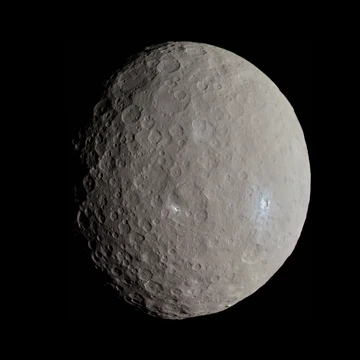
The IAU defines a dwarf planet as a body orbiting the Sun that has sufficient mass for self-gravity to overcome rigid-body forces, producing a nearly round shape in hydrostatic equilibrium. Yet in practice, this criterion is frequently relaxed. Of the six bodies the IAU specifically names—Ceres in the inner system and Pluto, Eris, Haumea, Makemake, and Quaoar beyond Neptune—only Pluto and Ceres have been confirmed to meet the equilibrium standard, thanks to the New Horizons and Dawn missions respectively. Eris is generally assumed to qualify given its similarity to Pluto and greater mass. Haumea and Makemake were granted dwarf planet status for naming purposes, retaining their names even if the equilibrium question remains unresolved. Quaoar appeared in a 2022–2023 annual report as a dwarf planet despite lacking confirmed equilibrium. Smaller candidates like Gonggong, Orcus, and Sedna are included by many planetologists simply because they appear to be solid bodies, which is a prerequisite for equilibrium. The IAU itself has been known to loosen the requirement, since a strict reading would exclude Mercury from planet status.
The Density and Solidity Puzzle
A persistent mystery surrounds mid-sized trans-Neptunian objects, many of which display densities as low as 1.0 to 1.2 g/cm³, far below Pluto's 1.86 g/cm³. Early speculation by Michael Brown attributed this to an almost entirely icy composition. However, Grundy and colleagues identified a critical flaw in that reasoning: there is no known evolutionary pathway by which mid-sized bodies would be purely icy while both larger and smaller neighbors contain rock. Their analysis showed that at Kuiper Belt temperatures, water ice is mechanically strong enough to maintain open interior spaces within objects of this size. This means the low densities likely reflect incomplete compaction under self-gravity rather than a fundamentally different composition. The practical implication is stark: the typical trans-Neptunian object below roughly 900 to 1000 km in diameter probably has not consolidated into a fully solid body, making it unlikely to qualify as a dwarf planet unless some other formative mechanism is at work.
The Equilibrium Threshold
Determining the diameter at which a body relaxes into a hydrostatic equilibrium shape has proven far more elusive than early models suggested. Michael Brown initially estimated that icy bodies round out somewhere between 200 and 400 km in diameter, drawing on comparisons with Saturn's moons Mimas and Proteus. Subsequent shape measurements, however, revealed that Mimas and other mid-sized Saturnian moons up to Iapetus—approximately 1,471 km across, comparable to Haumea and Makemake—are no longer in true equilibrium. Their shapes froze in place during an earlier thermal epoch and no longer match what their current rotation rates would produce. Rhea, at 1,528 km, stands as the smallest body for which gravitational measurements align with present-day equilibrium. Ceres, at 950 km, is close but retains unexplained deviations. Rocky bodies face a higher bar due to their greater rigidity. As of current knowledge, it remains unknown whether any trans-Neptunian object smaller than Pluto and Eris truly satisfies the equilibrium condition.
The Uncertain Census
The total number of dwarf planets in the Solar System remains fundamentally uncertain. Early estimates placed the count as high as 200 within the Kuiper Belt alone, with over 10,000 potentially existing in the broader outer region. Yet the combination of unexpectedly low densities, dark surface albedos, and spectroscopic evidence suggesting many large trans-Neptunian objects are not even solid bodies has pushed realistic estimates far lower—perhaps as few as nine among currently known candidates. In 2010, Gonzalo Tancredi submitted a report to the IAU evaluating 46 trans-Neptunian candidates, using light-curve amplitude analysis and diameter estimates exceeding 450 km, with some diameters measured directly, others derived from best-fit models, and still others calculated assuming a baseline albedo of 0.10. The wide spread between these figures underscores a deeper truth: without direct confirmation of hydrostatic equilibrium—something achievable only through spacecraft flybys or detailed gravitational mapping—the census of dwarf planets will remain an educated approximation rather than a settled fact.
Frequently Asked Questions
What are the Planets of the Solar System?
The Planets of the Solar System refers to the eight major bodies that orbit our Sun and have cleared their orbital paths of comparable objects, a definition set by the IAU in 2006. They span from small rocky worlds like Mercury to enormous gas and ice giants like Jupiter and Neptune.
How many planets make up the Solar System?
There are exactly eight recognized planets: Mercury, Venus, Earth, Mars, Jupiter, Saturn, Uranus, and Neptune. This count was settled after the 2006 IAU reclassification that removed Pluto from the planet list.
What categories of planets exist in the Solar System?
The eight planets split into two broad groups: four terrestrial (rocky) worlds—Mercury, Venus, Earth, and Mars—and four giant planets, which further divide into gas giants (Jupiter and Saturn) and ice giants (Uranus and Neptune).
Why do the giant planets matter so much to the Solar System?
The four giant planets account for more than 99% of all the mass in the Solar System outside the Sun, making them the dominant gravitational players. Their massive pull shapes the orbits of smaller bodies and helps structure the entire planetary system.
What separates the eight planets from dwarf planets like Pluto?
The key distinction is that each of the eight planets has cleared its orbital neighborhood of other similarly sized objects, whereas dwarf planets share their orbital zone with numerous smaller bodies. This 'orbital clearing' criterion, along with orbiting the Sun and having enough mass for a roughly spherical shape, is what the IAU uses to draw the line.
More in Planets and Dwarf Planets 1-24
Spotted an error? Know more?
Reader corrections go straight into our review queue. Suggest an edit · How this site is sourced