Definition of planet
A contested term for celestial bodies, defined by orbit, roundness, and dominance.

The definition of the term planet has changed several times since the word was coined by the ancient Greeks. In modern astronomy, there are two primary conceptions: a planet can be an astronomical object that dynamically dominates its region, or it can be defined as being in hydrostatic equilibrium (gravitationally rounded and compacted). The International Astronomical Union (IAU) released a formal definition in August 2006, applying only to the Solar System, stating that a planet must orbit the Sun, be massive enough for its own gravity to make it round, and have cleared its neighbourhood of smaller objects.
- Coined by
- ancient Greeks
- Original term
- ἀστέρες πλανῆται (asteres planetai), 'wandering stars'
- Iau definition year
- August 2006
- Iau meeting location
- Prague
- Bodies known to greeks
- Venus, Jupiter, Mercury, Mars, Saturn
- Discovery triggering definition debate
- Eris (January 2005)
Lore & Background
The word planet dates back to ancient Greece, where Greek astronomers used the term 'wandering stars' for star-like objects that moved over the sky, distinguishing them from fixed stars. Over millennia, the term included a variety of celestial bodies, from the Sun and Moon to satellites and asteroids. The issue of a clear definition came to a head in January 2005 with the discovery of the trans-Neptunian object Eris, which was more massive than Pluto, the smallest then-accepted planet. In August 2006, the IAU released its decision, defining a planet as a body that orbits the Sun, is massive enough for its own gravity to make it round, and has cleared its neighbourhood of smaller objects. Pluto fulfills the first two criteria but not the third, so it does not qualify under this formalized definition. The IAU's decision has not resolved all controversies; many astronomers have accepted it, but some planetary scientists have rejected it outright, proposing a geophysical or similar definition instead.
Reader's Guide
The definition of planet is notable because it has shifted repeatedly since antiquity, reflecting changing astronomical understanding. The ancient Greeks originally applied the term to five star-like bodies visible to the naked eye, while Graeco-Roman cosmology often counted the Sun and Moon among seven planets. The Copernican revolution reclassified Earth as a planet and removed the Sun and Moon from that category. The discovery of Uranus in 1781 and Neptune in 1846 expanded the known planets, but the discovery of Eris in 2005 forced a formal definition. The IAU's 2006 definition, which requires a body to orbit the Sun, be round, and clear its neighbourhood, excluded Pluto and sparked ongoing debate. The article notes that while many astronomers accept this definition, some planetary scientists reject it, preferring a geophysical definition based on hydrostatic equilibrium. This controversy highlights that the term remains contested, with no single universally accepted definition.
Did You Know?
- The word planet comes from the ancient Greek term for 'wandering stars'.
- The IAU definition of planet was released in August 2006 in Prague.
- Pluto fulfills the first two criteria of the IAU definition but not the third.
- The discovery of Eris in January 2005 triggered the push for a formal planet definition.
The Slow-Motion Discovery That Took Two Years to Notice
When the Palomar Observatory team of Mike Brown, Chad Trujillo, and David Rabinowitz first captured Eris on October 21, 2003, using the 1.2-meter Samuel Oschin Schmidt telescope, the object simply vanished into the noise. Their automated image-searching pipeline was tuned to flag anything moving faster than 1.5 arcseconds per hour against the starfield, a threshold set to minimize false positives. Eris, crawling along its high-eccentricity orbit, moved slower than that cutoff and was silently discarded. It was only after Sedna's 2003 discovery—clocking in at 1.75 arcseconds per hour—that the team lowered their motion threshold and re-examined the archived frames by eye. By January 2005, Eris's sluggish drift had finally revealed itself. The find was announced on July 29, 2005, the same day as Makemake and just two days after Haumea, a timing tangled up in a naming controversy. Remarkably, precovery images trace Eris's path back to September 3, 1954, meaning it had been sitting in their data for over fifty years before anyone noticed.
From Xena to Eris: A Name That Leaked
For a full year and a half, the object that would become Eris went by the bland provisional label 2003 UB313, and behind closed doors the discovery team called it something far more colorful: Xena. The nickname, borrowed from the long-running television series Xena: Warrior Princess, was reportedly reserved for whichever body they found that turned out to be bigger than Pluto. Brown later explained the logic—it began with X, evoking a mysterious planet X, carried a mythological ring, and fit the team's desire to feature more female deities in their discoveries. The name leaked when a New York Times reporter and college friend of Brown's, Ken Chang, pressed for the informal moniker during an interview, and the story spread across the press almost overnight. Because the IAU had not yet settled whether the object was a planet or a minor planet, the official naming had to wait until after the August 24, 2006, ruling. The team proposed Eris on September 6, 2006, invoking the Greek goddess of strife and discord, and the IAU assigned the name on September 13. The adjective form, drawn from the Greek and Latin oblique stem, is Eridian.
The Object That Rewrote the Rulebook
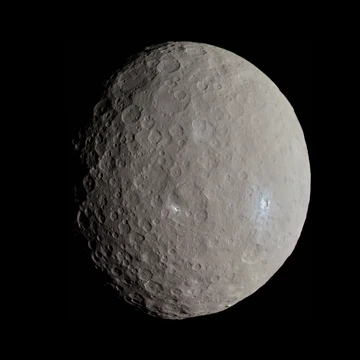
Eris arrived at precisely the wrong—or perhaps right—moment for the Solar System's roster. Because early observations suggested it was larger than Pluto, NASA initially described it as the tenth planet. That designation, combined with the very real possibility that more objects of comparable size lurked in the outer darkness, forced the International Astronomical Union to do something it had never done before: formally define what a planet actually is. The resulting resolution, approved on August 24, 2006, carved out a new category called dwarf planet, into which Eris, Pluto, and Ceres were all slotted. The known planet count dropped back to eight, exactly where it had stood before Pluto's 1930 discovery. The size question that sparked the whole debate was eventually settled when a 2010 stellar occultation revealed Eris to be marginally smaller than Pluto, and New Horizons' July 2015 flyby measured Pluto's mean diameter at 2,377 ± 2 kilometres, compared with Eris's 2,326 ± 12 kilometres. A single reclassification reshaped how humanity catalogs its neighborhood.
A Distant Giant No Probe Has Touched
Eris occupies a peculiar niche in the Solar System's architecture. As a scattered-disk trans-Neptunian object on a high-eccentricity orbit, it is the most massive and second-largest known dwarf planet, with a mass of roughly 0.28 percent of Earth's and about 27 percent more than Pluto's, even though Pluto edges it out slightly in volume. Its surface area is comparable to that of Russia or South America. At its February 2016 aphelion, Eris sat 96.3 astronomical units from the Sun—more than three times the distance of Neptune—making it and its confirmed moon Dysnomia the most distant known natural objects in the Solar System until 2018 AG37 and 2018 VG18 were identified. Dysnomia itself, spotted in October 2005, provided the orbital data that let scientists pin down Eris's mass at (1.66 ± 0.02) × 10²² kg by June 2007. A second, potentially larger moon may also exist. Despite all this, Eris remains the largest known object in the Solar System that no spacecraft has ever visited, a record that underscores just how remote the outer system truly is.
More in Planets and Dwarf Planets 1-24
Spotted an error? Know more?
Reader corrections go straight into our review queue. Suggest an edit · How this site is sourced