Planets beyond Neptune
Hypothetical planets beyond Neptune, from Planet X to Planet Nine.

Planets beyond Neptune refer to hypothetical planets proposed to exist in the outer Solar System, beyond the orbit of Neptune. The concept originated in the 19th century after the discovery of Neptune, when residual discrepancies in the orbits of Uranus and Neptune led astronomers to speculate that an unseen planet—often called Planet X—might be perturbing them. The search culminated in the discovery of Pluto in 1930, but Pluto was later found too small to cause the observed perturbations. The idea was revived in the 2010s with the hypothesis of Planet Nine, a distant super-Earth or ice giant, based on the clustering of extreme trans-Neptunian objects.
- First speculation date
- 17 November 1834
- Notable proponents
- Urbain Le Verrier, Percival Lowell, William Henry Pickering, George Forbes, Theodor Grigull, Venkatesh Ketakar
- Key discovery
- Pluto (1930) by Clyde Tombaugh
- Reclassification date
- 2006
- Reclassification body
- International Astronomical Union (IAU)
- Planet nine mass range
- 2 to 15 times the mass of the Earth
- Planet nine distance range
- beyond 200 AU to about 1,200 AU
Lore & Background
Following the discovery of Neptune in 1846, slight discrepancies in the orbits of Uranus and Neptune prompted speculation about another planet beyond Neptune. In 1834, Reverend Thomas John Hussey reported that French astronomer Alexis Bouvard had considered the idea, and that Peter Andreas Hansen believed two planets lay beyond Uranus. In 1848, Jacques Babinet proposed a planet named Hyperion of roughly 12 Earth masses at 48 AU, but Urbain Le Verrier dismissed it. In 1879, Camille Flammarion noted comets with aphelia near 47 and 49 AU, and George Forbes later calculated orbital elements for two trans-Neptunian planets based on comet aphelia clusters at 100 AU and 300 AU. In 1900–1901, William Henry Pickering led two searches for trans-Neptunian planets, finding none. In 1902, Theodor Grigull proposed a planet named Hades at 50 AU. In 1911, Venkatesh Ketakar predicted two planets, Brahma and Vishnu, with Brahma's mean distance close to Pluto's eventual orbit. Percival Lowell's Planet X hypothesis drove the search that led to Pluto's discovery in 1930. Pluto was reclassified as a dwarf planet in 2006 by the IAU. In 2014 and 2016, astronomers hypothesized Planet Nine, a super-Earth or ice giant 2 to 15 Earth masses, on an inclined, eccentric orbit between 200 AU and 1,200 AU, anti-aligned to clustered extreme trans-Neptunian objects.
Reader's Guide
The concept of planets beyond Neptune has shaped Solar System astronomy for over a century. The search for Planet X, initiated by Percival Lowell, directly led to Clyde Tombaugh's discovery of Pluto in 1930, which was initially hailed as validation. However, by 1978 Pluto was found too small to affect the giant planets, and the search for a tenth planet was abandoned in the early 1990s after Voyager 2 data showed that the orbital irregularities were due to an overestimation of Neptune's mass. The discovery of numerous icy objects beyond Neptune after 1992 sparked debate over Pluto's planetary status, culminating in the IAU's 2006 reclassification of Pluto and its largest neighbors as dwarf planets, leaving Neptune the farthest known planet. While the original Planet X does not exist, the hypothesis of an unseen planet was revived in 2014 and 2016 to explain anomalies in the outer Solar System, leading to the Planet Nine hypothesis. As of March 2014, WISE observations ruled out a Saturn-sized object out to 10,000 AU and a Jupiter-sized object out to 26,000 AU. The legacy of these searches underscores the iterative nature of astronomical discovery, where anomalies drive hypotheses that are refined or discarded as data improve.
The Classification Dilemma
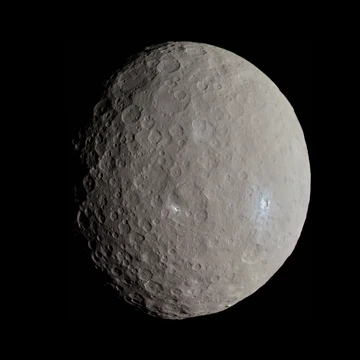
The IAU's definition of a dwarf planet hinges on a single, elegant criterion: the body must possess enough mass for its own gravity to overcome rigid-body forces and settle into a nearly round, hydrostatic equilibrium shape. In theory this is clean. In practice, for the distant trans-Neptunian objects, it is almost impossible to verify. Of all the bodies the IAU has singled out—Ceres, Pluto, Eris, Haumea, Makemake, and Quaoar—only Pluto and Ceres have been directly confirmed through spacecraft data from New Horizons and Dawn. Eris rides on the assumption that its similarity in size and greater mass to Pluto makes it a safe bet. Haumea and Makemake were granted their names for practical purposes, with the caveat that the labels would stick even if later evidence contradicted their status. Quaoar appeared in a 2022–2023 annual report as a dwarf planet despite showing no clear signs of equilibrium. In everyday usage, astronomers have quietly relaxed the rule to mean round and solid, a looser standard that, taken literally, would disqualify even Mercury.
The Density Paradox
One of the most puzzling observations about the trans-Neptunian region is that the majority of mid-sized objects, those up to roughly 900 to 1,000 kilometres across, carry densities of only about 1.0 to 1.2 grams per millilitre, far below Pluto's 1.86. Michael Brown initially attributed this to composition, speculating that these bodies were almost entirely ice. Yet Grundy and colleagues raised a troubling objection: there is no known evolutionary pathway that would make mid-sized bodies predominantly icy while both the larger and the smaller objects around them contain significant rock. Their analysis showed that at the frigid temperatures prevailing in the Kuiper Belt, water ice is mechanically strong enough to prop open interior voids in objects of this size. In other words, these mid-range trans-Neptunian objects likely have not compacted under their own gravity into fully solid, gravitationally controlled bodies. They remain porous, loosely held aggregates. The practical implication is stark: a typical trans-Neptunian object below the 900-to-1,000-kilometre mark is, absent some other formative mechanism, very unlikely to qualify as a dwarf planet at all.
The Vast Unknown
How many dwarf planets actually exist beyond Neptune? The honest answer is that nobody knows, and the range of estimates is staggering. Early counts have reached as high as two hundred within the Kuiper Belt alone, with more than ten thousand potentially lurking in the vast regions farther out. Yet the surprisingly low densities and albedos of many large trans-Neptunian objects, combined with spectroscopic readings of their surfaces, paint a more restrained picture. The number of true dwarf planets may be far smaller—perhaps as few as nine among the bodies we have identified so far. The IAU currently highlights six: Ceres in the inner system, plus Pluto, Eris, Haumea, Makemake, and Quaoar in the outer reaches. Planetologists tend to add at least Gonggong, Orcus, and Sedna to the working list, reasoning that if a body appears solid, it meets the basic prerequisite for equilibrium. The gap between thinking a body might be round and proving it is in hydrostatic balance remains wide, and the true census of these distant worlds is still one of the great open questions in planetary science.
The Equilibrium Illusion
Even the seemingly straightforward question of whether a body is round enough turns out to be deceptively complicated. Icy satellites as large as 1,500 kilometres in diameter have been shown to lack true hydrostatic equilibrium, while dark outer-system objects often have densities so low that they are not even solid. Michael Brown once estimated, comparing spacecraft-visited moons like Mimas (round at 400 km) and Proteus (irregular at 420 km), that icy bodies relax into equilibrium somewhere between 200 and 400 kilometres. Subsequent, more precise shape measurements shattered that neat picture. Mimas and Saturn's other mid-sized ellipsoidal moons, stretching up to Iapetus at 1,471 kilometres—roughly the size of Haumea and Makemake—carry equilibrium-like shapes that simply froze in place during an earlier epoch. They do not match the shapes their current rotation rates would produce. Rhea, at 1,528 kilometres, is the smallest body whose gravitational measurements are consistent with present-day equilibrium. Ceres, at 950 kilometres, is close but retains unexplained deviations. At present, it remains genuinely unknown whether any trans-Neptunian object smaller than Pluto or Eris is in hydrostatic balance today.
More in Planets and Dwarf Planets 1-24
Spotted an error? Know more?
Reader corrections go straight into our review queue. Suggest an edit · How this site is sourced