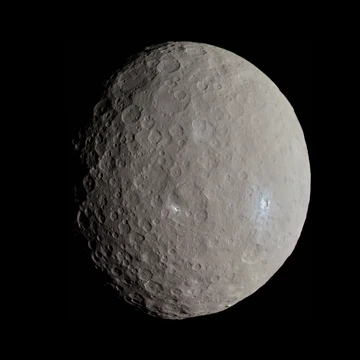
Pluto
Dwarf planet in the Kuiper belt, once the ninth planet.

Pluto (minor-planet number 134340) is a dwarf planet in the Kuiper belt, a ring of bodies beyond the orbit of Neptune. It is the ninth-largest and tenth-most-massive known object to directly orbit the Sun, and the largest known trans-Neptunian object by volume, though less massive than Eris. Originally considered the ninth planet, its status was changed in 2006 when the International Astronomical Union formally redefined the term planet to exclude dwarf planets such as Pluto.
Quick Facts
- Minorplanet
- yes
- Symbol
- or
- Discoverer
- Clyde W. Tombaugh
- Discovered
- February 18, 1930
- Discovery Site
- Lowell Observatory
- Mpc Name
- (134340) Pluto
- Named After
- Pluto
- Mp Category
- Dwarf planet / Trans-Neptunian object / Kuiper belt object / Plutino
- Epoch
- J2000
- Earliest Precovery Date
- August 20, 1909
- Aphelion
- ) / February 2114
- Perihelion
- ) / (September 5, 1989)
Facts from the source article.
Lore & Background
Pluto was discovered in 1930 by Clyde W. Tombaugh at Lowell Observatory, making it the first known object in the Kuiper belt. Its discovery followed a search for a hypothetical 'Planet X' initiated by Percival Lowell in 1906. The name Pluto was suggested by eleven-year-old Venetia Burney and was unanimously chosen by the Lowell staff; it references the Roman god of the underworld and also bears the initials of Percival Lowell. Pluto has a moderately eccentric and inclined orbit, ranging from 30 to 49 astronomical units from the Sun, and its orbit periodically brings it closer to the Sun than Neptune, though a stable orbital resonance prevents collision. It has five known moons: Charon (the largest, with a diameter just over half that of Pluto), Styx, Nix, Kerberos, and Hydra. Pluto and Charon are sometimes considered a binary system because their barycenter lies outside either body, and they are tidally locked.
Reader's Guide
Pluto's significance stems from its role in reshaping the definition of a planet. Discovered in 1930, it was immediately hailed as the ninth planet, but its planetary status was questioned when it was found to be much smaller than expected. Doubts increased with the discovery of additional Kuiper belt objects in the 1990s, particularly the more massive Eris in 2005. In 2006, the International Astronomical Union formally redefined the term planet to exclude dwarf planets such as Pluto, though many planetary astronomers continue to consider Pluto and other dwarf planets to be planets. The New Horizons spacecraft made the first flyby of Pluto and its moons on July 14, 2015, providing detailed measurements and observations. Pluto's name also influenced wider culture: Walt Disney apparently named Mickey Mouse's canine companion Pluto after it in 1930, and Glenn T. Seaborg named the element plutonium after Pluto in 1941, following the tradition of naming elements after newly discovered planets.
Did You Know?
- Pluto has roughly one-sixth the mass of the Moon and one-third of its volume.
- Light from the Sun takes 5.5 hours to reach Pluto at its orbital distance of 39.5 AU.
- The name Pluto was first suggested by eleven-year-old Venetia Burney in 1930.
- Pluto's planetary symbol is a monogram of the letters 'PL'.
More in Planets and Dwarf Planets 1-24
Spotted an error? Know more?
Reader corrections go straight into our review queue. Suggest an edit · How this site is sourced