Orcus (dwarf planet)
A Kuiper belt dwarf planet and the 'anti-Pluto'.

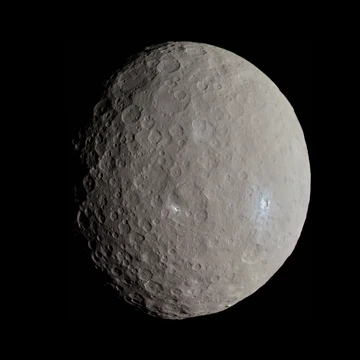
Orcus (minor-planet designation 90482) sits in the Kuiper belt as a dwarf planet, accompanied by a single large moon called Vanth. Its diameter falls between 870 and 960 kilometers (540 to 600 miles), putting it in the same size range as Ceres, the dwarf planet found in the inner Solar System. The surface is fairly bright—its albedo reaches 23 percent—and has a neutral color, with a lot of water ice. That ice mostly takes a crystalline form, which hints at past cryovolcanic activity. There may also be traces of methane or ammonia on the surface. American astronomers Michael Brown, Chad Trujillo, and David Rabinowitz spotted Orcus on 17 February 2004.
Orcus belongs to the plutino class: a trans-Neptunian object caught in a 2:3 orbital resonance with the ice giant Neptune, meaning it completes two orbits around the Sun for every three of Neptune’s. This pattern resembles Pluto’s, but the timing is flipped. When Orcus reaches aphelion (its farthest point from the Sun, most recently in 2019), Pluto is near perihelion (its closest point, most recently in 1989), and vice versa. Orcus is the second-largest known plutino, trailing only Pluto. Its perihelion lies about 120° away from Pluto’s, while the orbital eccentricities and inclinations are similar. These parallels and contrasts—plus its large moon Vanth, which invites comparison to Pluto’s moon Charon—earned Orcus the nickname “anti-Pluto.” That idea heavily influenced the choice of its name: Orcus was the Roman/Etruscan counterpart to the Roman/Greek Pluto.
**History**
**Discovery**
Orcus was found on 17 February 2004 by American astronomers Michael Brown (Caltech), Chad Trujillo (Gemini Observatory), and David Rabinowitz (Yale University). Later, precovery images from the Palomar Observatory, dating back as early as 8 November 1951, were retrieved from the Digitized Sky Survey.
**Name and symbol**
The minor planet was named after Orcus, a Roman god of the underworld. While Pluto (Roman) ruled the underworld, Orcus (Etruscan) punished the condemned. The Minor Planet Center published the name on 26 November 2004 (M.P.C. 53177). According to International Astronomical Union naming guidelines, objects similar in size and orbit to Pluto get names from underworld deities. The discoverers therefore proposed Orcus, the Etruscan god of the underworld and punisher of broken oaths.
Quick Facts
- Minorplanet
- yes
- Discovered
- 17 February 2004
- Discoverer
- Michael E. Brown · Chad Trujillo · David L. Rabinowitz
- Earliest Precovery Date
- 8 November 1951
- Mpc Name
- (90482) Orcus
- Pronounced
- ˈ · ɔr · k · ə · s
- Adjectives
- Orcinian ɔr · ˈ · s · ɪ · n · i · ə · n (trad.), Orcean ˈ · ɔr · s · i · ə · n (trad.)
- Named After
- Orcus
- Mp Category
- TNO · plutino · dwarf planet
- Epoch
- 31 May 2020 (JD 2459000.5)
- Uncertainty
- 2
- Observation Arc
- 68.16 yr (24,894 days)
Facts from the source article.
Lore & Background
Orcus was discovered on 17 February 2004 by American astronomers Michael Brown, Chad Trujillo, and David Rabinowitz. Precovery images from as early as 8 November 1951 were later found. Its name, published on 26 November 2004, comes from the Roman/Etruscan god of the underworld, Orcus, a punisher of the condemned. The name also references Orcas Island. Its moon Vanth, named on 30 March 2010, is a winged Etruscan underworld entity.
Orcus is a plutino, making two revolutions around the Sun for every three of Neptune's. Its orbit is moderately inclined at 20.6° to the ecliptic, and its perihelion is about 120° from Pluto's. Orcus last reached aphelion in 2019 and will reach perihelion around 12 January 2143. The surface is relatively bright, neutral in color, and rich in crystalline water ice, possibly from past cryovolcanic activity. Methane or ammonia may also be present.
The Orcus–Vanth binary system has a total mass of about (6.348±0.019)×10^20 kg, with Vanth containing about 13.7% of the system mass. Vanth's diameter is 442.5 km (275.0 mi) from a 2017 stellar occultation, while Orcus's diameter is about 910 km (570 mi) from ALMA measurements. Both bodies have similar densities around 1.5 g/cm³.
Reader's Guide
Orcus is significant as the second-largest known plutino after Pluto itself, and its contrasting orbital phase with Pluto has earned it the nickname 'anti-Pluto'. This contrast, along with its large moon Vanth comparable to Pluto's Charon, influenced its naming after the Etruscan underworld god Orcus. The surface of Orcus shows deep water-ice absorption bands, among the strongest of any Kuiper belt object not in the Haumea family, and the presence of crystalline water ice suggests past cryovolcanic activity. Its neutral color and spectral features resemble those of Uranus's large icy satellites and Pluto's moon Charon. The binary system's mass and density measurements provide insights into the composition and formation of trans-Neptunian objects. Orcus's orbit, locked in a 2:3 resonance with Neptune, keeps it always more than 18 AU from Neptune over a 14,000-year period, and simulations suggest its perihelion distance may decrease to as small as 27.8 AU over 10 million years.
Did You Know?
- Orcus is a plutino, locked in a 2:3 orbital resonance with Neptune, and its orbit is opposite in phase to Pluto's.
- The surface of Orcus is rich in crystalline water ice, which may be related to past cryovolcanic activity.
- Orcus's moon Vanth has a diameter of 442.5 km (275.0 mi), determined by a stellar occultation in 2017.
More in Planets and Dwarf Planets 1-24
Spotted an error? Know more?
Reader corrections go straight into our review queue. Suggest an edit · How this site is sourced