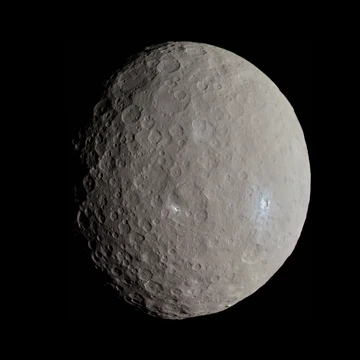
Mesoplanet
A planetary body intermediate in size between Mercury and Ceres.

A mesoplanet is a planetary-mass object with a size smaller than Mercury but larger than Ceres, defined by equatorial radius between approximately 500 km and 2,500 km. The term was coined by Isaac Asimov to describe bodies that fall in the size gap between major planets and minor planets, with Pluto being the only known example at the time of the term's introduction.
- Coined by
- Isaac Asimov
- Size range
- approximately 500 km to 2,500 km in equatorial radius
- Lower bound body
- Ceres
- Upper bound body
- Mercury
- Original example
- Pluto
- Etymology
- mesos (Greek for 'middle')
Lore & Background
The term mesoplanet was coined by Isaac Asimov in his essay 'What's in a Name?', which first appeared in the Los Angeles Times in the late 1980s and was reprinted in his 1990 book Frontiers. Asimov later revisited the term in his essay 'The Incredible Shrinking Planet', published in The Magazine of Fantasy and Science Fiction and then in the anthology The Relativity of Wrong (1988). Asimov noted that the Solar System contains many planetary bodies, and that the dividing line between major and minor planets is necessarily arbitrary. He observed a large gap in size between Mercury, the smallest body considered undoubtedly a major planet, and Ceres, the largest body considered undoubtedly a minor planet. At that time, only Pluto fell within this gap. Rather than arbitrarily assign Pluto to either category, Asimov proposed that any planetary body within the size gap between Mercury and Ceres be called a mesoplanet, from the Greek word mesos meaning 'middle'. Today, the known objects that would be included by this definition are Pluto, Eris, Haumea, Makemake, Gonggong, Quaoar, probably Sedna, and perhaps Orcus. These eight, together with Ceres, are the objects astronomers generally agree are dwarf planets, though with some doubt regarding Orcus.
Reader's Guide
The mesoplanet concept, though not an official astronomical classification, highlights the arbitrary nature of planetary definitions and the need for intermediate categories. Asimov's proposal directly addressed the ambiguity surrounding Pluto's status before the International Astronomical Union formally defined dwarf planets. The term remains useful for describing objects that are too large to be considered minor planets like Ceres but too small to be major planets like Mercury. The article notes that today the known mesoplanets include Pluto, Eris, Haumea, Makemake, Gonggong, Quaoar, probably Sedna, and perhaps Orcus—all of which, along with Ceres, are generally agreed to be dwarf planets, though with some doubt regarding Orcus. This demonstrates that Asimov's size-based category anticipated the modern dwarf planet classification, even though the two sets are not identical. The mesoplanet definition relies solely on size (equatorial radius between about 500 km and 2,500 km), whereas dwarf planet status also involves orbital and dynamical criteria. The term thus serves as a historical precursor and a reminder that taxonomic boundaries in astronomy are often shaped by convention rather than nature.
Did You Know?
- Mesoplanets are defined as having equatorial radii between approximately 500 km and 2,500 km.
- At the time Asimov coined the term, Pluto was the only known mesoplanet.
More in Planets and Dwarf Planets 1-24
Spotted an error? Know more?
Reader corrections go straight into our review queue. Suggest an edit · How this site is sourced