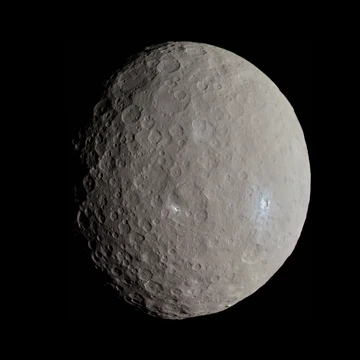
Makemake
A Kuiper belt dwarf planet with a subsurface ocean possibility.

Makemake (minor-planet number 136472) is a dwarf planet in the Kuiper belt, a region of icy objects beyond Neptune's orbit. It ranks as the fourth largest dwarf planet and trans-Neptunian object in the Solar System, with a diameter about 60% of Pluto's. American astronomers Michael E. Brown, Chad Trujillo, and David Rabinowitz discovered it on March 31, 2005, at Palomar Observatory. As one of the largest outer Solar System objects found by this team, its discovery helped spur the 2006 reclassification of Pluto as a dwarf planet.
Makemake's surface resembles Pluto's: highly reflective, largely covered in frozen methane, and stained reddish-brown by tholins. It has one known moon, which remains unnamed. The moon's orbit suggests Makemake has a high axial tilt, leading to extreme seasonal changes. Evidence of geochemical activity and cryovolcanism has led scientists to suspect a subsurface ocean of liquid water. Gaseous methane has been detected around Makemake, though it is unclear whether it forms a stable atmosphere or comes from temporary outgassing.
No high-resolution images of Makemake's surface exist because no space probe has visited it. From Earth, it appears as a star-like point of light even through telescopes. Scientists have expressed interest in sending a probe to explore Makemake due to its geological activity and potential subsurface ocean.
**History**
**Discovery** Makemake was discovered in 2005 by American astronomers Michael E. Brown, Chad Trujillo, and David Rabinowitz during their search for large objects beyond Neptune. Their search, begun in 2001, involved routinely imaging the night sky with a charge-coupled device camera on the 1.22-meter Samuel Oschin telescope at Palomar Observatory. The discovery images were taken on March 31, 2005, but Brown did not spot the exceptionally bright object until April 3, 2005, while inspecting the images.
Months earlier, Brown's team had discovered the large trans-Neptunian objects Haumea and Eris, thought to be at least Pluto-sized. Planning further observations for both, they originally intended to delay announcing Makemake until after Eris's planned announcement in October 2005. This changed when a team led by José Luis Ortiz Moreno at Spain's Sierra Nevada Observatory announced their own discovery of Haumea on July 27, 2005.
Quick Facts
- Minorplanet
- yes
- Symbol
- (mostly astrological)
- Discovery Ref
- Minor Planet Center
- Discoverer
- Michael E. Brown · Chad Trujillo · David Rabinowitz
- Discovery Site
- Palomar Observatory
- Discovered
- March 31, 2005
- Mpc Name
- (136472) Makemake
- Adjectives
- MakemakeanParker · Buie · Grundy · Noll · 2016
- Named After
- Makemake
- Mp Category
- Dwarf planet · TNO · classical (hot)
- Epoch
- November 21, 2025 / (JD 2461000.5)
- Uncertainty
- 1JPL Small-Body Database LookupMinor Planet Center
Facts from the source article.
Lore & Background
Makemake was discovered on March 31, 2005, by American astronomers Michael E. Brown, Chad Trujillo, and David Rabinowitz at Palomar Observatory. The discovery images were taken with the 1.22-meter Samuel Oschin telescope. Brown identified the object as exceptionally bright on April 3, 2005. The team had previously discovered Haumea and Eris, and originally planned to delay Makemake's announcement, but after a Spanish team announced Haumea, Brown rushed to announce Makemake and Eris on July 29, 2005. The announcement of these Pluto-sized objects prompted the International Astronomical Union to create a new definition of planet, reclassifying Pluto as a dwarf planet in August 2006.
Makemake is named after the creator of humanity and god of fertility in the myths of the Rapa Nui people of Easter Island. Before its naming, it was known by provisional designation 2005 FY9 and the nickname 'Easterbunny' given by Brown's team. The name was approved by the IAU in July 2008. Makemake's surface is highly reflective, covered largely by frozen methane, and stained reddish-brown by tholins. It has one known moon, which has not been named. The orbit of this moon suggests a high axial tilt, implying extreme seasons. Makemake shows evidence of geochemical activity and cryovolcanism, leading scientists to suspect it might harbor a subsurface ocean of liquid water. Gaseous methane has been detected, though it is unclear whether it is contained in an atmosphere or comes from temporary outgassing.
Reader's Guide
Makemake's significance lies in its role in the redefinition of what constitutes a planet. As one of the largest outer Solar System objects discovered by Brown's team, its announcement alongside Eris in 2005 forced the International Astronomical Union to create a formal definition of 'planet' in 2006, which reclassified Pluto as a dwarf planet. Makemake was the first object named under new IAU procedures for objects expected to be dwarf planets, and the fourth object announced as a dwarf planet after Ceres, Pluto, and Eris. It is specifically a plutoid, a subcategory of dwarf planets orbiting beyond Neptune.
Makemake is the largest member of the classical Kuiper belt, though it constitutes only a small fraction of the belt's total mass. Its orbit is stable on a scale of billions of years. No high-resolution images of its surface exist because it has not been visited by a space probe; it appears as a star-like point of light even through telescopes. Scientists have expressed desire to send a probe to explore Makemake because of its geological activity and potential subsurface ocean. The discovery of gaseous methane and evidence of cryovolcanism make it a target for future exploration to understand the potential for liquid water and geological processes in the outer Solar System.
More in Planets and Dwarf Planets 1-24
Spotted an error? Know more?
Reader corrections go straight into our review queue. Suggest an edit · How this site is sourced