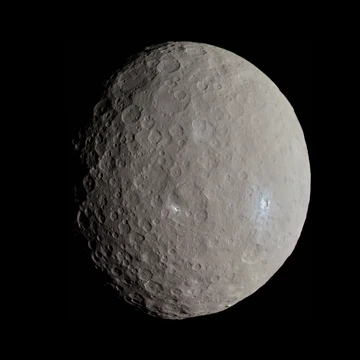
IAU definition of planet
IAU definition reclassified Pluto as a dwarf planet in 2006.

The International Astronomical Union (IAU) definition of planet, adopted in August 2006, is a formal classification for celestial bodies in the Solar System. It is notable for establishing three criteria for planethood—orbiting the Sun, hydrostatic equilibrium, and clearing its orbital neighborhood—and for reclassifying Pluto as a dwarf planet, sparking lasting controversy.
- Adoption date
- August 2006
- Number of known planets in solar system
- 8
- Criteria for planet
- in orbit around the Sun, sufficient mass for hydrostatic equilibrium, cleared the neighbourhood around its orbit
- Dwarf planet example
- Pluto
- Exoplanet mass limit
- 13 Jupiter masses for objects of solar metallicity
Lore & Background
The definition emerged from a contentious process spurred by discoveries of Kuiper Belt objects comparable to Pluto, such as Quaoar, Sedna, and Eris. In 2005, the IAU set up a 19-member committee chaired by Iwan Williams to consider a definition, and later a second committee chaired by Owen Gingerich made a firm proposal. The original draft proposal on August 16, 2006, would have recognized Ceres, Charon, and Eris as planets, but the final adopted version required a third criterion—clearing the neighborhood—which excluded Pluto. An alternate proposal to include dwarf planets as a subcategory of planets was voted against.
Reader's Guide
The IAU definition is significant because it formally resolved a long-standing debate over Pluto's status, echoing a 19th-century reclassification of asteroids. By requiring a body to 'clear its neighbourhood,' the definition made planethood dependent on location, which has been criticized as problematic—for example, a Mars-sized body in the inner Oort cloud would not meet criterion 3. The decision drew both support and criticism from astronomers. The definition also established a working definition for exoplanets, setting a mass limit of 13 Jupiter masses for deuterium fusion and requiring a mass ratio below the L4/L5 instability. The IAU stated there are eight known planets in the Solar System, and the definition's legacy includes the creation of the dwarf planet category for bodies like Pluto that meet only the first two criteria.
Did You Know?
- Pluto was initially thought to be larger than Mercury when discovered in 1930.
- The discovery of Eris in 2005, erroneously measured as slightly larger than Pluto, spurred the reclassification.
- Mercury is not actually in hydrostatic equilibrium but is explicitly included as a planet by the IAU definition.
- The term 'pluton' was proposed in the first draft for planets with highly inclined orbits beyond Neptune.
More in Planets and Dwarf Planets 1-24
Spotted an error? Know more?
Reader corrections go straight into our review queue. Suggest an edit · How this site is sourced