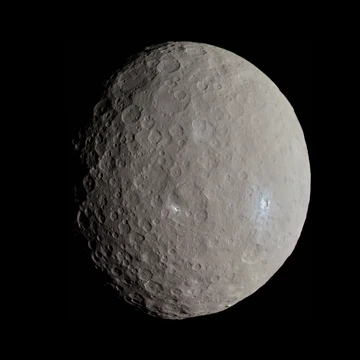
Haumea
Dwarf planet with rings, rapid rotation, and disputed discovery.

Haumea (minor-planet number 136108) is a dwarf planet that orbits the Sun beyond Neptune. It is roughly the size of Uranus’s moon Titania and, by nominal estimates, ranks as the third-largest known trans-Neptunian object, behind Eris and Pluto. Its mass is about one-third that of Pluto and 1/1400 of Earth’s. Though its shape has never been directly observed, light-curve calculations suggest it is a Jacobi ellipsoid—the form expected if it were a dwarf planet—with its major axis twice as long as its minor. In October 2017, astronomers announced that Haumea has a ring system, the first discovered around a trans-Neptunian object and a dwarf planet.
Haumea was discovered in 2004 by a team led by Mike Brown at the Palomar Observatory, and formally announced in 2005 by a team led by José Luis Ortiz Moreno at the Sierra Nevada Observatory in Spain, who found it in precovery images from 2003. That announcement gave it the provisional designation 2003 EL61. On 17 September 2008, the International Astronomical Union named it after Haumea, the Hawaiian goddess of childbirth and fertility, under the expectation it would prove to be a dwarf planet. Precovery images have been identified back to 22 March 1955.
Its gravity was long thought sufficient for it to have settled into hydrostatic equilibrium, but that is now uncertain. Haumea’s elongated shape, rapid rotation, rings, and high albedo—from a surface of crystalline water ice—are believed to result from a giant collision. That collision left Haumea as the largest member of the Haumea family, which includes several large trans-Neptunian objects and its two known moons, Hiʻiaka and Namaka.
Two teams claim credit for the discovery. Brown’s team found Haumea on 28 December 2004, using images from 6 May 2004, and published an online abstract on 20 July 2005. Ortiz’s team found it on images from 7–10 March 2003 and emailed the Minor Planet Center on 27 July 2005. Brown initially conceded credit but later suspected fraud after learning the Spanish observatory had accessed his observation logs before the announcement—logs that contained enough information to precover Haumea in their 2003 images. Ortiz admitted accessing the logs but denied wrongdoing, saying he was verifying whether a new object had been discovered. Under IAU protocol, discovery credit goes to whoever first submits a report with sufficient positional data.
Quick Facts
- Minorplanet
- yes
- Symbol
- (mostly astrological)
- Discoverer
- Brown et al. · Ortiz et al.
- Discovered
- 7 March 2003 (Ortiz) · 28 December 2004 (Brown)
- Earliest Precovery Date
- 22 March 1955
- Mpc Name
- (136108) Haumea
- Pronounced
- h · aʊ · ˈ · m · eɪ · . · ə · ,_ · ˌ · h · ɑː · uː · -
- Adjectives
- Haumean
- Named After
- Haumea
- Mp Category
- Dwarf planet · TNO · Haumea family · trinary
- Epoch
- 17 December 2020 (JD 2459200.5)
- Uncertainty
- 2
Facts from the source article.
Lore & Background
Haumea was discovered in 2004 by a team headed by Mike Brown of Caltech at the Palomar Observatory, and formally announced in 2005 by a team headed by José Luis Ortiz Moreno at the Sierra Nevada Observatory in Spain, who had discovered it that year in precovery images taken by the team in 2003. From that announcement, it received the provisional designation 2003 EL61. On 17 September 2008, it was named after Haumea, the Hawaiian goddess of childbirth and fertility, under the expectation by the International Astronomical Union (IAU) that it would prove to be a dwarf planet. Precovery images of Haumea have been identified back to 22 March 1955.
Haumea's mass is about one-third that of Pluto and 1/1400 that of Earth. Although its shape has not been directly observed, calculations from its light curve are consistent with it being a Jacobi ellipsoid, with its major axis twice as long as its minor. Haumea's gravity was until recently thought to be sufficient for it to have relaxed into hydrostatic equilibrium, though that is now unclear. Its elongated shape, together with its rapid rotation, rings, and high albedo (from a surface of crystalline water ice), is thought to be the consequences of a giant collision, which left Haumea the largest member of a collisional family that includes several large trans-Neptunian objects and Haumea's two known moons, Hiʻiaka and Namaka.
Two teams claim credit for the discovery of Haumea. Brown initially conceded discovery credit to Ortiz, but came to suspect the Spanish team of fraud upon learning that the Spanish observatory had accessed Brown's observation logs the day before the discovery announcement. Ortiz later admitted he had accessed the Caltech observation logs but denied any wrongdoing. IAU protocol is that discovery credit goes to whoever first submits a report to the MPC, but the IAU announcement on 17 September 2008 did not mention a discoverer. The location of discovery was listed as the Sierra Nevada Observatory, but the chosen name, Haumea, was the Caltech proposal.
Reader's Guide
Haumea's significance lies in its status as a dwarf planet with a ring system, the first discovered for a trans-Neptunian object. Its rapid rotation (3.9 hours) is faster than any other known equilibrium body in the Solar System. The object is thought to be the largest member of a collisional family, which includes its two moons, Hiʻiaka and Namaka, and several other large trans-Neptunian objects. The discovery controversy between the Caltech and Spanish teams highlights the competitive nature of planetary astronomy. Haumea's orbit has a slightly greater eccentricity than other members of its family, thought to be due to a weak 7:12 orbital resonance with Neptune. Its future orbit is unlikely to be stable; a study showed Haumea was the most statistically likely to be ejected out of its orbit into interstellar space or the inner Solar System over the next billion years. The IAU naming process, which chose the Caltech proposal over the Spanish team's 'Ataecina', reflects the guidelines for naming classical Kuiper belt objects after mythological beings associated with creation.
Did You Know?
- It is the third-largest known trans-Neptunian object, after Eris and Pluto.
- In October 2017, astronomers announced the discovery of a ring system around Haumea, the first for a trans-Neptunian object and a dwarf planet.
More in Planets and Dwarf Planets 1-24
Spotted an error? Know more?
Reader corrections go straight into our review queue. Suggest an edit · How this site is sourced