Exploration of dwarf planets
Dwarf planet exploration began in earnest after Pluto's 2006 reclassification.

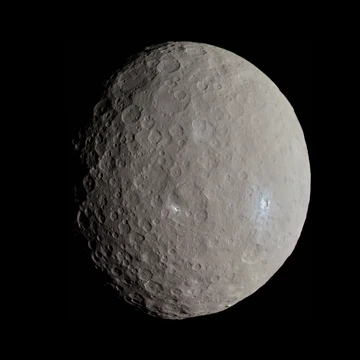
The study of dwarf planets has become a major focus of space exploration since the International Astronomical Union reclassified Pluto in 2006. A major breakthrough came in 2015, when the New Horizons probe flew past Pluto and the Dawn spacecraft visited Ceres.
Reaching these distant worlds requires careful management of fuel. Probes on long journeys to the outer Solar System often enter hibernation to save power, preserving enough energy for navigation and communication over many years. Large fuel reserves are also essential for adjusting course, making corrections, and entering orbit around a target. Gravity assists from planets or moons are a key technique: a spacecraft uses a body’s gravitational pull to gain speed and change direction without burning extra fuel, cutting travel time significantly. High-gain antennas, which focus radio signals into a narrow beam, are vital for maintaining contact with probes far from Earth, allowing mission controllers to receive data and send commands.
The Dawn mission launched in September 2007 from Cape Canaveral. It first orbited the asteroid Vesta in July 2011, then left in September 2012 for Ceres. By December 2014, Dawn had imaged a disc around Ceres, and in January 2015 it produced a low-resolution stop-motion animation of the dwarf planet’s rotation. After January 26, 2015, its images surpassed those from ground telescopes. Dawn entered orbit around Ceres on March 6, 2015. It ran out of fuel and lost contact with Earth on October 31, 2018, and will remain in orbit around Ceres until at least 2038.
The New Horizons probe launched in 2006 to study the Plutonian system. In 2007, it used a gravity assist from Jupiter, gaining 4 km/s (14,000 km/h; 9,000 mph) and shortening its trip to Pluto by three years. It entered the Plutonian system on February 4, 2015, capturing images of Pluto and its moon Charon from about 203,000,000 km away. From April to June 2015, its images were sharper than those from ground telescopes. On July 14, 2015, New Horizons took close-up photos of Pluto from 18,000 km away. The data reached Earth on September 13, 2015.
One proposed mission is IHP-1, part of China’s Shensuo program. It is designed to fly by Jupiter, the dwarf planet Quaoar, and its moon Weywot before heading into interstellar space. IHP-1 is scheduled to launch with IHP-2 and the proposed IHP-3.
- Reclassification year
- 2006
- First flyby milestones
- 2015
- Dawn launch date
- September 2007
- Dawn ceres orbit date
- March 6, 2015
- New horizons launch year
- 2006
- New horizons pluto flyby date
- July 14, 2015
- Proposed ihp-1 encounter year
- 2040
Lore & Background
The exploration of dwarf planets demands significant fuel resources, which vary depending on the targeted celestial bodies. Various methods have been developed to conserve fuel in probes traveling long distances. Missions to dwarf planets in the outer Solar System necessitate careful planning and execution, with spacecraft hibernation employed specifically to conserve energy for prolonged interplanetary journeys. Successful missions also require substantial fuel reserves on board for trajectory adjustments, course corrections, and orbital insertions. Gravity assists are critical for optimizing spacecraft trajectories and accelerating them toward their target dwarf planets without expending extra fuel. High-gain antennas are pivotal for maintaining uninterrupted contact with spacecraft operating in remote reaches of the Solar System, enabling real-time monitoring and operational control.
In 2015, two major missions reached dwarf planets. The Dawn spacecraft, launched in September 2007, entered orbit around Ceres on March 6, 2015, after exploring Vesta. Dawn exhausted its fuel reserves on October 31, 2018, and lost communication with Earth; it will remain in orbit around Ceres until at least 2038. The New Horizons probe, launched in 2006, performed a gravity assist using Jupiter in 2007, increasing its velocity by 4 km/s and cutting travel time to Pluto by three years. On July 14, 2015, New Horizons took close-up photos of Pluto from 18,000 kilometers away; data was transmitted to Earth and received on September 13, 2015.
A proposed probe, IHP-1 in the Shensuo program, is designed to fly by Jupiter, the dwarf planet Quaoar, and its moon Weywot before heading into interstellar space. IHP-1 is set to launch with IHP-2 and proposed IHP-3, using a gravity assist from Earth in December 2027, flying by Jupiter in March 2029, and encountering Quaoar and Weywot in 2040. The concept of human exploration of dwarf planets has intrigued scientists since Pluto's discovery in 1930, with potential economic benefits from mining rare elements and minerals.
Reader's Guide
The exploration of dwarf planets marks a significant shift in Solar System study following Pluto's 2006 reclassification by the IAU. The 2015 flybys of Pluto and Ceres by New Horizons and Dawn represent key milestones, demonstrating the feasibility of reaching these distant bodies. Technical requirements include substantial fuel reserves, spacecraft hibernation for energy conservation, and gravity assists to reduce travel time and fuel consumption. High-gain antennas are essential for maintaining communication over vast distances, allowing mission controllers to receive scientific data and send commands. The Dawn mission, after exploring Vesta, entered orbit around Ceres and operated until fuel exhaustion in 2018, remaining in orbit until at least 2038. New Horizons used a Jupiter gravity assist to reach Pluto, capturing close-up images in July 2015. Proposed missions like IHP-1 aim to explore Quaoar and its moon in the 2040s. Human exploration remains a concept, with potential mining of rare ores offering economic incentives. These efforts underscore the growing importance of dwarf planets in understanding the Solar System's composition and history.
Did You Know?
- Pluto was reclassified as a dwarf planet by the International Astronomical Union in 2006.
- The proposed IHP-1 spacecraft is designed to fly by the dwarf planet Quaoar and its moon Weywot in 2040.
More in Planets and Dwarf Planets 1-24
Spotted an error? Know more?
Reader corrections go straight into our review queue. Suggest an edit · How this site is sourced