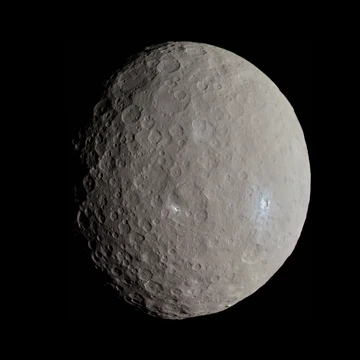
Eris (dwarf planet)
Most massive dwarf planet, second-largest, and unvisited by spacecraft.

Eris (minor-planet number 136199) holds the title of the most massive dwarf planet in the Solar System and is the second-largest by size. This object resides in the scattered disk beyond Neptune, following a highly elliptical orbit. It ranks as the ninth most massive body directly orbiting the Sun and the sixteenth most massive object in the entire Solar System when moons are included. No spacecraft has ever visited Eris, making it the largest Solar System body never approached by a human-made probe. Its diameter measures 2,326 ± 12 kilometers, and its mass equals 0.28% of Earth’s—27% greater than Pluto’s, though Pluto is slightly larger in volume. Both Eris and Pluto have surface areas comparable to Russia or South America.
Eris has one confirmed moon, Dysnomia, and there is evidence suggesting a second, much larger moon might exist. As of February 2016, Eris sat 96.3 astronomical units from the Sun, more than three times farther out than Neptune or Pluto. Until the discoveries of 2018 AG37 and 2018 VG18 in 2018, Eris and Dysnomia were the most distant known natural objects in the Solar System, aside from long-period comets.
Because Eris initially appeared larger than Pluto, NASA called it the Solar System’s tenth planet. This, combined with the likelihood of finding other similarly sized objects, pushed the International Astronomical Union to formally define the term “planet.” Under the definition approved on August 24, 2006, Eris, Pluto, and Ceres became “dwarf planets,” reducing the count of known planets to eight—the same number as before Pluto’s 1930 discovery. A 2010 stellar occultation revealed Eris is slightly smaller than Pluto, which New Horizons measured in July 2015 at a mean diameter of 2,377 ± 2 kilometers.
**Discovery** Mike Brown, Chad Trujillo, and David Rabinowitz discovered Eris on January 5, 2005, using images taken on October 21, 2003, with the 1.2-meter Samuel Oschin Schmidt telescope at Palomar Observatory. The discovery was announced on July 29, 2005, the same day as Makemake and two days after Haumea, partly due to a controversy surrounding Haumea’s announcement. The team had spent years scanning for large outer Solar System bodies, previously finding dwarf planets Quaoar, Orcus, and Sedna.
Quick Facts
- Minorplanet
- yes
- Symbol
- (mostly astrological)
- Discoverer
- M. E. Brown / C. A. Trujillo / D. L. Rabinowitz
- Discovered
- January 5, 2005
- Mpc Name
- (136199) Eris
- Pronounced
- ˈ · ɛr · ᵻ · s, ˈ · ɪər · ᵻ · s
- Adjective
- Eridian ɛ · ' · r · ɪ · d · i · ə · n
- Named After
- Ἔρις Eris
- Mp Category
- Dwarf planet / TNO / SDO / Binary
- Observation Arc
- 71.08 yr (25,963 d)
- Epoch
- November 21, 2025 / (JD 2461000.5)
- Earliest Precovery Date
- September 3, 1954
Facts from the source article.
Lore & Background
Eris was discovered in January 2005 by a Palomar Observatory–based team led by Mike Brown, from images taken on October 21, 2003. The discovery was announced on July 29, 2005, the same day as Makemake and two days after Haumea. The team had been systematically scanning for large outer Solar System bodies and had discovered other large TNOs including Quaoar, Orcus, and Sedna. Precovery images of Eris have been identified back to September 3, 1954.
Eris has one large confirmed moon, Dysnomia, and might have another much larger moon. Observations of Dysnomia's orbit allowed scientists to determine Eris's mass, calculated in June 2007 as (1.66±0.02)×10^22 kg, 27%±2% greater than Pluto's. Both Eris and Pluto have a surface area comparable to that of Russia or South America. In February 2016, Eris's distance from the Sun was 96.3 AU, more than three times that of Neptune or Pluto.
Because Eris appeared to be larger than Pluto, NASA initially described it as the Solar System's tenth planet. This motivated the International Astronomical Union to define the term 'planet' for the first time. Under the IAU definition approved on August 24, 2006, Eris, Pluto, and Ceres are dwarf planets. Observations of a stellar occultation by Eris in 2010 showed it was slightly smaller than Pluto, which was measured by New Horizons as having a mean diameter of 2,377 ± 2 km in July 2015.
Reader's Guide
Eris's significance stems from its role in redefining what constitutes a planet. Its discovery, along with the prospect of other similar-sized objects, forced the International Astronomical Union to create the first formal definition of 'planet' in 2006. Under that definition, Eris, Pluto, and Ceres were classified as dwarf planets, reducing the number of known planets in the Solar System to eight—the same as before Pluto's discovery in 1930. The naming process itself reflected the controversy: the object was informally called 'Xena' by the discovery team, and the team initially considered names like 'Lila' and 'Persephone' before proposing 'Eris' on September 6, 2006. The name was accepted on September 13, 2006, after an unusually long period under the provisional designation 2003 UB313. Brown chose Eris because the goddess of strife and discord 'caused strife and discord by causing quarrels among people, and that's what this one has done too.' Eris remains the most massive known dwarf planet and the largest Solar System object never visited by a spacecraft.
Did You Know?
- Eris has a diameter of 2,326 ± 12 km, slightly smaller than Pluto's 2,377 ± 2 km.
- Eris's mass is 27% greater than Pluto's, making it the most massive dwarf planet.
- Eris was informally called 'Xena' by its discovery team before receiving its official name.
- In February 2016, Eris was 96.3 AU from the Sun, more than three times Neptune's distance.
More in Planets and Dwarf Planets 1-24
Spotted an error? Know more?
Reader corrections go straight into our review queue. Suggest an edit · How this site is sourced