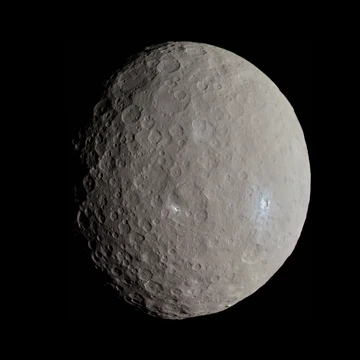
Dwarf planet
A rounded solar orbiter that has not cleared its orbit.

A dwarf planet is a small, round object that orbits the Sun directly, but unlike the eight classical planets, it hasn’t cleared its orbital neighborhood of other debris. The classic example is Pluto, long considered a full planet until the "dwarf" category was created in 2006. While many planetary geologists still regard dwarf planets and large moons as planets, the International Astronomical Union (IAU) and most astronomers have kept them off the official planet list since then. These worlds can be geologically active—a fact confirmed in 2015 by spacecraft visits to Ceres and Pluto, which is why planetary geologists find them especially fascinating.
Astronomers generally agree that at least nine of the largest candidates are dwarf planets: Pluto, Eris, Haumea, Makemake, Gonggong, Quaoar, Sedna, Ceres, and Orcus, listed roughly from largest to smallest. The tenth candidate, Salacia, is borderline and uncertain. Of these ten, spacecraft have visited only Pluto and Ceres. Seven others have at least one known moon (Eris, Haumea, Makemake, Gonggong, Quaoar, Orcus, and Salacia), which allows scientists to calculate their masses and densities and model their geophysical nature. Sedna stands out as the only one with neither a spacecraft visit nor a known moon, making its mass hard to pin down. Some astronomers include many smaller bodies as dwarf planets, but there’s no broad agreement on that.
**History of the concept**
The story begins in 1801 with the discovery of Ceres and other objects between Mars and Jupiter, which were initially called planets. By about 1851, when the planet count reached 23, astronomers started using the term "asteroid" (Greek for "star-like") for these smaller bodies, distinguishing them as minor rather than major planets. When Pluto was found in 1930, most people thought the Solar System had nine major planets plus countless smaller asteroids and comets. For nearly 50 years, Pluto was believed to be larger than Mercury, but in 1978 its moon Charon was discovered, allowing an accurate mass measurement. Pluto turned out to be much smaller—about one-twentieth of Mercury’s mass, making it by far the smallest planet. Though still more than ten times as massive as Ceres (the largest asteroid), it had only one-fifth the mass of Earth’s Moon. Its odd orbit—highly elliptical and tilted—made it clear Pluto was unlike the other planets.
- Prototypical dwarf planet
- Pluto
- Year concept adopted
- 2006
- Largest candidates in decreasing diamete
- Pluto, Eris, Haumea, Makemake, Gonggong, Quaoar, Sedna, Ceres, Orcus
- Tenth largest candidate borderline
- Salacia
- Visited by spacecraft
- Pluto and Ceres
- Known moons among candidates
- Eris, Haumea, Makemake, Gonggong, Quaoar, Orcus, Salacia
- Candidate with no known moons and not vi
- Sedna
Lore & Background
The concept of dwarf planets emerged from a history of reclassification. Starting in 1801, Ceres and other bodies between Mars and Jupiter were considered planets, but by around 1851 astronomers began distinguishing them as minor planets. With Pluto's discovery in 1930, the Solar System was thought to have nine major planets, but after 1978, measurement of Pluto's moon Charon revealed Pluto was much smaller than initial estimates—roughly one twentieth the mass of Mercury and only one-fifth the mass of Earth's Moon. Its unusual orbital eccentricity and inclination made it evident that Pluto was a different kind of body. In the 1990s, astronomers found objects in the same region as Pluto (the Kuiper belt) sharing its orbital characteristics, leading to the view that Pluto was the largest member of a new class, the plutinos. This forced a choice: either classify these larger bodies as planets or reclassify Pluto, as had happened with Ceres after additional asteroids were discovered. The discovery of Eris in January 2005, thought to be slightly larger than Pluto, intensified the debate. At the IAU General Assembly in August 2006, an initial draft proposal included Charon, Eris, and Ceres as planets, but after objections, an alternative by Julio Ángel Fernández and Gonzalo Tancredi proposed an intermediate category for objects round but not orbitally dominant. This removed Pluto, Ceres, and Eris from the planet list. The term 'dwarf planet' was originally coined as a term for the smallest planets, not the largest sub-planets, and is still used that way by many planetary astronomers. The IAU decided that dwarf planets are not to be considered planets, though Resolution 5B, which would have defined them as a subtype of planet, was defeated. Alternative terms such as nanoplanet and subplanet were discussed but no consensus was reached.
Reader's Guide
The significance of dwarf planets lies in their role as a bridge between the classical planets and smaller bodies, and in the ongoing scientific and taxonomic debate they represent. Astronomers generally agree that at least nine largest candidates are dwarf planets, with a tenth, Salacia, considered borderline. Of these, two have been visited by spacecraft (Pluto and Ceres), and seven others have at least one known moon, allowing mass and density estimates that feed geophysical models. Only Sedna has neither been visited nor has known moons, making mass estimation difficult. The IAU's 2006 definition sparked disagreement: some scientists, including Alan Stern, director of NASA's mission to Pluto, reject the definition, arguing that orbital characteristics should not define dwarf planets as non-planets. Mike Brown, discoverer of Eris, agrees with reducing the number of planets to eight. NASA announced it would use the new guidelines. The term 'dwarf planet' itself has conflicting connotations, having been used as a synonym for asteroid as early as 1838 and as an antonym for giant planet. In most languages, equivalent terms translate 'dwarf planet' literally, but Japanese uses 'junwakusei', meaning 'quasi-planets'. IAU Resolution 6a of 2006 recognizes Pluto as the prototype of a new category of trans-Neptunian objects, though the name and nature of that category were left unspecified, with terms like 'plutons' and 'plutonian objects' considered but not adopted due to potential confusion with geological plutons.
Did You Know?
- The prototypical dwarf planet is Pluto, which was regarded as a planet for decades before the concept was adopted in 2006.
- Of the ten largest dwarf planet candidates, only Pluto and Ceres have been visited by spacecraft.
- IAU Resolution 5B, which would have defined dwarf planets as a subtype of planet, was defeated in the same session that 5A was passed.
More in Planets and Dwarf Planets 1-24
Spotted an error? Know more?
Reader corrections go straight into our review queue. Suggest an edit · How this site is sourced