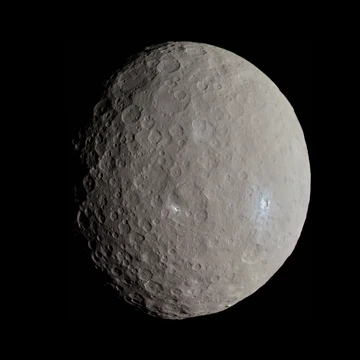
Ceres (dwarf planet)
Dwarf planet in the main asteroid belt, first discovered asteroid.

Ceres sits in the main asteroid belt, between Mars and Jupiter. It was the first object ever spotted in that belt, discovered on New Year's Day 1801 by Giuseppe Piazzi at Sicily's Palermo Astronomical Observatory. Piazzi initially announced it as a new planet. Over time, it was reclassified as an asteroid, and later became the only confirmed dwarf planet in the asteroid belt. It is also the largest known object in the solar system without a moon, and the only recognized dwarf planet whose orbit lies entirely inside Neptune's. In the minor planet numbering system, it is designated 1 Ceres or (1) Ceres.
Ceres has a diameter roughly one-quarter that of Earth's moon. Because it is so small, even at its brightest it is invisible to the naked eye except under extremely dark skies. Its apparent magnitude ranges from 6.7 to 9.3, peaking at opposition—when it is closest to Earth—every 15 to 16 months. Consequently, its surface features are barely discernible even with powerful telescopes, and little was known about it until NASA's Dawn spacecraft arrived for its orbital mission in 2015.
Dawn revealed Ceres's surface to be a mix of water, ice, and hydrated minerals like carbonates and clay. Gravity data suggest the dwarf planet is partially differentiated: it has a muddy, ice–rock mantle and core, topped by a less dense but stronger crust that is at most 30 percent ice by volume. Although Ceres likely contains an internal ocean of liquid water, brines still flow through the outer mantle and reach the surface, forming cryovolcanoes such as Ahuna Mons roughly every 50 million years. This makes Ceres the closest known cryovolcanically active body to the Sun. It also has an extremely thin, transient atmosphere of water vapor, vented from localized sources on its surface.
**History** In the years between the acceptance of heliocentrism in the 18th century and the discovery of Neptune in 1846, several astronomers argued that mathematical laws predicted a hidden or missing planet between Mars and Jupiter. As early as 1596, Johannes Kepler believed the ratios between planetary orbits would fit "God's design" only if two additional planets existed—one between Jupiter and Mars, and one between Venus and Mercury. Other theorists, such as Immanuel Kant, wondered whether Jupiter's gravity had created the gap.
Quick Facts
- Minorplanet
- yes
- Discoverer
- Giuseppe Piazzi
- Discovered
- 1 January 1801
- Mpc Name
- (1) Ceres
- Pronounced
- ˈ · s · ɪər · iː · z, SEER · eez
- Named After
- Cerēs
- Adjectives
- Cererian, -ean (s · ᵻ · ˈ · r · ɪər · i · ə · n)
- Mp Category
- dwarf planet · asteroid
- Epoch
- 21 January 2022 (JD 2459600.5)
- Time Periastron
- 7 December 2022
- Period
- 4.60041 · 3 yr
- Synodic Period
- 1.278 · 3 yr · 466.6 · 4 d
Facts from the source article.
Lore & Background
Ceres was discovered during a search for a predicted missing planet between Mars and Jupiter, based on the Titius–Bode law. After its discovery, it was initially considered a planet, but as other similar objects were found, it was reclassified as an asteroid. In modern times, it became the only confirmed dwarf planet within the asteroid belt. Its surface features were barely visible until the NASA spacecraft Dawn approached Ceres for its orbital mission in 2015. Dawn found Ceres's surface to be a mixture of water, ice, and hydrated minerals such as carbonates and clay. Gravity data suggest Ceres is partially differentiated into a muddy mantle/core and a less dense, stronger crust that is at most thirty percent ice by volume. Ceres likely has an internal ocean of liquid water, with brines flowing through the outer mantle and reaching the surface, allowing cryovolcanoes such as Ahuna Mons to form roughly every fifty million years. This makes Ceres the closest known cryovolcanically active body to the Sun. It has an extremely tenuous and transient atmosphere of water vapour, vented from localised sources on its surface.
Reader's Guide
Ceres holds a significant place in astronomical history as the first object identified in the asteroid belt, discovered on 1 January 1801 by Giuseppe Piazzi. Its discovery was part of a systematic search for a missing planet predicted by the Titius–Bode law, and it initially was classified as a planet. Over time, as more objects were found in the same region, Ceres was reclassified as an asteroid and later as a dwarf planet, the only confirmed one in the asteroid belt. Its designation in the minor planet numbering system is 1 Ceres, reflecting its status as the first such object discovered. The NASA Dawn mission, which arrived in 2015, revealed Ceres to be a geologically active world with water ice, hydrated minerals, and cryovolcanoes, making it the closest known cryovolcanically active body to the Sun. Ceres also has a tenuous atmosphere of water vapour. Its legacy includes influencing the development of orbit determination methods by Carl Friedrich Gauss, who predicted its path after its initial sighting was lost. The naming of the element cerium after Ceres further underscores its cultural impact.
Did You Know?
- Ceres was discovered on 1 January 1801 by Giuseppe Piazzi at Palermo Astronomical Observatory in Sicily.
- It is the only recognized dwarf planet in the solar system whose orbit lies within that of Neptune.
- Ceres has cryovolcanoes such as Ahuna Mons, which form roughly every fifty million years.
- The element cerium, discovered in 1803, was named after Ceres.
More in Planets and Dwarf Planets 1-24
Spotted an error? Know more?
Reader corrections go straight into our review queue. Suggest an edit · How this site is sourced