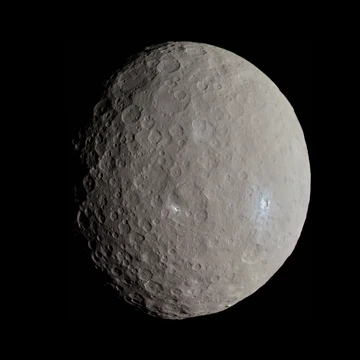
90568 Goibniu
A large, hot classical Kuiper belt object and possible dwarf planet.

90568 Goibniu (provisional designation 2004 GV9) is a large object in the outer Solar System, discovered in April 2004 by the Near-Earth Asteroid Tracking survey using the Samuel Oschin telescope at Palomar Observatory in California. It belongs to the classical Kuiper belt and is part of the dynamically "hot" population, meaning its orbit is highly inclined relative to the ecliptic.
Measurements from the Herschel and Spitzer space telescopes give Goibniu a diameter of 680 ± 34 km. Its brightness varies by only 0.16 magnitudes over a rotation period of 5.86 hours. Some astronomers have suggested it might be a dwarf planet, but its shape is unknown—it could be a spheroid with dark patches or an elongated body whose rotation axis points toward Earth. Its low albedo indicates it has never been resurfaced, making it unlikely to have the geological activity expected of larger dwarf planets.
The object was first spotted on 13 April 2004 by a team including Steven Pravdo, D. MacDonald, Kenneth Lawrence, and Michael D. Hicks. The Minor Planet Center announced the discovery the next day, after confirmation by other observatories. Precovery images from the Digitized Sky Survey, dating back to 1993–1997, were reported by astronomer Reiner Stoss in June 2004, allowing a precise orbit calculation. Even earlier precovery images exist from as far back as December 1954.
The provisional designation 2004 GV9 was assigned at discovery. The permanent minor planet number 90568 was given on 30 August 2004. The discoverers' naming privilege expired ten years after numbering, and the object remained unnamed until September 2025, when it was officially called Goibniu, after the Irish god of metallurgy and hospitality. The name follows IAU guidelines recommending creation-myth names for Kuiper belt objects.
Goibniu orbits the Sun at an average distance of 41.9 astronomical units, with an eccentricity of 0.08 and an inclination of 22°. Its orbit takes 271 years, bringing it as close as 38.7 AU at perihelion and as far as 45.2 AU at aphelion. As a classical Kuiper belt object, it lies in the region 39–48 AU from the Sun. Its high inclination marks it as a dynamically "hot" member, likely scattered by Neptune's gravity early in Solar System history.
The object rotates once every 5.86 ± 0.03 hours.
Quick Facts
- Minorplanet
- yes
- Discoverer
- NEAT (obs. code 644)
- Discovery Site
- Palomar Obs.
- Discovered
- 13 April 2004
- Mpc Name
- (90568) Goibniu
- Pronounced
- ˈ · ɡ · ɔɪ · v · n · j · uː
- Named After
- Goibniu (mod. Gaibhne)
- Mp Category
- TNO · classical (hot) · distant · Scat-Ext
- Epoch
- 5 May 2025 (JD 2460800.5)
- Uncertainty
- 0 or 1
- Observation Arc
- 70+ yr
- Earliest Precovery Date
- 21 December 1954
Facts from the source article.
Lore & Background
Goibniu was discovered on 13 April 2004 by the Near-Earth Asteroid Tracking survey using the 1.22-meter Samuel Oschin telescope at Palomar Observatory. The discovery observations involved Steven Pravdo, D. MacDonald, Kenneth Lawrence, and Michael D. Hicks. The Minor Planet Center announced the discovery on 14 April 2004 after other observatories confirmed it. Precovery observations from Digitized Sky Survey images dating back to 1954 were later reported, allowing precise orbit determination.
Goibniu orbits the Sun at an average distance of 41.9 AU, with an orbital eccentricity of 0.08 and an inclination of 22°. It is a classical Kuiper belt object, specifically a dynamically 'hot' member, believed to have been scattered by Neptune's gravitational influence early in Solar System history. Its diameter is 680 ± 34 km, measured by the Herschel and Spitzer space telescopes. It rotates every 5.86 hours with a low light curve amplitude of 0.16 magnitudes, suggesting it could be a spheroid with albedo spots or an ellipsoid with its rotation axis pointed toward Earth.
Its surface is dark, with a geometric albedo of about 0.077, and it is moderately red with a V-R color index of approximately 0.52. Its mass and density are unknown due to the lack of known moons, though density estimates from Jacobi ellipsoid models range from 1.14 to 1.49 g/cm³. Some astronomers, including Noemi Pinilla-Alonso, Michael Brown, and Gonzalo Tancredi, have considered it a possible dwarf planet, but its low albedo suggests it has never been resurfaced and is unlikely to have the planetary geology typical of dwarf planets.
Reader's Guide
Goibniu is significant as a large trans-Neptunian object that highlights the diversity of classical Kuiper belt objects. Its classification as a dynamically 'hot' member provides clues about the early Solar System's history, as such objects were likely scattered by Neptune. The object's size—680 km in diameter—places it among the larger Kuiper belt objects, leading some astronomers to consider it a possible dwarf planet. However, its low albedo and lack of evidence for resurfacing challenge that status, as it may not exhibit the planetary geology expected of dwarf planets. The uncertainty about its shape—whether a spheroid with albedo spots or an ellipsoid—adds to its scientific interest. Named in 2025 after the Irish god of metallurgy and hospitality, Goibniu represents the ongoing process of cataloging and understanding the outer Solar System's minor bodies. Its discovery by the NEAT survey and precovery images from the 1950s demonstrate the value of archival data in refining orbits and physical properties.
Did You Know?
- Goibniu was named after the Irish god of metallurgy and hospitality on 1 September 2025.
- Its diameter of 680 ± 34 km was measured by the Herschel and Spitzer space telescopes.
- Precovery observations of Goibniu date back to December 1954.
- It has a low geometric albedo of about 0.077, suggesting it has never been resurfaced.
More in Planets and Dwarf Planets 1-24
Spotted an error? Know more?
Reader corrections go straight into our review queue. Suggest an edit · How this site is sourced