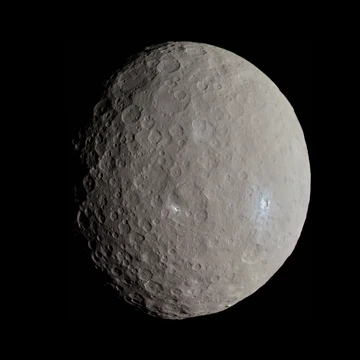
(84522) 2002 TC302
A red, icy possible dwarf planet in the scattered disk.

(84522) 2002 TC302 is an unnamed trans-Neptunian object in the scattered disk, orbiting the Sun on a highly distant and elliptical orbit. It is notable for being in a 2:5 orbital resonance with Neptune, for its large size of approximately 500 km in diameter, and for its cold, icy surface rich in complex organic compounds called tholins, which give it a red color. It is considered a possible dwarf planet.
Quick Facts
- Minorplanet
- yes
- Discovered
- 9 October 2002
- Discovery Site
- Palomar Observatory
- Mpc Name
- (84522) 2002 TC · 302
- Mp Category
- TNOSDO · 2:5 res.distant
- Epoch
- 21 November 2025 (JD 2461000.5)
- Uncertainty
- 2
- Observation Arc
- 25+ yr
- Earliest Precovery Date
- 5 August 2000
Facts from the source article.
Lore & Background
2002 TC302 was discovered on 9 October 2002 at Palomar Observatory by Chad Trujillo, Michael E. Brown, and the Near-Earth Asteroid Tracking program. Its discovery was announced by the Minor Planet Center on 7 November 2002, and precovery images from as early as 5 August 2000 were later found. The object is currently known only by its provisional designation and minor planet number 84522, and as of May 2026 it has not been named.
It follows a highly tilted and elliptical orbit (eccentricity 0.29, inclination 35°) at distances ranging from 39.0 to 71.5 AU, with a semi-major axis of 55.3 AU. It is locked in a 2:5 mean-motion resonance with Neptune, meaning its orbital period is exactly 2.5 times Neptune's. Stellar occultations observed in 2018 and 2021 revealed its shape to be an oblate spheroid, with a major diameter of about 543 km and a minor diameter of about 460 km. Its surface is very cold, reaching 44 K at perihelion, and is composed of frozen water, carbon dioxide, carbon monoxide, methanol, and tholins, which color it red.
Reader's Guide
2002 TC302 is significant as a medium-sized trans-Neptunian object that straddles the boundary between irregular bodies and dwarf planets. Its size, shape, and composition make it a key object for understanding the formation and evolution of the outer Solar System. The object's 2:5 orbital resonance with Neptune is one of the most common resonances among TNOs, and its orbit is stable for at least 5 billion years. The discovery of its oblate spheroid shape via stellar occultations provided the first accurate size and shape measurements, revising earlier overestimates that had suggested a diameter as large as 1,200 km. Its surface, rich in methanol and tholins, places it in the "cliff1" or methanol-rich category of TNOs. The presence of a possible unresolved moon, inferred from indirect evidence, could help determine its mass and density, which remain unknown. Its legacy lies in demonstrating the diversity of icy bodies beyond Neptune and the importance of occultation observations for characterizing distant objects.
Did You Know?
- 2002 TC302 is in a 2:5 orbital resonance with Neptune, meaning it orbits the Sun exactly 2.5 times for every 5 orbits of Neptune.
- The first successful stellar occultation by 2002 TC302 was observed on 28 January 2018 by 12 telescopes across Europe.
- It rotates slowly, with a rotation period of approximately 56 hours.
More in Planets and Dwarf Planets 1-24
Spotted an error? Know more?
Reader corrections go straight into our review queue. Suggest an edit · How this site is sourced