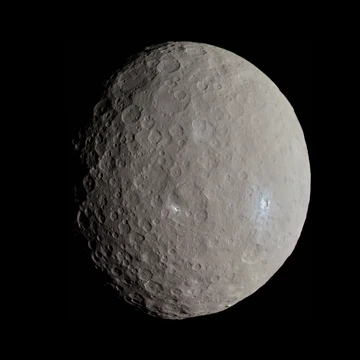
78799 Xewioso
A dark, mid-sized trans-Neptunian object at the Kuiper belt's inner edge.

78799 Xewioso, initially designated 2002 XW93, is a trans-Neptunian object found at the inner boundary of the Kuiper belt. It has a dark surface and an estimated diameter ranging from 490 to 640 kilometers.
Discovered on 10 December 2002 at Palomar Observatory in California, the object was identified by a team including Chad Trujillo, Michael E. Brown, Eleanor F. Helin, Steven Pravdo, Kenneth Lawrence, and Michael D. Hicks, using the 1.22-meter Samuel Oschin telescope. Follow-up observations were made with Palomar's 1.52-meter telescope in early January 2003, and the discovery was announced alongside two other trans-Neptunian objects on 5 January 2003. The earliest known precovery observation dates to a photographic plate from 17 December 1989, found by Reiner M. Stoss.
The object was named after Xɛ̀vioso, a thunder god in the mythologies of the Tado peoples of West Africa. This name was announced by the International Astronomical Union on 1 September 2025. Before that, it was known by its provisional designation 2002 XW93. Its minor planet number, 78799, was assigned on 6 February 2004.
Xewioso orbits the Sun at distances between 28 and 47 AU, with an average of 38 AU, completing one orbit roughly every 230 years. Its orbit has an eccentricity of 0.24 and an inclination of 14° relative to the ecliptic. It last passed perihelion in 1926. Because its orbit crosses Neptune's, it can technically be classified as a centaur, though it is generally considered an inner classical Kuiper belt object from the dynamically "hot" population.
The object is dark, with a geometric albedo between 0.01 and 0.08 and an absolute magnitude of 5.4. Its diameter, measured by the Herschel Space Observatory in 2010, is between 490 and 640 kilometers. Its color and rotation period are unknown, and its absolute magnitude has significant uncertainty. With a size of roughly 565 kilometers, it falls into the proposed category of "mid-sized" trans-Neptunian objects, which are thought to have porous, unheated interiors. However, since no natural satellites have been detected, its mass and density cannot be measured.
Quick Facts
- Minorplanet
- yes
- Discovered
- 10 December 2002
- Discoverer
- Palomar Obs.
- Earliest Precovery Date
- 17 December 1989
- Mpc Name
- (78799) Xewioso
- Named After
- Xɛvioso
- Pronounced
- ˌ · h · ɛ · v · i · ˈ · oʊ · s · oʊ
- Mp Category
- TNOclassical (inner/hot)2other TNOdistant
- Epoch
- 2025 May 05 (JD 2460800.5)
- Uncertainty
- 2
- Observation Arc
- 35.19 yr (12,854 d)
- Aphelion
- 46.88 AU
Facts from the source article.
Lore & Background
Xewioso was discovered on 10 December 2002 by a team of astronomers using Palomar Observatory's 1.22-meter Samuel Oschin telescope. The discovery team included Chad Trujillo, Michael E. Brown, Eleanor F. Helin, Steven Pravdo, Kenneth Lawrence, and Michael D. Hicks. Follow-up observations were made on 4 and 5 January 2003 with Palomar's 1.52-meter telescope, and the discovery was announced by the Minor Planet Center on 5 January 2003, alongside two other trans-Neptunian objects. The earliest known precovery observation dates to 17 December 1989, found by Reiner M. Stoss on photographic plates from Palomar's Digitized Sky Survey.
The object was named after Xɛ̀vioso, a thunder god in the mythologies of the Tado (Fon and Ewe) peoples of West Africa. The naming was announced by the International Astronomical Union's Working Group for Small Body Nomenclature on 1 September 2025. Its minor planet catalog number 78799 was assigned by the MPC on 6 February 2004.
Xewioso orbits the Sun at a distance of 28–47 AU (average 38 AU) once every about 230 years. Its orbit has an eccentricity of 0.24 and an inclination of 14°, and it last passed perihelion in 1926. It is considered an inner classical Kuiper belt object of the dynamically 'hot' population, and because its orbit crosses Neptune's, it can technically be considered a centaur. Physically, Xewioso is dark with an extremely low geometric albedo (0.01–0.08) and an absolute magnitude of 5.4, yielding a diameter of 490–640 km. Its size was measured by the Herschel Space Observatory in 2010 via far-infrared thermal emission. Its color and rotation period are unknown, and it has no known natural satellites, so its mass and density cannot be measured.
Reader's Guide
Xewioso is significant as a mid-sized trans-Neptunian object (TNO) with a diameter of roughly 565 km, placing it in the proposed class of 'mid-sized' TNOs between 400 and 1,000 km. These objects are believed to represent the transition between small, low-density TNOs and large, high-density dwarf planets. Planetary scientists have hypothesized that mid-sized TNOs should have highly porous and unheated interiors, based on low densities (around 1 g/cm³) found in similar-sized objects like Uni and Gǃkúnǁʼhòmdímà. However, because Xewioso lacks any known moons, its mass and density remain unmeasured, leaving its internal structure uncertain. Its discovery was part of the Caltech Wide Area Sky Survey, which aimed to find bright, Pluto-sized Kuiper belt objects. The object's naming after a West African thunder god reflects the tradition of naming TNOs after mythological figures. Its orbit at the inner edge of the Kuiper belt and its high inclination make it a member of the dynamically 'hot' population, and its orbit-crossing with Neptune allows it to be technically classified as a centaur.
Did You Know?
- Its diameter is between 490 and 640 kilometers (300–400 mi), based on Herschel Space Observatory observations.
- The earliest known precovery observation of Xewioso dates to 17 December 1989.
More in Planets and Dwarf Planets 1-24
Spotted an error? Know more?
Reader corrections go straight into our review queue. Suggest an edit · How this site is sourced